
Mixing Old and New: How Antiques and Contemporary Pieces Can Share a Room

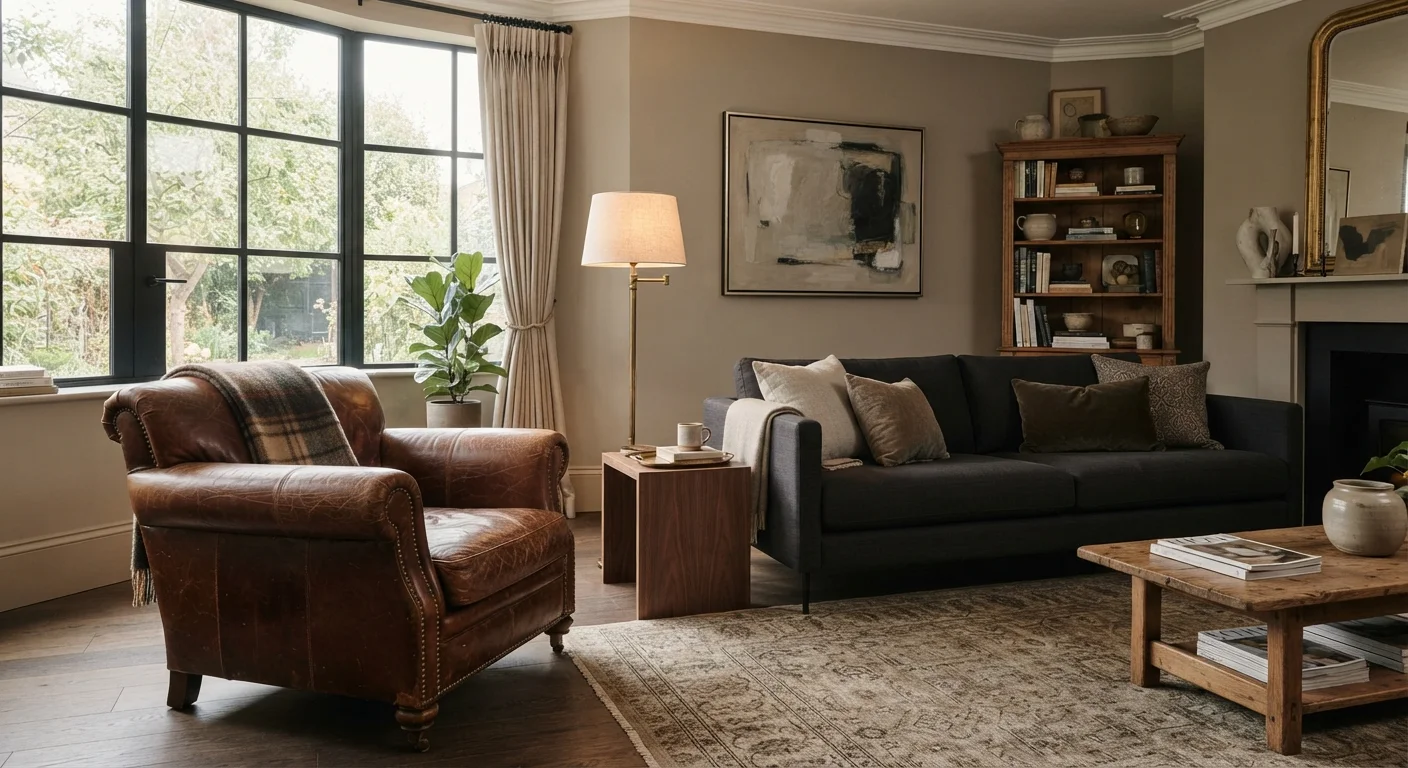
Curating a room with pieces from different eras takes intention, not a matching suite. Here's how contrast and continuity make it work.
Key takeaways
- A shared color palette or material is enough to unify pieces from completely different periods.
- Scale and proportion matter more than matching — mismatched heights and weights create tension, not charm.
- One dominant era with carefully chosen contrasts reads as intentional; an even split often looks undecided.
- Repetition of a single element — a metal finish, a curve, a wood tone — threads disparate pieces together.
- Antiques earn their place more easily when they carry a clear function rather than sitting as pure display.
Why the Mix Works — When It Works
Rooms that feel genuinely interesting usually contain some tension — a rough surface next to a smooth one, an ornate frame on a plain wall, a century-old dresser beside a low-profile contemporary bed. The mix signals that the room was assembled by a person with actual taste, not purchased as a set. That's the appeal. The risk is that the same approach, done without intention, produces a room that simply looks unresolved.
The difference between a successful mix and a confused one almost always comes down to a small number of decisions made early: which era leads, how many competing focal points you allow, and what visual thread connects pieces that have nothing else in common. Get those right and the room can absorb almost anything.
If you're working within a compact space, the same principles apply — see our decorating principles for smaller rooms for guidance on keeping a layered look from feeling crowded.
Best Practices for Mixing Antiques and Contemporary Pieces
The following practices aren't rules so much as tested approaches. Adapt them to your own space and the pieces you already own.
Let one era lead and use the other as an accent.
When antique and contemporary pieces appear in roughly equal measure, neither reads as intentional. Committing to a dominant style — say, a primarily contemporary room with one or two antique anchors — gives the eye somewhere to rest and makes the contrast feel deliberate rather than accidental.
Establish a shared color thread across all pieces.
Color is one of the fastest ways to pull dissimilar objects into the same conversation. Even if the forms and periods vary widely, pieces that share a hue — a warm ivory, a deep charcoal, a specific green — will register as a considered group rather than a random collection.
Match proportions across the room, not just styles.
Pieces that are dramatically different in visual weight — a hulking Victorian sideboard beside a delicate wire-frame chair, for instance — create imbalance that reads as careless rather than eclectic. Proportion governs whether a room feels grounded or chaotic.
Repeat one material or finish at least three times through the room.
Repetition of a single element — a brass hardware finish, an exposed natural wood, a matte black frame — creates an internal logic that makes even very different pieces feel coordinated. Three instances of the same material is generally the minimum for the pattern to register consciously.
Give antiques a clear function rather than displaying them purely as objects.
An antique used as a working piece of furniture — a desk, a storage chest, a side table — integrates far more naturally than one displayed like a museum artifact. Functional antiques invite the eye to move past them; decorative-only antiques tend to stop the eye and demand justification.
Leave deliberate breathing room around statement pieces.
In a mixed room, negative space — the empty area around and between objects — allows each piece to read individually before the eye groups them together. Crowding disparate pieces together amplifies their differences in a way that feels chaotic; space between them lets each hold its own.
The Role of Material and Texture
When two pieces share no period, style, or color, material often becomes the bridge. A mid-century walnut credenza and a contemporary walnut dining table can anchor opposite ends of a room because the wood tone reads as a deliberate echo. Brass, linen, marble, and matte black each have long decorating histories — they appear in antique and modern contexts alike, which is exactly what makes them such useful connectors.
Texture works similarly. A rough, hand-thrown ceramic vase can sit comfortably next to a polished chrome lamp if the room around them contains enough tactile variety to make both feel invited. For a deeper look at how layering materials lifts a room without relying on color, see how texture transforms neutral rooms.
Use Metal Finishes as a Reliable Bridge
Warm metals — brass, bronze, aged gold — appear in both antique hardware and contemporary lighting and fixtures, making them one of the most reliable connectors across eras. If you're unsure how to link an antique piece to a modern context, look for a lamp, drawer pull, or picture frame in a metal tone that echoes something already present on the antique. That single shared finish can do the work of an entire color scheme.
Scale is the variable that trips people up most. An imposing Victorian armoire next to a slim Parsons desk doesn't just look mismatched — it makes the desk disappear. Before bringing an antique into a contemporary room, measure it and compare it against the pieces already there. A significant difference in visual weight needs compensation elsewhere in the room, not just tolerance.
Putting It Into Practice
Start with what you have. Most people decorating a mixed room already own pieces from different periods — the question is usually which ones to keep prominent and which to reassign or remove. Walk the room and identify one piece that feels like an anchor: the item you most want to keep and design around. Everything else becomes a supporting decision.
From there, use the room refresh checklist to audit what's currently competing for attention. Visual clutter in a mixed room often stems not from having too many eras present but from having too many focal points fighting at once — a problem addressed directly in why rooms look cluttered even after tidying.
If you're deciding where to invest energy — whether on a standout antique furniture piece or on smaller contemporary accessories — statement furniture vs. statement accessories offers a useful framework for making that call. And if you're building out walls in a room that mixes eras, the guidance in gallery walls that actually hang together applies just as well to a collection of prints spanning different decades.
The broader decorating context — proportion, color, material, and finishing touches across the whole home — is covered in Interior Decorating From Start to Finish, which can help you see the mix-of-eras question as part of a larger, room-by-room plan.
All published content on this website is for informational and educational purposes only and should not be taken as professional advice. We recommend that readers seek expert opinion before making any decisions. The website is not responsible for any actions taken based on the information provided on this website. We are not liable for any inaccuracies, modifications, or omissions in information. Moreover, external links or third-party content are provided for convenience; we are not liable for their correctness. Users are advised to verify every piece of information before they use it for any purpose.