
Why Your Room Looks Cluttered Even After You've Tidied

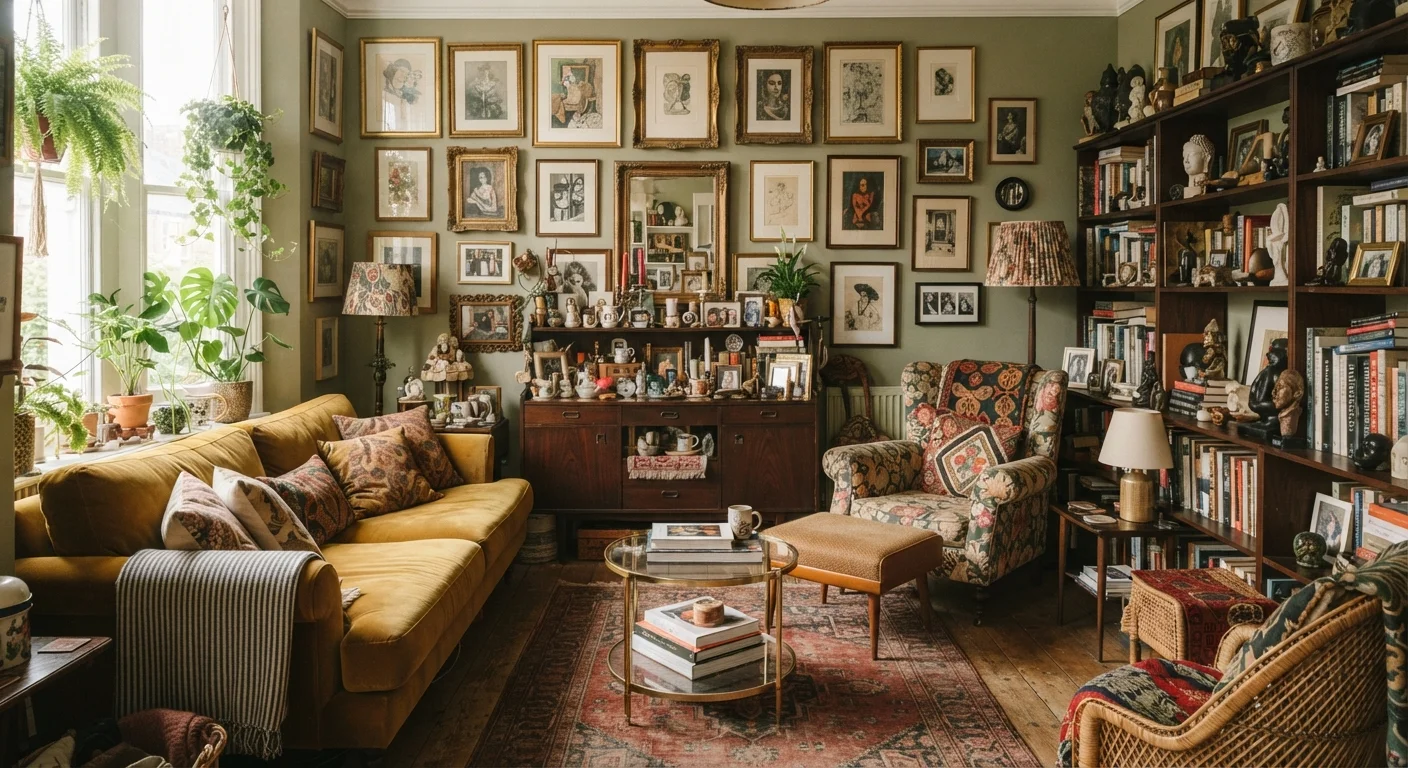
Clutter isn't always about stuff — scale, repetition, and visual noise are the real culprits. Here's how to diagnose and fix the problem.
Key takeaways
- A room can look cluttered even after tidying if scale, proportion, or color variety are off.
- Too many small objects create visual noise that reads as clutter even when everything is organized.
- Furniture pushed against walls and insufficient negative space both contribute to a cramped feeling.
- Repetition of too many competing patterns or finishes overwhelms the eye quickly.
- Simple edits — grouping, scaling up, and limiting color — resolve most visual clutter without buying anything new.
Why Tidying Isn't Enough
You've put things away, straightened the cushions, cleared the coffee table — and the room still feels off. That nagging sense of disorder even in a technically tidy space is one of the most common frustrations homeowners face, and it has a specific cause: visual clutter is not the same as physical clutter.
Physical clutter is stuff in the wrong place. Visual clutter is what happens when scale is mismatched, colors compete, surfaces are overloaded, or furniture is arranged in a way that fights the room's natural geometry. Tidying addresses the first problem. The second requires a different kind of attention.
For a broader framework on approaching any room with intention, see our room-by-room decorating guide. And if you want a practical diagnostic tool, the room refresh checklist is a useful starting point for identifying exactly what's working and what isn't.
Clutter Is Often a Design Problem, Not a Storage Problem
Many people assume the fix for a cluttered-looking room is more storage or fewer possessions. In reality, the issue is frequently how objects are arranged, sized, and distributed across a space. Before purchasing any new furniture or organizers, take time to diagnose the visual problem — the solution may cost nothing at all.
The Mistakes That Create Visual Noise
Most cluttered-looking rooms are the product of a handful of specific, correctable design errors. Understanding why each one happens — and what to do instead — is the fastest path to a calmer, more composed space.
Displaying too many small objects at once, even when each is neatly arranged.
Why it happens: Small decorative items are easy to accumulate gradually, and individually they seem harmless. Over time, shelves and surfaces fill with objects that collectively create a fragmented, restless visual field.
Using furniture that is too small for the room's scale, particularly rugs and sofas.
Why it happens: Undersized furniture is often chosen to 'save space,' but the effect is the opposite: small pieces make a room feel fragmented and cause the eye to jump between too many separate elements.
Pushing all furniture against the walls in an attempt to open up the center of the room.
Why it happens: The logic seems sound: clear floor space in the middle should feel more open. In practice, it creates an awkward perimeter arrangement that makes a room feel hollow and disconnected.
Mixing too many competing colors, finishes, or patterns without a unifying thread.
Why it happens: Rooms are often assembled piece by piece over time, with each item chosen in isolation. The result is an unintentional collection of colors and textures that have no visual relationship to one another.
Overloading walls with artwork and frames in a way that leaves no visual resting point.
Why it happens: Gallery walls are popular and can look striking, but without careful curation they become a patchwork of competing shapes, sizes, and styles that exhaust the eye.
Ignoring the visual weight of surfaces like countertops, coffee tables, and entryway consoles.
Why it happens: Flat surfaces attract objects by default — mail, remotes, candles, books — until every horizontal plane is fully occupied. Even when each item is useful, the cumulative effect is visual noise.
Don't Mistake Busyness for Personality
A common impulse is to fill every surface and wall to make a room feel 'lived-in' and personal. But there is a meaningful difference between curated character and visual overload. Giving objects room to breathe actually makes each piece more visible and meaningful — it does not make the room feel empty or cold.
If you're working with a room that blends pieces from different periods or styles, these principles become even more important to apply carefully. Our guide to mixing antiques and contemporary furniture explores how contrast can work intentionally rather than creating visual conflict.
Putting It Into Practice
Fixing a visually cluttered room rarely requires buying anything new. In most cases, the work is subtractive and organizational: editing your objects down, scaling up a key anchor piece, or simply rearranging what you already own.
Start with the surfaces. Clear every horizontal surface completely, then return only what genuinely earns its place. Next, look at your furniture arrangement — are pieces floating in a way that creates a conversation zone, or are they pressed to the walls leaving dead center space? Finally, stand in the doorway and identify where your eye lands first. That focal point should be deliberate, not accidental.
For small rooms where these principles carry even more weight, our article on decorating small rooms to feel more spacious covers how scale and light decisions can transform a compact space. The goal in any room is the same: enough visual rest that the things you love actually register.
All published content on this website is for informational and educational purposes only and should not be taken as professional advice. We recommend that readers seek expert opinion before making any decisions. The website is not responsible for any actions taken based on the information provided on this website. We are not liable for any inaccuracies, modifications, or omissions in information. Moreover, external links or third-party content are provided for convenience; we are not liable for their correctness. Users are advised to verify every piece of information before they use it for any purpose.