
Container Gardening: Growing Well in Small and Unusual Spaces

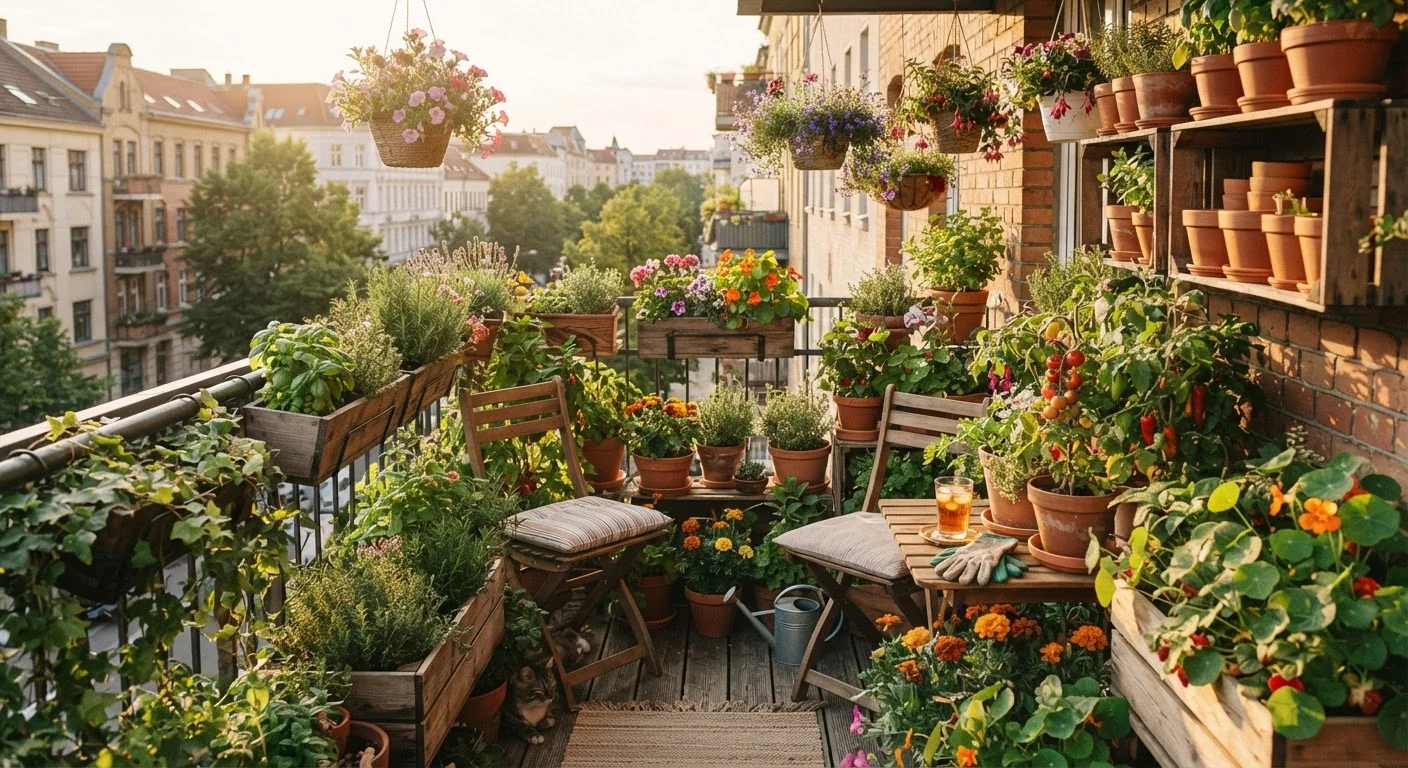
Balconies, windowsills, and patios can all support thriving plants. This guide covers containers, soil mixes, drainage, and plant selection.
Key takeaways
- Container size and drainage holes are the two most critical factors in whether your plant survives.
- Standard garden soil compacts in pots and should never be used — always choose a purpose-made potting mix.
- Most vegetables, herbs, and many fruiting plants grow successfully in containers with the right setup.
- Containers dry out faster than ground beds, so consistent watering is essential.
- Matching your plant's light needs to your specific space — balcony, windowsill, or patio — is step one.
Why Container Gardening Works
Container gardening removes the biggest barrier most people face: access to ground soil. Whether you rent an apartment with a sunny balcony, own a paved patio, or have a shaded yard with a bright windowsill, containers let you place growing conditions where you control them. That flexibility is the core advantage.
Unlike in-ground beds, containers allow you to move plants to follow sunlight, protect them from late frosts, and tailor soil conditions to individual plant needs. If you've ever wondered how to start without digging up a yard, see our practical first-timer's guide for broader context before diving into containers specifically.
Containers also keep invasive plants — like mint — contained (literally), make pest management easier to isolate, and let renters garden without permanent changes to a property. The trade-offs are real: containers dry out faster, need regular feeding, and have limited root space. Understanding both sides helps you plan realistically.
Choosing the Right Container
The container you choose affects everything from moisture retention to root health. Here's what to evaluate:
- Size: Match container volume to mature root depth. Lettuce and herbs do well in 6–8 inch deep containers. Tomatoes need at least 5 gallons (roughly a 12-inch-diameter pot); peppers, 3–5 gallons. Undersized containers stunt growth and require constant watering.
- Material: Terracotta is porous, which promotes airflow to roots but dries out quickly — good for drought-tolerant plants like lavender, harder for thirsty vegetables. Plastic retains moisture longer and is lightweight, making it practical for balconies with weight limits. Fabric grow bags provide excellent air pruning of roots and drainage.
- Color: Dark containers absorb heat and can overheat roots in full sun. In hot climates or south-facing exposures, lighter-colored containers or those with insulating walls are preferable.
- Unconventional options: Colanders, wooden crates lined with burlap, galvanized tubs, and even sturdy canvas bags all work — provided they have or can be given drainage.
If you're styling containers on a deck or patio, they can double as decorative elements. Our interior decorating hub includes ideas for extending your aesthetic from indoors to outdoor container displays.
When grouping containers together, cluster plants with similar water needs — it simplifies your care routine and prevents over- or under-watering plants that share a watering schedule.
Mixed groupings with incompatible moisture needs are one of the leading causes of plant loss in container gardens, particularly for beginners managing multiple pots.
Before committing to a container location, observe the spot at three different times of day — morning, midday, and late afternoon — to accurately assess how many hours of direct sun it actually receives.
Overestimating available light is extremely common, especially on balconies where walls and overhangs block sun for portions of the day, leading to mismatch between plant needs and actual conditions.
Soil Mixes: Why Garden Dirt Doesn't Work
This is one of the most common early mistakes: scooping soil from your yard or garden bed and filling a container with it. In the ground, that soil benefits from earthworm activity, natural drainage through layers, and constant biological renewal. In a pot, it compacts quickly, restricts water flow, and suffocates roots.
Always start with a potting mix — not potting soil, which can be ambiguous and sometimes too dense. A quality potting mix is formulated to stay loose and drain freely in the confined environment of a container. It typically contains peat moss or coco coir, perlite or vermiculite for drainage and aeration, and sometimes a slow-release fertilizer starter charge.
For specific plant categories, you can refine the base mix:
- Herbs and vegetables
- Standard potting mix works well; add 10–20% compost for nutrient density. Our article on composting at home can help you produce your own.
- Succulents and cacti
- Add coarse sand or extra perlite to increase drainage — roughly 50% amendment to 50% base mix.
- Acid-loving plants
- Blueberries and azaleas benefit from a mix with added sulfur or a dedicated ericaceous (acid) potting mix.
Refresh or replace potting mix every one to two growing seasons. Reused mix becomes depleted and increasingly compacted.
Drainage: The Non-Negotiable
If a container has no drainage hole, water accumulates at the bottom, roots sit in standing water, and the plant develops root rot — often before any visible symptom appears above soil. Drainage is not optional.
Drill holes in containers that lack them using a masonry or standard drill bit depending on material. Space multiple holes evenly across the base. Elevate containers slightly on pot feet or bricks so water can escape freely rather than pooling under the container.
Skip the Gravel Layer — It Harms, Not Helps
Placing gravel or stones at the bottom of a container to "improve drainage" is a widespread practice that actually raises the saturated zone in the pot, keeping roots wetter for longer. Fill containers fully with the appropriate potting mix and rely on drainage holes for water management. This single correction prevents a significant portion of container plant failures.
One persistent myth: placing a layer of gravel at the bottom of a container improves drainage. Research in horticultural science consistently shows the opposite — a gravel layer actually raises the "perched water table" (the zone of saturated soil that forms above drainage layers), which means roots sit in wet conditions longer, not shorter. See our breakdown of garden myths that keep new growers stuck for more on this and similar misconceptions.
Use saucers thoughtfully. A saucer prevents deck staining and catches runoff, but if water sits in it for more than an hour after watering, empty it — especially for plants sensitive to wet roots.
Selecting Plants That Thrive in Containers
Most plants that can be grown in ground can be adapted to containers — the key is matching mature size, root depth, and light requirements to your space.
Edibles
- Herbs: Basil, parsley, chives, thyme, and rosemary are excellent starters. Mint must be contained solo — it crowds everything else and spreads aggressively.
- Salad greens: Lettuce, spinach, arugula, and kale can be harvested repeatedly from shallow containers, making them ideal for windowsills and small balconies.
- Compact vegetables: Bush bean varieties, patio-type tomatoes, dwarf peppers, radishes, and green onions all perform well in 3–10 gallon containers.
Ornamentals
- Petunias, calibrachoa, and impatiens fill container edges with color and tolerate varied light levels.
- Dwarf ornamental grasses and compact shrubs like boxwood can anchor large containers as focal points.
For light-limited spaces such as north-facing windows or shaded balconies, ferns, peace lilies, and pothos thrive without direct sun. Our companion guide to indoor plants and natural light covers this in depth. When deciding whether to start from seed or buy transplants, our seeds vs. seedlings comparison lays out the practical trade-offs.
Watering, Feeding, and Seasonal Care
Containers dry out significantly faster than ground beds because they have limited soil volume and are exposed on all sides to air and heat. Check moisture by inserting your finger two inches into the soil — if it's dry at that depth, water thoroughly until it runs freely from the drainage hole. Shallow, frequent sips encourage shallow roots; deep, thorough watering promotes stronger root systems.
Because nutrients leach out with each watering, containers need regular feeding. A balanced, slow-release granular fertilizer worked into the mix at planting provides a foundation. Supplement with a liquid fertilizer every two to four weeks during the active growing season, following package directions without exceeding recommended rates — over-fertilizing burns roots.
For seasonal transitions, consult our gardening calendar to time planting, feeding, and overwintering correctly for your region. In winter, protect containers from freeze-thaw cycles that crack terracotta; move them to a garage or insulate with burlap wrapping. Some perennials can be overwintered in containers indoors in cool, bright locations.
This article provides general gardening guidance for educational purposes. Local growing conditions, climate zones, and specific plant requirements vary. Verify pest control products and fertilizer use align with local regulations before applying.
All published content on this website is for informational and educational purposes only and should not be taken as professional advice. We recommend that readers seek expert opinion before making any decisions. The website is not responsible for any actions taken based on the information provided on this website. We are not liable for any inaccuracies, modifications, or omissions in information. Moreover, external links or third-party content are provided for convenience; we are not liable for their correctness. Users are advised to verify every piece of information before they use it for any purpose.