
Cable TV vs. Streaming: What Actually Changed and What Didn't

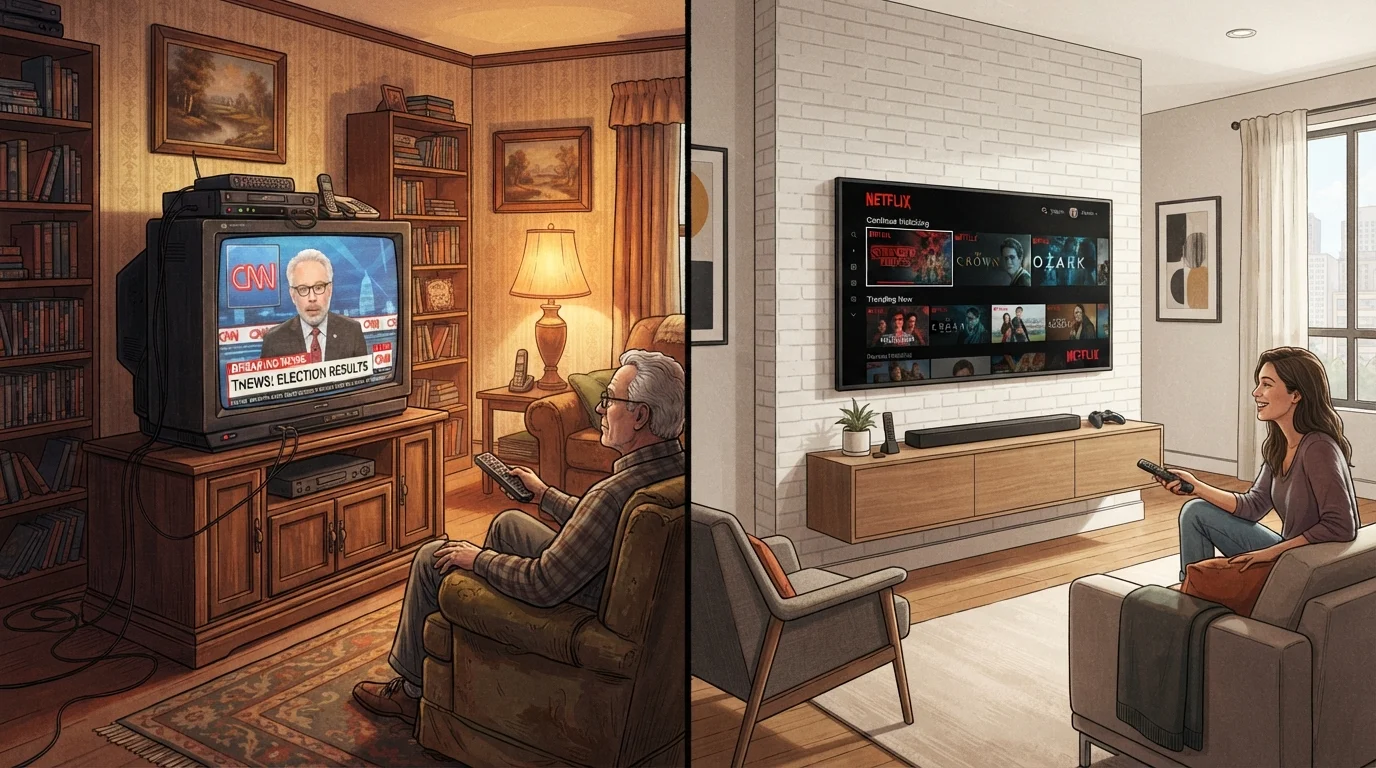
Streaming promised to fix everything wrong with cable. A look at where it succeeded, where it fell short, and what the differences really mean for viewers.
Option A
Cable TV
The established, all-inclusive broadcast bundle.
Best for: Viewers who want live sports, local news, and a single bill covering dozens of channels without managing multiple subscriptions.
Option B
Streaming
The flexible, on-demand alternative to the bundle.
Best for: Viewers who prefer watching on their own schedule, want access to specific original series, and are comfortable managing a handful of separate subscriptions.
Key takeaways
- Streaming delivered genuine flexibility and on-demand access that cable largely couldn't match.
- The cost advantage of streaming has narrowed significantly as platforms have multiplied and raised prices.
- Cable's grip on live sports and local news remains its clearest competitive strength over streaming.
- Streaming fragmented the shared viewing experience that cable once provided as a default.
- Neither model has fully solved the problem of paying for content you don't actually watch.
- Many households now pay for both cable and streaming services simultaneously.
What Streaming Actually Promised
When streaming services began their serious rise in the early 2010s, the pitch was simple and seductive: pay less, watch more, and never sit through a commercial again. Cable, the argument went, was a bloated, overpriced bundle forcing viewers to subsidize dozens of channels they'd never willingly choose. Streaming was going to fix all of that.
Some of those promises held up remarkably well. On-demand access — the ability to watch what you want, when you want, without recording anything — genuinely changed how millions of Americans relate to television. Binge-watching became a cultural behavior, not just a word. Original programming on streaming platforms began attracting serious critical attention, and the conversation around prestige TV shifted accordingly. For a clear look at how that reshaped the broader cultural moment, the streaming wars reshaped how Americans talk about TV.
But several other promises — particularly around cost and simplicity — turned out to be more complicated once the market matured.
Side-by-Side: How the Two Models Actually Compare
Laying both models against each other reveals that the gap between cable and streaming has closed in some areas while widening in others. Neither is a clean winner across every dimension.
| Criterion | Cable TV | Streaming |
|---|---|---|
| Live sports coverage | Broad, reliable, most major rights | Fragmented, platform-dependent |
| Local news access | Standard inclusion with local affiliates | Limited; varies by service and region |
| On-demand flexibility | Limited; DVR required for time-shifting | Core feature; watch anytime |
| Monthly cost | Higher single bill; predictable | Lower per service; adds up with multiple |
| Ad interruptions | Frequent on most channels | Optional; ad-free tiers available |
| Original programming | Available on premium cable tiers | Heavy investment; major prestige titles |
| Setup and management | Single provider; one interface | Multiple apps, logins, and billing cycles |
| Contract flexibility | Often requires annual contracts | Typically month-to-month |
The table above captures the structural differences, but the lived experience adds nuance. Cable's channel guide is predictable — for better or worse. Streaming interfaces vary wildly between platforms and can feel overwhelming, a phenomenon explored in depth in the discussion of streaming fatigue and decision paralysis.
Where Streaming Fell Short of Its Own Hype
The cost argument — once streaming's strongest card — has weakened considerably. When a household subscribes to several platforms simultaneously, the combined monthly total can rival or exceed a basic cable package. That math has gotten harder to ignore. For a thorough accounting of what streaming actually costs once hardware, data, and add-ons enter the picture, see the real costs of streaming.
Live television has also proven stubbornly difficult for streaming to fully replicate. Sports rights remain expensive and fragmented across platforms, and local news — a genuine daily habit for a large portion of cable's audience — still isn't seamlessly delivered by most streaming services. Live TV on streaming platforms offers an honest look at where that gap persists.
There's also the cancellation problem. Streaming platforms, driven by subscriber metrics that differ fundamentally from traditional ratings, have developed a pattern of ending series before audiences feel ready — sometimes after a single season. The business logic behind those decisions is genuinely different from how network TV operated. Why streaming platforms cancel popular shows breaks down that logic in detail.
The Bundling Cycle Is Repeating
Several major streaming platforms have begun forming content bundles with each other — packaging two or three services together at a combined price. This mirrors the logic that originally defined cable bundles, suggesting the industry may be moving through a familiar cycle rather than escaping it. Whether bundled streaming ends up cheaper or more expensive than legacy cable depends heavily on which services a given household actually uses.
What Cable Got Right — and Still Does
Cable's most durable strength is live, real-time television. Major sporting events, breaking news, and appointment viewing like awards shows all still funnel through cable infrastructure at scale in ways that streaming hasn't fully matched in reliability or rights coverage. For households where Sunday football or a nightly local newscast is genuinely essential, cable remains the more complete solution.
There's also the shared-experience dimension. Cable, for all its flaws, created a common schedule. Everyone who watched a show watched it at the same time, and the water-cooler conversation the next morning reflected that. Streaming's on-demand model is genuinely liberating, but it fractured that shared rhythm in ways that subtly changed how pop culture coheres — or doesn't. The nature of TV greenlight decisions shifted too; how streaming changed pilot season explains how the content pipeline itself was rewired.
Finally, for viewers who aren't interested in managing apps, passwords, and separate billing cycles, cable's single-provider simplicity still has genuine appeal. One bill, one interface, one point of contact for support — that's not nothing.
What Neither Model Has Solved
The uncomfortable truth is that the core frustration viewers had with cable — paying for vast amounts of content they never actually watch — hasn't disappeared under streaming. It's just been redistributed. Instead of funding 200 channels they ignore, many subscribers now pay for four or five platforms and rotate through them, rarely exhausting what any single one offers before the next billing cycle arrives.
Discovery remains genuinely hard on both sides. Cable's linear schedule told you what was on; streaming's algorithmic recommendations tell you what you might like — a fundamentally different promise that doesn't always deliver. If you're new to navigating the streaming landscape and want a practical orientation, a new viewer's map through streaming is a useful starting point.
The larger picture is one of genuine trade-offs rather than a clear winner. Streaming brought real improvements: flexibility, quality original programming, and a viewing experience centered on the audience rather than the broadcaster's clock. Cable retained real strengths: live coverage, simplicity, and a shared schedule that streaming hasn't replaced. Most American households, in practice, aren't choosing one over the other — they're living with both.
All published content on this website is for informational and educational purposes only and should not be taken as professional advice. We recommend that readers seek expert opinion before making any decisions. The website is not responsible for any actions taken based on the information provided on this website. We are not liable for any inaccuracies, modifications, or omissions in information. Moreover, external links or third-party content are provided for convenience; we are not liable for their correctness. Users are advised to verify every piece of information before they use it for any purpose.