
Why Dark Walls Are Less Scary Than You Think

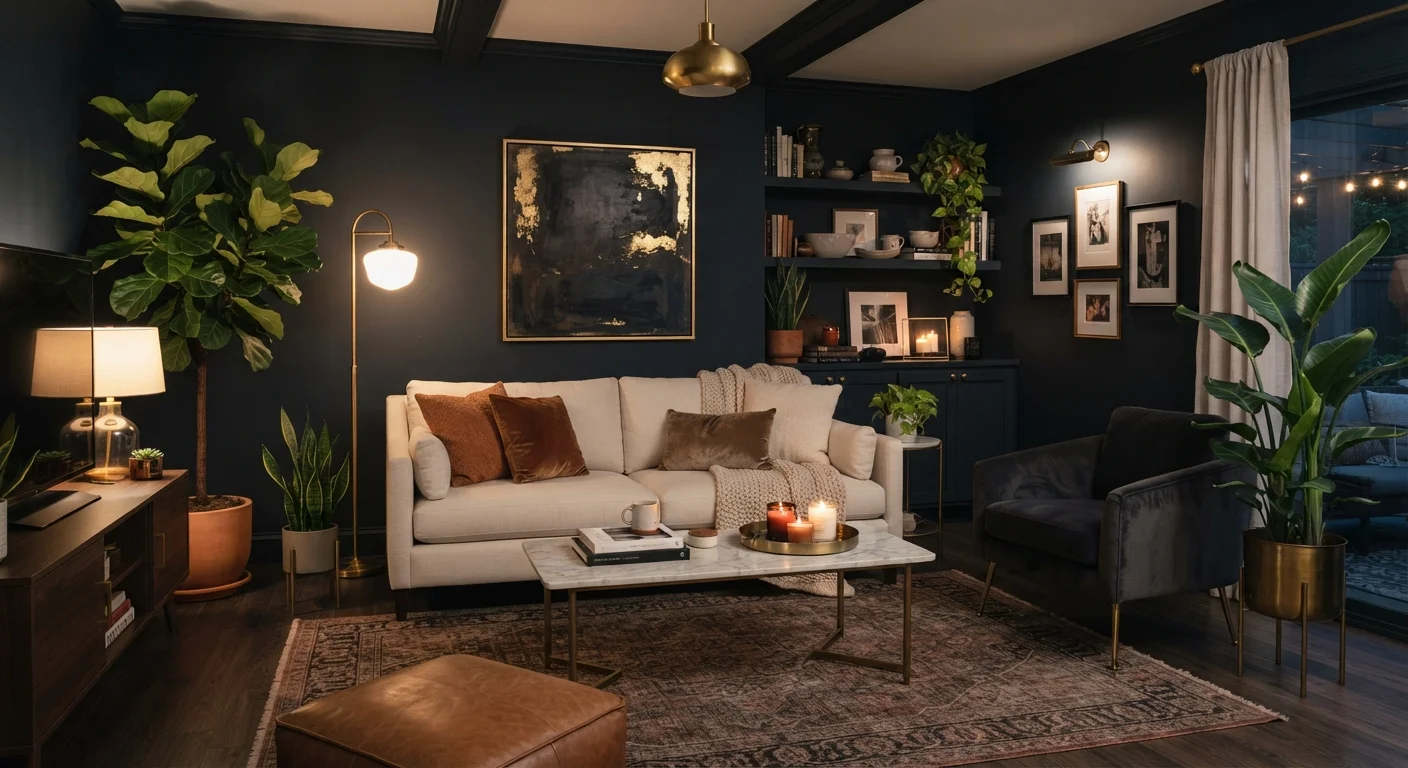
Dark paint and wallpaper get a bad reputation, but they can add depth and drama when used thoughtfully. Here's the case for going bold.
Key takeaways
- Dark walls don't automatically make a room feel smaller — light, contrast, and layout matter more.
- A single dark accent wall can add drama without overwhelming a space.
- Warm lighting is the most important partner to any dark paint color.
- Dark colors work in any room, including small ones, when applied thoughtfully.
- Repainting is reversible — experimenting with dark walls carries less permanent risk than most assume.
The Case Against Playing It Safe
Beige, white, and greige have dominated American living rooms for decades — partly because they're safe bets, and partly because many homeowners carry a deep-seated fear of dark paint. Dark walls, the conventional wisdom goes, will swallow a room whole, depress the mood, and be impossible to undo. But interior designers tell a different story.
Dark colors — think forest green, deep slate, charcoal, navy, plum, or near-black — do something that pale neutrals simply can't: they create depth and intimacy, making a room feel deliberate and layered rather than unfinished. The anxiety around going dark is largely based on misconceptions, and understanding what's actually true can be freeing.
This article explores how colour choices shape a room's mood, but here we focus specifically on debunking the myths that keep homeowners from trying something bolder. Consider this your permission slip.
Common Myths About Dark Walls — Corrected
Most resistance to dark walls comes from a handful of persistent misconceptions. Below, we address each one directly.
Myth
Dark walls make a room feel smaller and more cramped.
Fact
Dark walls create enclosure, but enclosure and cramped are not the same thing. With proper lighting and furniture scale, dark rooms often feel cozy and intimate rather than tight.
The perception of space in a room depends on multiple overlapping factors: ceiling height, furniture scale, the amount of natural and artificial light, and the contrast between surfaces. A dark wall in a room with adequate lighting, appropriately sized furniture, and light-colored trim can actually feel more spacious than the same room painted white and overcrowded with mismatched pieces.
That said, if your primary goal is creating the illusion of a larger space, our companion piece on decorating small rooms covers layout and scale strategies that genuinely move the needle.
Myth
Dark paint is permanent — if you hate it, you're stuck.
Fact
Dark paint can be covered, though it may require a quality primer and additional coats. It's no more permanent than any other paint color.
Paint is among the most reversible design decisions you can make. A high-quality tinted primer followed by two coats of a lighter color will cover even the deepest charcoal. The process takes a weekend, not a renovation. If you're hesitant, that's understandable — but the fear of reversibility shouldn't be your main reason for avoiding a color you love.
Testing with a large swatch rather than a tiny chip, and living with it for several days before committing, is the simplest way to reduce regret without avoiding the decision altogether.
Myth
Dark walls require expensive, designer-level furniture to look good.
Fact
Dark walls are surprisingly forgiving and can elevate modest furnishings by making them look more deliberate and considered.
One of the underappreciated advantages of a dark backdrop is that it works like a stage: everything in front of it becomes more intentional-looking. A simple cream linen sofa, a warm wood bookshelf, or even a collection of thrifted frames arranged thoughtfully on a dark wall can look polished and curated. The dark color does compositional work that white walls simply don't.
The key is contrast. Light furnishings against dark walls create visual interest automatically. Metallic hardware — lamps, frames, handles — catches what light there is and adds brightness without overhead illumination.
Myth
Dark rooms are always gloomy and depressing.
Fact
A dark room with warm-toned light sources feels enveloping and atmospheric, not gloomy. Color temperature and lighting design matter more than wall color.
Gloominess in a room is almost always a lighting problem, not a paint problem. Cool, overhead fluorescent lighting makes any room feel clinical or flat — even a bright white one. Warm bulbs (look for a color temperature around 2700K), floor lamps, table lamps, sconces, and candles transform a dark room into something that feels genuinely inviting.
Think of how a dark-walled restaurant or bar tends to feel comfortable and atmospheric rather than oppressive. That effect comes from layered lighting at human scale, not from the absence of dark paint. The same principle applies at home.
Myth
Dark colors only work in large rooms with high ceilings.
Fact
Dark paint can work in compact spaces too — a small bathroom or powder room painted in a deep hue often looks intentional and dramatic, not crowded.
Small rooms are actually some of the best candidates for dark paint, because you're working with limited square footage where a bold choice can be fully appreciated without feeling overwhelming. A tiny powder room painted a deep forest green or midnight blue, with a simple mirror and warm lighting, is a design moment — the kind of space that surprises guests in the best possible way.
The logic is that small rooms already have inherent scale limitations. Leaning into that by making them feel deliberately cozy and jewel-box-like is often more effective than fighting it with pale paint that can make small spaces look unfinished.
Practical Tips for Committing to a Dark Wall
Once you're ready to move past the myths, execution is everything. Here are the most important considerations before you open a can of dark paint.
- Start with a single wall. An accent wall — especially the one your eye naturally travels to when entering the room — is the lowest-commitment way to test a dark hue. It adds drama without full saturation.
- Sample generously. Dark paint looks dramatically different on a small chip versus a large swatch in your actual room. Paint at least a 12-by-12-inch patch and observe it at multiple times of day before committing.
- Plan your primer. Going dark typically requires a tinted primer in a similar tone to the finish color. Skipping this step means more coats and inconsistent coverage.
- Mind the sheen. Flat and matte finishes absorb light and minimize imperfections — a good choice for bedrooms and dining rooms. Eggshell adds slight reflectivity. High gloss on dark colors is a bold choice that amplifies both the drama and any wall flaws.
- Coordinate your furnishings. Light-colored upholstery, natural wood tones, and metallic accents (brass, aged bronze, matte gold) pop beautifully against dark walls and prevent a room from feeling visually heavy.
If you're brand new to decorating, our guide for absolute beginners covers the foundational decisions that make every subsequent choice — including color — easier to navigate.
And if dark paint still feels like too large a leap, texture can do heavy lifting in a neutral room without requiring any commitment to a bold hue at all.
One Room Where Dark Walls Truly Shine
If you want to experiment in the most forgiving possible setting, consider the dining room. Dining rooms are typically used in the evening under artificial light, which means natural light limitations matter less. A dark, saturated wall — deep burgundy, forest green, or inky navy — in a dining room creates an atmosphere that feels rich and celebratory, like dining in a private club rather than a home kitchen overflow.
Layer in a statement light fixture (a chandelier or pendant that casts warm, downward light), a table with reflective or light-toned surfaces, and a carefully composed gallery wall of framed prints, and the dark backdrop becomes the best design decision in the house.
The point isn't to go dark everywhere — it's to recognize that dark walls are a tool, not a liability. Used with intention, they can give a room exactly the weight and character that a bright neutral can't provide.
All published content on this website is for informational and educational purposes only and should not be taken as professional advice. We recommend that readers seek expert opinion before making any decisions. The website is not responsible for any actions taken based on the information provided on this website. We are not liable for any inaccuracies, modifications, or omissions in information. Moreover, external links or third-party content are provided for convenience; we are not liable for their correctness. Users are advised to verify every piece of information before they use it for any purpose.