
Open Shelving vs. Closed Cabinetry: What Each Style Actually Does to a Room

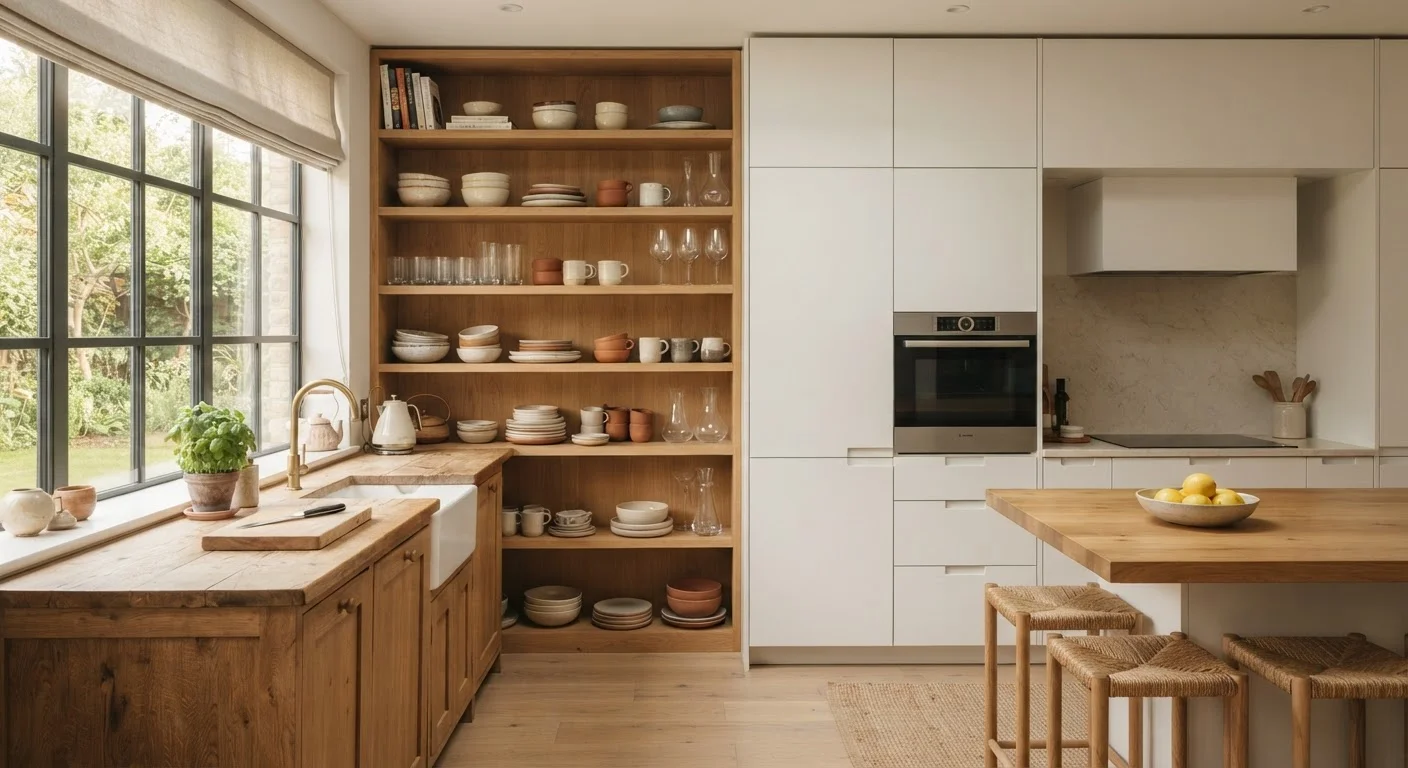
Both open and closed storage have real trade-offs. Here's how to weigh aesthetics, practicality, and upkeep before committing.
Option A
Open Shelving
The expressive, airy display option.
Best for: Homeowners who curate their belongings, enjoy visual displays, and commit to consistent tidying.
Option B
Closed Cabinetry
The tidy, hide-it-all workhorse.
Best for: Busy households that prioritize easy upkeep, maximum storage capacity, and a clean visual baseline.
Key takeaways
- Open shelving makes a room feel larger and more personal, but demands deliberate curation and regular dusting.
- Closed cabinetry reduces visual noise and simplifies cleaning, but can make a space feel heavier if overused.
- Mixing both styles is a practical middle ground that many interior designers favor for kitchens and living areas.
- Your existing lighting, ceiling height, and room size should influence which style takes the lead.
- Neither option is inherently superior — the right choice depends on how you actually use and maintain the space.
What Each Style Actually Does Visually
Storage choices are, at their core, design decisions — they set the visual tone of a room before a single decorative object is placed. Understanding what each approach does to the eye helps you choose with intention rather than trend.
Open shelving removes visual barriers. Without a door panel or face frame, your gaze travels deeper into the room, and the wall appears to recede. This is especially useful in kitchens and dining areas where upper cabinets would otherwise form a solid horizontal block at eye level. Because the shelves themselves take up little visual mass, the room can read as more spacious — a principle discussed more broadly in decorating for smaller spaces.
Closed cabinetry adds visual weight and enclosure. That isn't always a negative — in large, sparsely furnished rooms, solid cabinetry can anchor a wall and prevent the space from feeling cold or undefined. But in smaller or darker rooms, a run of solid upper cabinets can make walls advance toward you, compressing the perceived square footage.
Color matters, too. Open shelving in a dark finish can feel bold and intentional; pale closed cabinetry can nearly disappear into a light wall. The visual effect is never about one element in isolation — it's always about how storage interacts with light, ceiling height, and the objects around it.
The Honest Upkeep Comparison
No storage decision is maintenance-free, but the demands are genuinely different between the two styles — and it's worth being realistic before committing.
| Criterion | Open Shelving | Closed Cabinetry |
|---|---|---|
| Visual weight | Light, open, airy | Solid, anchoring, heavier |
| Dust and grease accumulation | High — items exposed | Low — contents protected |
| Daily tidiness requirement | High — disorder is always visible | Low — disorder hidden behind doors |
| Storage capacity | Moderate — open layout limits stacking | High — enclosed space maximizes volume |
| Display potential | Excellent — objects become décor | None — contents concealed |
| Installation complexity | Generally simpler, fewer components | More involved, hardware required |
| Best room type | Kitchens, living rooms, bathrooms | Kitchens, pantries, laundry rooms |
Open shelves collect dust, grease, and ambient cooking residue. In a kitchen especially, items stored openly near a cooktop will need wiping down regularly. The objects themselves — dishes, glassware, books — also gather grime that a cabinet door would otherwise contain. If your styling is minimal and your items are in regular rotation, this is manageable. If you plan to display items you rarely touch, expect visible dust accumulation within weeks.
Closed cabinetry keeps contents clean with far less effort. The interior can go weeks or months without attention. The trade-off is the exterior: door panels, handles, and hinges all attract fingerprints and smudges, particularly in households with children. Textured or matte finishes tend to show fewer marks than high-gloss surfaces.
There's also a subtler upkeep dimension: visual tidiness. Open shelves that fall out of order look messy from anywhere in the room. Closed cabinets can hide mild disorder behind a closed door — a meaningful difference on busy days. If the sight of an imperfectly arranged shelf would stress you out, that's a real and valid reason to lean toward closed storage. For more on why visual disorder lingers even after tidying, see why rooms can still feel cluttered.
Where Each Style Works Best — and Where It Struggles
Both storage types have contexts where they genuinely excel and others where they create more problems than they solve.
Open shelving at its best: upper wall zones in kitchens, living room alcoves, home offices with books and plants, and bathroom niches where towels and small vessels can be easily accessed and attractively arranged. It rewards spaces where items are beautiful, frequently used, or deliberately chosen — curated displays mixing old and new objects are a natural fit for open shelving.
Open shelving at its worst: beside a greasy range without a powerful vent hood, in a household where storage needs change frequently, or when the underlying wall finish or shelf bracket style doesn't suit the room's design language. Poorly considered open shelving can read as unfinished rather than intentional.
Closed cabinetry at its best: pantry zones, base cabinets in high-use kitchens, laundry rooms, and any area where you store items that are functional but not decorative — cleaning supplies, bulk goods, mismatched containers. It's also more forgiving in rental or transitional spaces where you can't predict how storage needs will shift.
Closed cabinetry at its worst: installed floor-to-ceiling across an entire small kitchen with no visual break. This configuration can feel oppressive, particularly if the cabinet color is dark or the room lacks natural light. Breaking up a full run with a section of open shelving — or even glass-front doors — relieves the visual compression considerably.
Designing a Room That Uses Both Well
In practice, the most versatile and livable rooms rarely choose a single storage mode. A thoughtful mix of open and closed storage gives you expressive display areas alongside practical concealment — and the contrast itself becomes part of the design.
A common and effective approach: keep lower cabinetry closed (where practicality and concealment matter most) and introduce open shelving at upper or eye-level zones where carefully chosen objects can breathe. This naturally follows how most people use storage — frequently-accessed or visually appealing items up top, functional clutter stored below and out of sight.
When combining both, consistency in material and color is what keeps the result from looking arbitrary. Open shelves that match the cabinet finish or complement the wall color read as intentional; mismatched shelving bolted onto otherwise uniform cabinetry can undermine both. Think of the shelving as part of the same design system, not an afterthought.
Finally, consider how your storage choices interact with other focal points in the room. Whether your emphasis is on statement furniture or statement accessories will influence how much visual work you want your storage to do. Open shelving that doubles as a display surface competes for attention; closed cabinetry recedes and lets other elements lead. Neither is the wrong call — the goal is knowing which role each element is playing before you install it.
Glass-Front Doors: A Middle Path
If you're drawn to open shelving's airiness but want some protection for your stored items, glass-front cabinet doors offer a genuine compromise. They preserve visibility and visual depth while keeping dust and grease off your dishes and glassware. Reeded or fluted glass adds texture and partially obscures contents, which means less pressure to keep the interior styled at all times — a practical advantage worth considering before ruling out cabinetry entirely.
All published content on this website is for informational and educational purposes only and should not be taken as professional advice. We recommend that readers seek expert opinion before making any decisions. The website is not responsible for any actions taken based on the information provided on this website. We are not liable for any inaccuracies, modifications, or omissions in information. Moreover, external links or third-party content are provided for convenience; we are not liable for their correctness. Users are advised to verify every piece of information before they use it for any purpose.