
Fandom Then and Now: How Audience Devotion Has Changed Since the Beatlemania Era
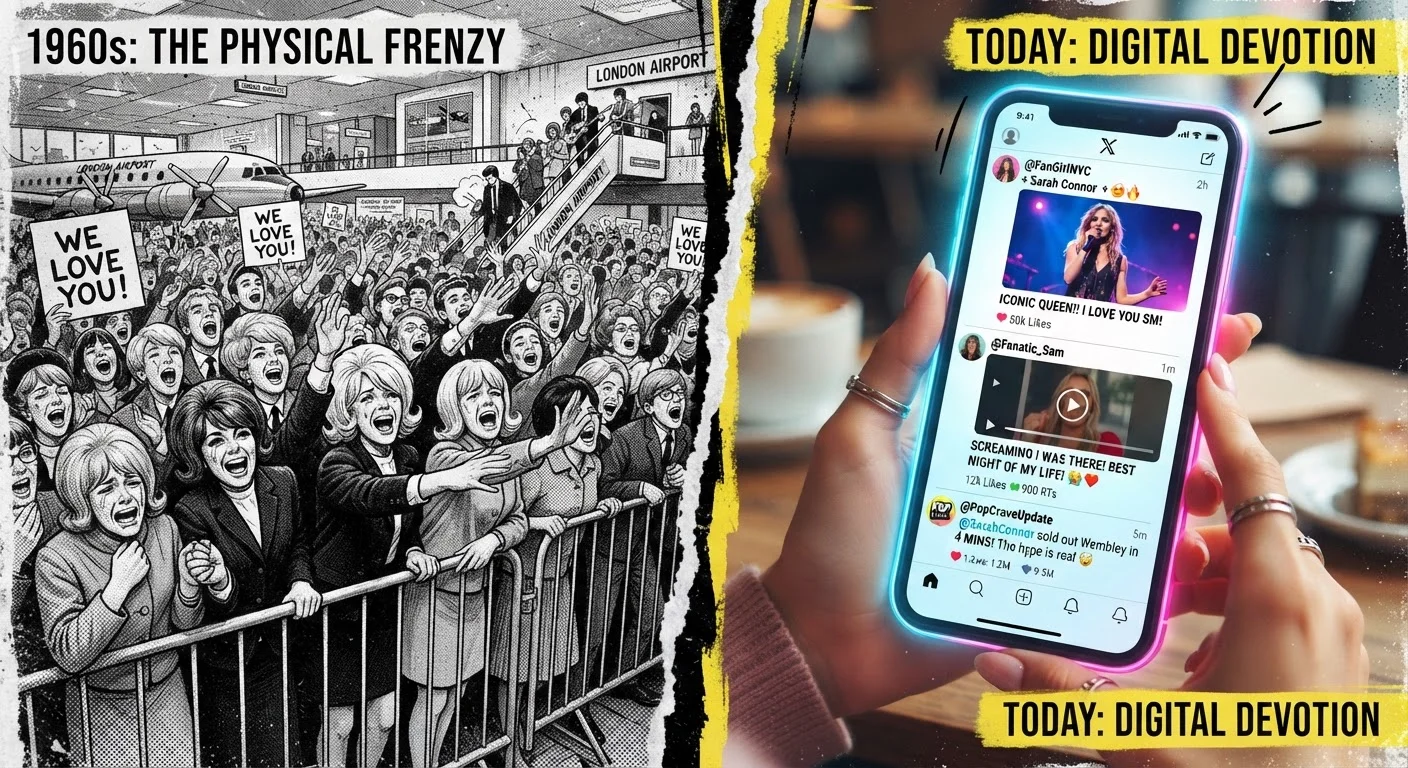
From screaming crowds at airports to Twitter stan accounts — a look at how fan culture has evolved across decades.
Our Verdict
Fandom has evolved from a largely passive, place-bound devotion into a globally networked, participatory force that shapes careers, drives cultural conversations, and blurs the line between audience and collaborator. Neither era is simply better — each reflects the communication technology and social values of its time.
| Best for | Recommended |
|---|---|
| Those nostalgic for the communal, visceral energy of classic fan moments | Classic-era fandom rituals |
| Readers who want to understand today's stan culture and online fan organizing | Digital-age fandom |
Key takeaways
- Beatlemania-era fandom was largely physical and communal, defined by shared public spectacle.
- Digital platforms shifted fandom from passive consumption to active, participatory culture.
- Parasocial relationships have deepened as social media creates the illusion of direct celebrity access.
- Modern fan communities can organize globally within hours, amplifying both support and criticism.
- The economics of fandom have changed — fans now directly fund artists through streaming, merch, and crowdfunding.
Screaming at the Airport: What Classic Fandom Looked Like
When The Beatles landed at John F. Kennedy International Airport on February 7, 1964, roughly 3,000 fans had gathered — some waiting for hours in February cold — to catch a glimpse. The scenes that followed over the next several years, variously described as "mass hysteria" by contemporary journalists, became a cultural shorthand for fan devotion at its most electric. Beatlemania wasn't an isolated phenomenon; it rhymed with earlier Sinatra swooning and prefigured Elvis worship. What those moments shared was a fundamentally physical, place-based quality.
Classic-era fans consumed pop culture through tightly controlled channels: radio airplay, TV appearances on programs like The Ed Sullivan Show, fan magazines, and live concerts. Interaction was largely one-directional. You watched, you listened, you bought the record. The closest fans got to a two-way relationship was writing a letter to a fan club — which was typically answered by paid staff, not the artist. Yet the emotional intensity was undeniable and, for many participants, genuinely community-forming. Fan clubs in the 1960s and '70s served a real social function, connecting isolated devotees before the internet made that effortless.
Collective fandom also had a strongly local character. Your fandom was shaped by what your regional radio stations played, which concerts came to your city, and who your classmates were obsessed with. The experience was shared but geographically bounded. See our decade-by-decade cultural reference for a broader look at the moments that crystallized these communal experiences.
From Fan Clubs to Stan Accounts: The Digital Transformation
The internet didn't just move fan culture online — it fundamentally restructured the power dynamics within it. Usenet groups in the early 1990s gave way to message boards, then LiveJournal communities, and eventually Twitter, TikTok, and Discord servers. Each platform shift lowered the barrier to participation and raised the ceiling on how organized and influential a fan base could become.
The word "stan" — now standard cultural vocabulary — entered mainstream discourse from Eminem's 2000 song of the same name and gained formal dictionary recognition by the mid-2010s. It describes a fan whose devotion crosses into intense, active advocacy. Stan culture operates with something closer to a participatory logic: fans don't merely consume, they stream songs to boost chart positions, coordinate mass-voting campaigns for award shows, flood trending topics with supportive hashtags, and create original content — fan fiction, edits, analysis threads — that extends the cultural life of the artist's work.
This shift has real consequences for how careers are made and sustained. Streaming numbers, which directly affect chart positions and label confidence, can be meaningfully moved by organized fan activity. That's a form of cultural power earlier generations of fans simply didn't possess. For a deeper look at how this reshapes the celebrity relationship itself, our examination of parasocial bonds in the social media age unpacks the dynamics on both sides.
| Classic-Era Fandom (1960s–1980s) | Digital-Age Fandom (2000s–Present) | |
|---|---|---|
| Primary channels | Radio, TV, fan magazines, live concerts | Streaming, social media, podcasts, fan Discord servers |
| Fan-to-artist interaction | One-way; fan club letters answered by staff | Perceived direct access via social media posts and replies |
| Geographic reach | Largely local and national | Global, near-instantaneous coordination |
| Fan influence on careers | Record sales, concert attendance | Streaming numbers, chart campaigns, award voting |
| Community organizing | Physical fan clubs, local meet-ups | Online communities, cross-platform organizing |
| Speed of cultural moments | Days or weeks to spread nationally | Hours or minutes to trend globally |
What Changed, What Didn't, and What Got More Complicated
Some things are surprisingly durable. The emotional core — the feeling of being moved by an artist, of finding identity and community through shared devotion — hasn't changed in any fundamental way. What's changed is the infrastructure through which those feelings flow, and the expectations that infrastructure generates.
Modern fans often feel a sense of direct relationship with artists that earlier fan generations couldn't reasonably claim. Artists post casually to Instagram Stories, reply to tweets, and share behind-the-scenes glimpses that previous eras reserved for authorized documentaries. This creates what researchers call parasocial intimacy — a feeling of closeness that, while emotionally real to the fan, remains structurally one-sided. The risk isn't the feeling itself; it's when that perceived closeness generates expectations the artist cannot and should not be required to meet.
Fan communities have also developed a more explicitly political dimension. Coordinated fan groups have organized voter registration drives, raised money for disaster relief, and taken public stances on social issues — sometimes in the name of their favorite artists, sometimes independently of them. That political energy is not without tension, as our piece on fan expectations and artist activism explores in depth. Fans can also mobilize rapidly against perceived slights — toward their idols or toward other fan communities — and that speed can shade into harassment that earlier, slower-moving fan cultures rarely produced at scale.
The economics have shifted just as dramatically. Concert ticket prices have risen steeply across the industry over several decades, meaning that the live, in-person experience that was once the emotional center of classic fandom has become financially out of reach for many younger fans. Digital intimacy has, in some ways, become a substitute — and for some fans, the online community is the primary experience of fandom, not a supplement to it. Award show viewing habits reflect this evolution too, as our coverage of award show cultural shifts documents.
Understanding Your Own Fan Experience
Whether you grew up with vinyl or Spotify, it's worth reflecting on what draws you to fan communities. Research in media psychology suggests that belonging to a fan community can provide genuine social connection and a sense of shared identity — benefits that hold whether the community meets in person or online. Being aware of parasocial dynamics doesn't diminish the enjoyment; it just helps you stay grounded about the nature of the relationship.
All published content on this website is for informational and educational purposes only and should not be taken as professional advice. We recommend that readers seek expert opinion before making any decisions. The website is not responsible for any actions taken based on the information provided on this website. We are not liable for any inaccuracies, modifications, or omissions in information. Moreover, external links or third-party content are provided for convenience; we are not liable for their correctness. Users are advised to verify every piece of information before they use it for any purpose.