
Cultural Moments That Defined American Entertainment: A Decade-by-Decade Reference

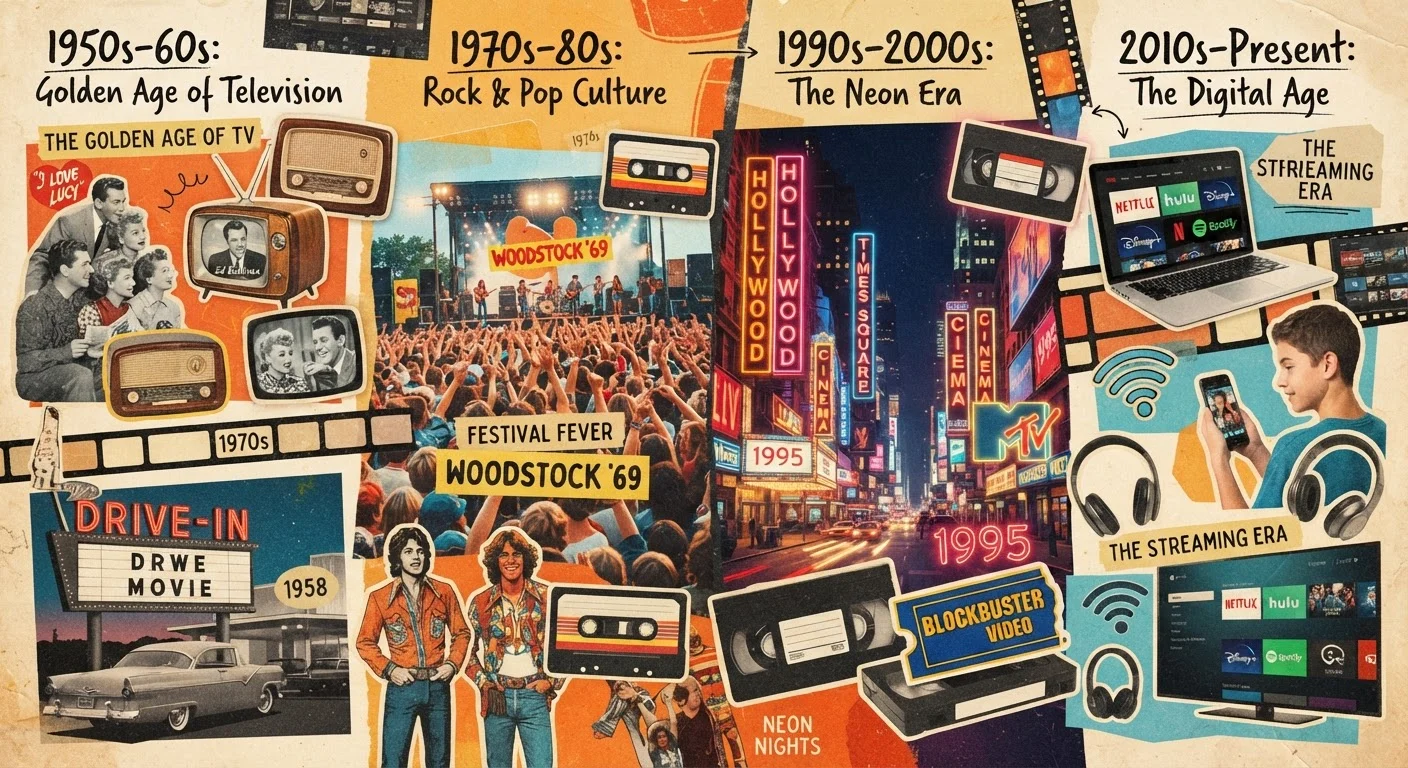
From Woodstock to the Super Bowl halftime show — a factual, era-by-era reference to the events that changed the cultural conversation.
How to Use This Reference
This guide is organized decade by decade, from the 1960s through the 2020s, spotlighting the events, broadcasts, and cultural flashpoints that most visibly shifted the national conversation. It is designed as a lookup resource — a quick orientation to why a specific era felt the way it did, and which moments carried the most lasting weight.
For a deeper look at what separates a fleeting trend from a true cultural earthquake, see The Anatomy of a Viral Moment. And if the vocabulary of pop culture coverage sometimes leaves you puzzled, The Language of Trending glossary offers plain-English definitions.
| Apollo 11 TV audience (est.) | ~600 million viewers worldwide (NASA historical records) |
| MTV launch date | August 1, 1981 |
| Soul Train national debut | 1971 |
| Survivor U.S. premiere | May 31, 2000 (CBS broadcast records) |
| American Idol U.S. premiere | June 11, 2002 (Fox broadcast records) |
| DVD format introduced | 1997 (U.S. market) |
| Woodstock festival date | August 15–18, 1969 |
| Michael Jackson's Thriller video release | December 2, 1983 |
1960s–1970s: Broadcast Television and the Mass Audience
The 1960s established television as the dominant medium of American shared experience. The live broadcast of the Apollo 11 moon landing in July 1969 drew an estimated 600 million viewers worldwide — a number that underscored TV's power to unite strangers around a single moment. Domestically, the assassination of President John F. Kennedy in 1963 demonstrated that TV could also serve as the nation's collective grief channel, with continuous coverage running for four days.
Woodstock in August 1969 anchored a different kind of mass gathering — one defined by music and countercultural identity rather than a screen. The festival has since become shorthand for the idealism (and logistical chaos) of that era. The 1970s extended broadcast's reach through the rise of music performance shows, including Soul Train, which debuted nationally in 1971 and gave Black artists and audiences a flagship platform at a time when mainstream variety programming rarely did.
1980s–1990s: MTV, Blockbusters, and the Celebrity Machine
MTV launched on August 1, 1981, with the Buggles' "Video Killed the Radio Star" — a choice that turned out to be genuinely prophetic. The channel didn't just promote music; it created a new grammar for celebrity, tying an artist's image and visual storytelling directly to commercial success. Michael Jackson's Thriller short film (1983) is widely cited as the moment music video became a serious art form with mainstream cultural reach.
The 1990s added the 24-hour news cycle and the rise of tabloid culture to the mix. The O.J. Simpson trial in 1995 drew daytime TV audiences that rivaled prime-time numbers — a signal that real-life drama could outperform scripted programming. Meanwhile, the introduction of the DVD format (1997) and the launch of pay-per-view changed how Americans consumed film outside theaters, setting the stage for the streaming era to come. Why the '90s and 2000s keep coming back explores how this decade's aesthetics continue to cycle back into the mainstream.
2000s–2010s: Reality TV, Social Media, and the Fragmented Audience
The early 2000s introduced reality television as a dominant format. Survivor (premiered 2000) and American Idol (premiered 2002) pulled massive audiences and shifted network strategy permanently, proving that unscripted programming could be both cheap to produce and culturally magnetic. Simultaneously, the Super Bowl halftime show evolved from a marching-band showcase into one of the year's most-watched entertainment events — a venue where wardrobe malfunctions (2004) and elaborate choreography alike became front-page news.
By the mid-2010s, social media had fundamentally disrupted the idea of a unified national audience. Twitter, Instagram, and YouTube didn't just distribute entertainment — they produced it. Vine creators, YouTube vloggers, and the first wave of influencers redefined what celebrity meant. Award shows, once reliable ratings anchors, began their long viewership decline during this period. How award shows became cultural flashpoints examines that transformation in detail. The Streaming & TV hub tracks how viewing habits continue to shift.
2020s: Streaming Dominance and the Always-On Conversation
The pandemic years accelerated a structural shift that was already underway: streaming became the primary entertainment delivery system for most American households. Shared TV moments — the kind that sent everyone to the office water cooler — migrated to group chats, Twitter threads, and TikTok reaction videos. Specific finales, album drops, and live events (the Super Bowl, award shows, concert films) retained outsized cultural gravity precisely because they offered synchronous, shared experience in an otherwise on-demand world.
The 2020s also saw fan communities exert more direct influence on the entertainment industry than any previous generation — pressuring platforms to renew canceled shows, driving album chart outcomes through coordinated streaming, and making artists' public stances a central part of their brand. The pressure on artists to take a stand looks at that dynamic closely. For readers curious about how individual moments become movements — or don't — the misreadings that shape pop culture coverage offers a useful corrective.
All published content on this website is for informational and educational purposes only and should not be taken as professional advice. We recommend that readers seek expert opinion before making any decisions. The website is not responsible for any actions taken based on the information provided on this website. We are not liable for any inaccuracies, modifications, or omissions in information. Moreover, external links or third-party content are provided for convenience; we are not liable for their correctness. Users are advised to verify every piece of information before they use it for any purpose.