
Lighting Layers: The Decorating Decision Most People Leave Until Last

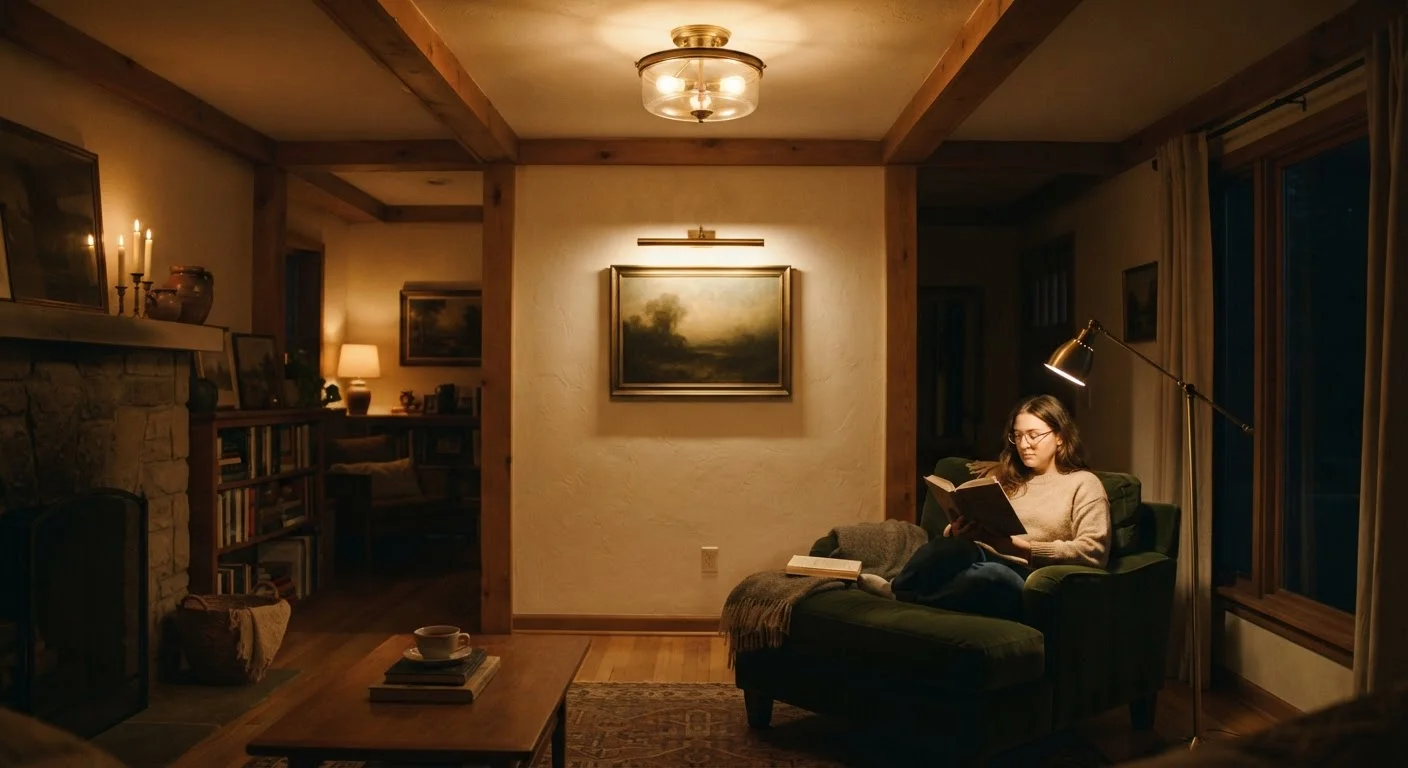
Ambient, task, and accent lighting each play a different role. Understanding how they interact is one of the fastest ways to improve a room.
Key takeaways
- Most rooms need three types of lighting: ambient, task, and accent.
- Overhead fixtures alone create flat, harsh light that undermines even well-decorated rooms.
- Dimmers are one of the highest-impact, lowest-cost upgrades in any lighting plan.
- Accent lighting draws attention to what you want seen — and away from what you don't.
- Lighting decisions work best when made alongside paint and furniture choices, not after.
Why Lighting Is the Last Decision That Should Come Last
Most people decorate in a predictable order: paint first, furniture next, rugs and accessories after that — and then, at the very end, they figure out the lights. It's an understandable sequence, but it's also why so many well-furnished rooms feel flat or uncomfortable once the sun goes down.
Lighting isn't a finishing touch. It's the layer that determines how everything else looks. The paint color you spent weeks selecting will shift dramatically depending on bulb temperature. The texture of a linen sofa disappears under flat overhead light. The art you hung with care becomes invisible without something directing attention toward it.
Understanding how lighting layers work — and why each one matters — is one of the most practical upgrades available to any decorator, regardless of budget or skill level. It's also one of the few design tools that changes how a space feels as well as how it looks. For a broader grounding in decorating decisions, see our guide for beginners.
The Three Layers and What Each One Does
Ambient lighting is the base layer — the general illumination that lets you see and move safely through a room. It's usually delivered by ceiling fixtures, recessed lights, or flush-mount fittings. On its own, ambient light tends to be flat and even, which sounds useful but actually eliminates the shadows and variation that give a room visual dimension.
Task lighting is focused and functional. It's the light you direct at a workspace, a reading chair, a kitchen counter, or a bathroom mirror. Task lighting exists to reduce eye strain and support specific activities. A pendant over a kitchen island, a desk lamp, or a swing-arm wall sconce beside a bed are all task lights — they serve a clear purpose rather than illuminating the whole room.
Accent lighting is the layer most people skip, and it's the one that often makes the biggest visual difference. It draws attention to specific objects or surfaces: a painting, an architectural feature, a textured wall, a collection on a shelf. Picture lights, directional spotlights, and LED strip lights inside cabinets all function as accent lighting. Their job is to create focal points and to add the visual depth that ambient light strips away.
Start with Lamps Before Rewiring Anything
You don't need to move fixtures or hire an electrician to begin layering light. Portable floor lamps and table lamps are the fastest way to test how additional light sources change a room's feel. Position one at seated eye level in a corner and observe how the room changes — then decide whether a permanent fixture makes sense.
Think of the three layers as a conversation: ambient sets the volume, task focuses the message, and accent adds the emphasis. Rooms where all three work together feel considered and alive. Rooms that rely on one layer feel either harsh or dim.
The Role of Dimmers and Bulb Temperature
Even a perfectly conceived three-layer plan will underperform if you can't adjust the output. Dimmers are arguably the single most valuable lighting investment in any room — they allow each layer to be tuned independently depending on time of day, activity, or mood. A dining room at full ambient brightness for a dinner party should feel entirely different at 40% brightness for a quiet evening, even with the same fixtures in place.
Bulb temperature — measured in Kelvin (K) — has an equally significant effect. Bulbs in the 2700K–3000K range produce warm, yellowish light that suits living rooms and bedrooms. Bulbs in the 3500K–4000K range produce a neutral to cool white that works well in kitchens and home offices. Daylight bulbs at 5000K and above are accurate and bright but tend to feel clinical in residential spaces.
This matters because bulb temperature interacts directly with paint color. As noted in our article on paint sheen and light, the way a surface reflects light is shaped not just by its finish but by the quality of light hitting it. Warm bulbs deepen warm tones and can muddy cool ones. Testing bulbs before committing to a large purchase is a practical step many decorators overlook.
Applying the Framework Room by Room
Lighting needs differ by room — not just in quantity but in which layers deserve emphasis.
In a living room, flexibility is the priority. Multiple ambient sources (rather than one overhead fixture) prevent harshness; floor lamps and table lamps at seated eye level are especially effective. A statement pendant or chandelier can serve as both ambient and visual anchor. Accent lighting — a picture light, a lit shelf, an uplighter behind a large plant — adds the warmth that makes a room feel lived in.
In a kitchen, task lighting is critical. Under-cabinet lighting illuminates countertops where overhead fixtures create shadows from the cook's own body. Pendant lights over an island add a task layer with a design element built in. Accent lighting inside glass-fronted cabinetry provides both function and visual interest.
In a bedroom, the goal shifts toward calm. Overhead lighting should be dimmable or avoided as a primary source after dark. Bedside lamps or wall sconces serve as task lights for reading. A small lamp on a dresser or a lit alcove creates the kind of accent layer that transforms a bedroom from utilitarian to restful.
Lighting is also a meaningful tool in compact spaces. Decorating small rooms effectively involves using uplighting to raise perceived ceiling height and avoiding single-source overhead fixtures that emphasize every constraint.
How Lighting Interacts with Color, Texture, and Materials
Lighting doesn't operate in isolation — it's in constant dialogue with every other surface in the room. This is especially clear with color. Paint choices shape mood in part because color is never seen independently of the light that falls on it. A deep navy wall under warm accent lighting reads as rich and intimate; under cool overhead light it can look flat and uninviting.
Texture responds to lighting in similarly dramatic ways. Raking light — light that hits a surface from an angle rather than head-on — throws texture into relief and makes it visible. Texture does significant work in neutral rooms, but only if the lighting allows it to be seen. A linen wall treatment, a plaster finish, or a woven rug all flatten under direct overhead light and come alive under a floor lamp positioned to the side.
Materials matter too. Matte surfaces absorb light and feel soft; glossy ones bounce it and add brightness. This makes bulb placement as important as bulb choice — a glossy backsplash lit from above behaves very differently from one lit from below or from the side.
The underlying principle: light is not a neutral delivery system for illumination. It is an active ingredient in how a room reads, and understanding it as such is what separates a decorated room from a designed one.
Frequently Asked Questions
All published content on this website is for informational and educational purposes only and should not be taken as professional advice. We recommend that readers seek expert opinion before making any decisions. The website is not responsible for any actions taken based on the information provided on this website. We are not liable for any inaccuracies, modifications, or omissions in information. Moreover, external links or third-party content are provided for convenience; we are not liable for their correctness. Users are advised to verify every piece of information before they use it for any purpose.