
The Full Landscape of Fiber Arts: Knitting, Crochet, Weaving, and Beyond

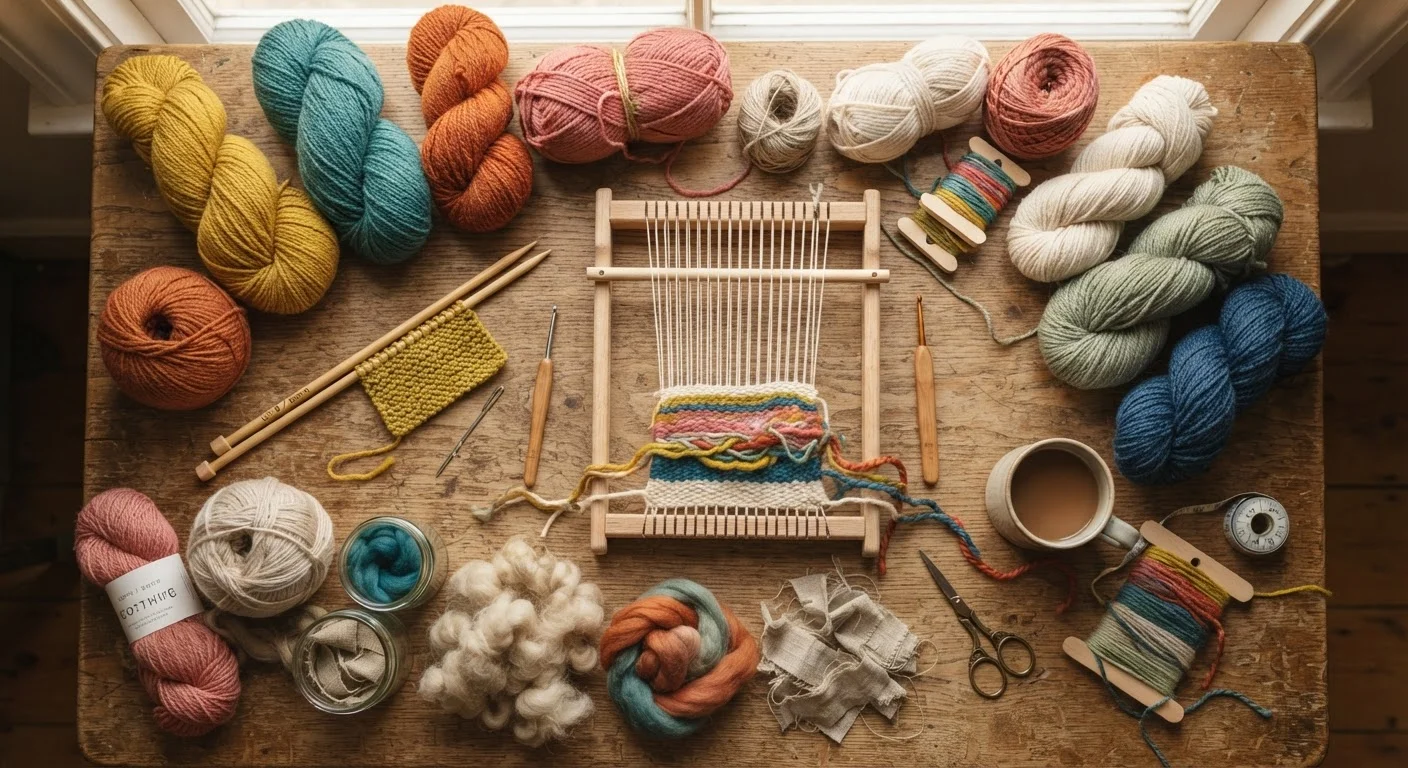
Fiber arts span a surprisingly wide range of techniques and traditions. This guide maps out the major forms and what distinguishes each from the others.
Key takeaways
- Fiber arts include a wide family of techniques — knitting, crochet, weaving, embroidery, macramé, and spinning, among others.
- Knitting and crochet are both yarn-based but use distinct tools and produce structurally different fabrics.
- Weaving is one of the oldest textile methods and ranges from simple frame looms to complex floor-loom setups.
- Most fiber arts are highly portable and adaptable across life stages, making them unusually durable hobbies.
- Choosing a starting point often comes down to tactile preference, project goals, and available space or budget.
What Counts as a Fiber Art?
The term fiber arts covers any craft that uses natural or synthetic fiber — yarn, thread, roving, cord, fabric — as its primary material. It's a broad umbrella that spans ancient textile traditions and contemporary studio practices alike. What unites them is the act of manipulating fiber into something useful, decorative, or expressive.
The category is notably diverse. A hand-knitted sweater, a woven wall hanging, a cross-stitched sampler, a macramé plant holder, and a hand-spun skein of wool all qualify. That breadth can feel overwhelming at first, but it also means there's almost certainly a fiber art that matches your temperament, lifestyle, and available space. Think of this guide as a map of the territory — not a buying guide, but an orientation.
If you're drawn to making things with your hands more broadly, it's worth knowing how fiber arts compare to other craft disciplines. Exploring hands-on hobbies like pottery or woodworking offers a useful parallel look at the costs, space needs, and learning curves across very different craft paths.
Knitting: Structure Built from Loops
Knitting constructs fabric by pulling loops of yarn through other loops using two or more needles. The result is a stretchy, flexible textile well-suited to garments — sweaters, socks, hats, and scarves are knitting's signature territory. The fabric's elasticity comes directly from its looped structure; pull on it gently and it bounces back.
Beginners typically start with two straight needles and a simple stitch pattern. From there, the skill tree branches considerably: circular needles for seamless construction, double-pointed needles for small circumferences like sock cuffs, colorwork techniques like Fair Isle and intarsia, and lace patterns that use deliberate yarn-overs to create openwork designs.
Knitting rewards patience and has a relatively steep initial learning curve — holding two needles while managing tension and yarn take some physical coordination. That said, the motion becomes almost meditative once the basics click. Many knitters describe long-haul projects as a kind of moving mindfulness practice.
When starting knitting, cast on more stitches than your project requires and practice on a swatch first — this lets you establish consistent tension before committing to real work.
Tension inconsistency is the most common beginner frustration in knitting; swatching separates practice from project and builds the muscle memory that determines finished-fabric quality.
In crochet, count your stitches at the end of every row until the stitch count becomes automatic — accidental increases and decreases are nearly invisible until several rows later.
Catching count errors early prevents the need to rip back large sections of work, which is the primary source of early-learner discouragement in crochet.
If you're drawn to weaving but unsure about commitment, start with a rigid heddle loom — it produces real, usable cloth and teaches foundational concepts without requiring significant space or expense.
A rigid heddle loom bridges the gap between cardboard-loom exercises and full floor-loom practice, giving beginners a genuine sense of the craft before scaling up.
Crochet: One Hook, Endless Possibilities
Crochet also uses yarn but works with a single hook rather than two needles. Instead of interlocking loops across an active row, crochet builds each stitch to completion before moving to the next. This produces a denser, more structured fabric — excellent for home goods like dishcloths, baskets, and blankets, and increasingly popular for garments with a relaxed drape.
Most practitioners find crochet slightly faster to learn than knitting, partly because there's only one tool to manage and mistakes are easier to spot and fix — you simply rip back to the error without losing stitches off a needle. The vocabulary of crochet stitches (single, half-double, double, treble) sounds technical but follows a logical size progression that becomes intuitive quickly.
Crochet also excels at three-dimensional construction. Amigurumi — small stuffed toys crocheted in the round — has become a massive global phenomenon. Granny squares, a time-honored modular unit, are enjoying renewed creative attention as makers use them to build patchwork garments and accessories with a distinctly handmade aesthetic.
Weaving: The Ancient Interlace
Weaving interlaces two sets of threads — the warp (vertical, held under tension on a loom) and the weft (horizontal, passed over and under the warp) — to create cloth. Unlike knitting or crochet, woven fabric doesn't stretch significantly; its structure is rigid and stable, which makes it ideal for household textiles, wall art, and sturdy accessories.
Entry points range from a simple cardboard or rigid heddle loom — compact, affordable, and beginner-friendly — to large floor looms that require dedicated studio space and represent a more serious investment of both money and learning time. Tapestry weaving, inkle weaving (for narrow bands and straps), and tablet weaving (for complex patterned ribbons) are all distinct sub-disciplines within the broader practice.
Weaving has deep roots across virtually every culture on Earth, and that heritage lends the craft a richness that many practitioners find motivating. Contemporary weavers often draw on both historical pattern traditions and modern abstract design sensibilities.
Beyond the Big Three: Embroidery, Macramé, Spinning, and More
The fiber arts landscape extends well past knitting, crochet, and weaving. Here's a concise overview of other significant forms:
- Embroidery — Stitching decorative thread onto a fabric base. Sub-forms include cross-stitch, crewelwork (wool on linen), and the freehand surface embroidery popularized on social media for its painterly quality. Minimal equipment needed: fabric, a hoop, needles, and floss.
- Macramé — Knotting cord (often cotton or jute) into decorative objects: wall hangings, plant hangers, and jewelry. It uses no needles or hooks — just fingers and knots. Macramé has seen significant cultural revival since the 2010s and is notably beginner-accessible.
- Spinning — Drafting raw fiber (wool, alpaca, flax) and twisting it into yarn using a drop spindle or spinning wheel. Spinners often pair this with dyeing to create entirely custom yarn for other projects. It's a craft that connects makers directly to the material origins of textile work.
- Felting — Using moisture and agitation (wet felting) or barbed needles (needle felting) to mat wool fibers into a dense, non-woven fabric. Excellent for sculptural work, accessories, and decorative panels.
- Tatting and bobbin lace — Fine thread-based techniques for creating intricate lace fabric. Both have steeper learning curves but devoted communities that offer instruction and pattern archives.
Fiber arts are among the most adaptable leisure pursuits available — low-impact, portable, and scalable to any life stage. Hobbies that hold up across decades explores why crafts like these remain meaningful through changing energy levels and circumstances.
Choosing Your Starting Point
With so many forms available, how do you pick one? A few practical questions help narrow the field:
- How portable do you need your craft to be?
- Embroidery, crochet, and knitting travel beautifully — just a small bag of supplies. Weaving on a floor loom does not. Macramé sits in between, depending on project scale.
- Do you prefer working toward a functional or decorative outcome?
- Knitting and crochet lean functional (garments, accessories). Weaving and embroidery straddle both. Macramé and needle felting often skew decorative.
- How much startup investment are you comfortable with?
- Embroidery, macramé, and needle felting have the lowest entry costs. A rigid heddle loom is a moderate investment. Floor looms and spinning wheels represent significant outlays.
Community matters, too. Whether you practice alone or alongside others shapes the experience considerably. Weighing a home studio against a community class is worth reading before you decide where and how to develop your practice — many fiber arts have thriving local guilds and online communities that dramatically accelerate learning.
The most important thing is to start somewhere. Most practitioners find that trying one fiber art sparks curiosity about the others — the crafts share a common vocabulary of texture, color, and material logic that makes moving between them surprisingly natural.
All published content on this website is for informational and educational purposes only and should not be taken as professional advice. We recommend that readers seek expert opinion before making any decisions. The website is not responsible for any actions taken based on the information provided on this website. We are not liable for any inaccuracies, modifications, or omissions in information. Moreover, external links or third-party content are provided for convenience; we are not liable for their correctness. Users are advised to verify every piece of information before they use it for any purpose.