
Leisure Pursuits That Hold Up Across Decades of Life

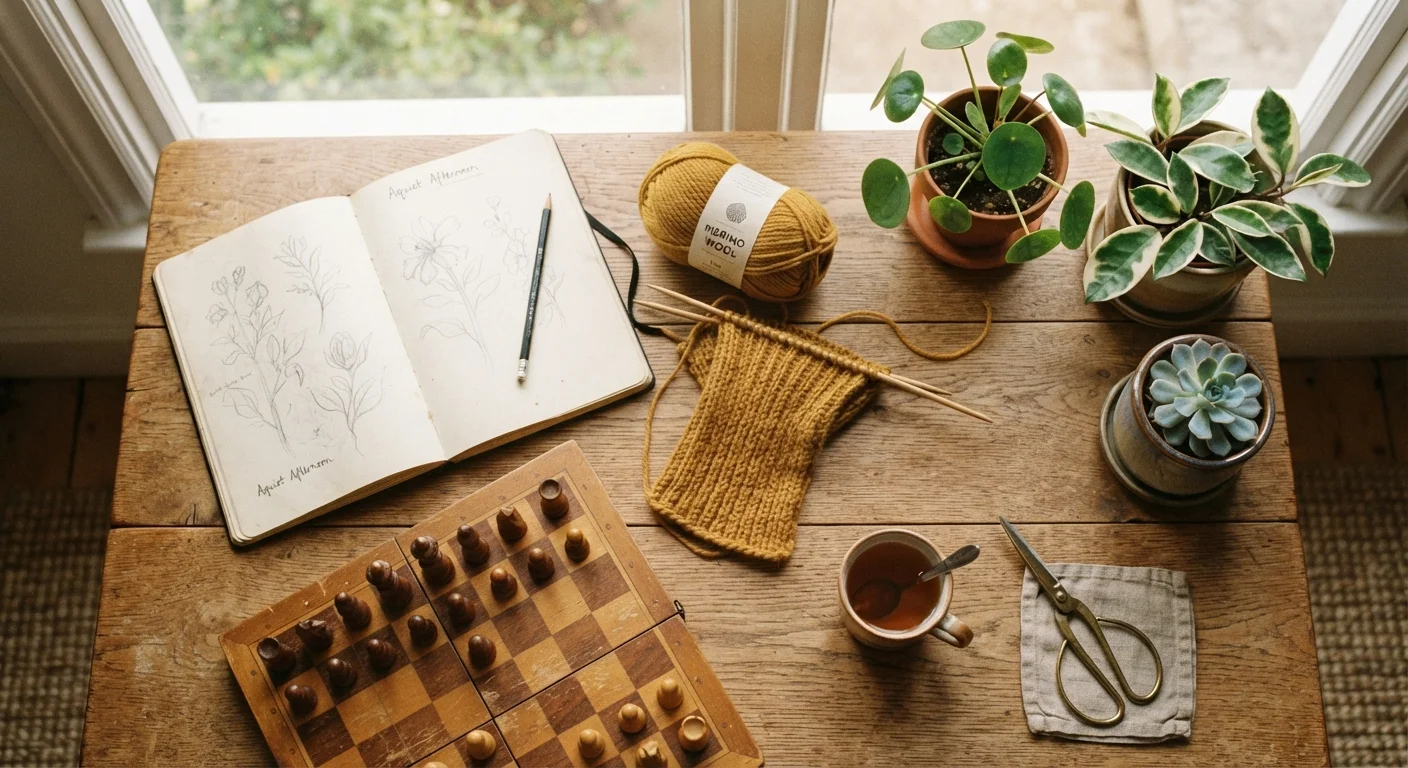
Some hobbies age beautifully with their practitioners. These pastimes are notably adaptable across changing energy levels, mobility, and life stages.
Key takeaways
- The most durable hobbies adapt to changing energy levels, mobility, and available time across life stages.
- Pursuits with gradual skill ladders keep practitioners engaged for decades without requiring peak physical ability.
- Combining solo and social dimensions makes a hobby more resilient to life transitions like retirement or relocation.
- Starting a lifelong hobby at any age is supported by evidence — it is rarely too late to begin.
- Low-cost-to-entry hobbies with rich depth tend to outlast gear-heavy or trend-dependent pastimes.
Why Some Hobbies Last a Lifetime
Most adults have, at some point, picked up a hobby with genuine enthusiasm only to watch it quietly fade within a year. The culprit is rarely laziness — it's usually a mismatch between the hobby's demands and the reality of a changing life. A high-intensity pursuit that felt exhilarating at 32 might feel punishing at 55, while a purely solitary pastime might lose its appeal after a move or a shift in social circumstances.
The leisure pursuits that hold up across decades share a few telling qualities: they offer depth that rewards years of practice, they can be scaled up or down in intensity, and they tend to weave naturally into both solitary and communal settings. If you've ever wondered whether the myths about starting too late are actually true, the short answer is no — research on adult learning consistently shows that meaningful skill acquisition continues well into later life.
Below are seven pastimes that have proven their staying power — not because they are easy or trendy, but because they grow with the person practicing them.
Drawing and Sketching
Drawing requires nothing more than a pencil and paper to begin, yet it can absorb a lifetime of study in proportion, light, composition, and personal style. That simplicity of entry combined with near-infinite depth makes it one of the most resilient hobbies known to adult practitioners. You can sketch at a kitchen table in your twenties, carry a small sketchbook through a busy career, and return to longer sessions in retirement without losing the thread.
Physical demands are minimal, meaning the hobby doesn't require adapting significantly as mobility changes. Artists working well into their eighties and nineties have documented that the act of close observation — really looking at the world before committing it to paper — sharpens rather than diminishes with age and experience.
Drawing can be picked up with a single pencil and carried, without interruption, through every decade of adult life.
Gardening
Few hobbies connect a practitioner so directly to the rhythms of time and season. Gardening evolves naturally alongside the gardener: raised beds and container growing make it accessible for those with limited mobility, while the intellectual side — soil science, companion planting, seed saving — expands indefinitely for those who want it. The hobby is equally viable on a balcony or a half-acre plot.
Beyond the physical benefits (gentle movement, fresh air, exposure to nature), there's a growing body of research associating regular gardening with lower stress and improved mood. It also produces something tangible — food, flowers, habitat for wildlife — which gives it a grounding purpose that purely skill-based hobbies sometimes lack.
Gardening scales from a single pot on a windowsill to a full kitchen garden, adapting as naturally as the gardener does.
Playing a Musical Instrument
Music is one of the few pursuits where regular practice produces demonstrably measurable changes in the brain across the entire lifespan. Learning an instrument as an adult — or returning to one set aside in childhood — can support cognitive engagement, fine motor coordination, and emotional expression simultaneously. The social dimension is also rich: community orchestras, folk sessions, jazz jams, and choral groups exist in nearly every city and town in America.
Instrument choice matters for longevity. Some instruments become physically easier to play as technique matures; others can be adapted for changing hand or lung capacity. The point isn't to perform at a conservatory level — it's the ongoing dialogue between the player and the music that sustains the pursuit across decades.
Music offers one of the richest combinations of cognitive, physical, and social engagement of any leisure pursuit.
Fiber Arts (Knitting, Crochet, Weaving)
Fiber arts have experienced a genuine cultural renaissance in recent years, attracting younger practitioners while retaining the deep knowledge base of longtime crafters. Knitting and crochet are portable, inexpensive to begin, and offer a meditative quality that many practitioners describe as actively calming — a combination that's hard to replicate on a screen. For a broader sense of what this world encompasses, the full landscape of fiber arts maps out the major techniques worth knowing.
The community dimension is strong: knitting circles, yarn festivals, and online fiber communities create social connections that outlast any individual project. As a practitioner's eyesight or fine motor ability changes, the hobby can shift toward chunkier yarns and larger needles, or toward weaving and tapestry work, which require less precise hand movement.
Fiber arts combine portability, meditative calm, and vibrant community in a package that adapts gracefully with age.
Chess and Strategy Games
Chess has been a leisure staple across cultures and centuries for good reason: it offers genuine intellectual challenge at any skill level, requires no physical ability, costs almost nothing to play, and connects practitioners to a global community of players. The rise of online play has made finding opponents of any level trivially easy, while local clubs and library programs keep the in-person tradition alive.
Other strategy games — Go, bridge, and backgammon among them — offer similar qualities. The cognitive engagement these games demand is often cited by researchers studying active aging, though it's worth noting that no single activity has been proven to prevent cognitive decline. What these games undeniably offer is sustained mental engagement and a reason to keep showing up, week after week, for decades.
Chess and similar strategy games require no physical ability, cost almost nothing, and scale to any skill level for life.
Writing (Journaling, Essays, Fiction)
Writing is perhaps the most flexible of all creative hobbies because it requires so little infrastructure. A notebook and a quiet hour are enough to begin. Unlike performance arts, it carries no audience pressure unless the writer chooses; unlike visual arts, it needs no studio space. It can be as private as a personal journal or as public as a community writing group — and it shifts easily between those modes across different life phases.
The hobby also deepens in a particular way with age. Life experience genuinely enriches writing; practitioners often describe their sixties and seventies as their most productive and personally meaningful creative periods. Writing connects well with healthy mental habits, with regular reflective writing associated in research literature with improved emotional processing and self-awareness.
Writing deepens with lived experience, making it one of the rare hobbies that genuinely improves as its practitioner ages.
Bird-Watching and Nature Study
Bird-watching requires minimal equipment to begin — a basic pair of binoculars and a regional field guide are enough — but it rewards decades of patient attention with an ever-expanding world of species, habitats, and seasonal patterns. It can be practiced from a back porch, a city park, or the remote wilderness, making it one of the most geographically adaptable hobbies on this list.
The hobby also has a strong social dimension: local Audubon chapters, Christmas bird counts, and community science programs give practitioners a reason to gather year-round. As mobility changes, the hobby scales smoothly from active field hiking to feeder-watching from a comfortable chair — and the depth of accumulated knowledge only makes those quieter sessions richer.
Bird-watching adapts from active field trips to feeder-watching from an armchair, losing none of its depth along the way.
Building a Leisure Life That Lasts
What makes these pursuits genuinely durable isn't any single quality — it's their layered nature. Each has a low enough floor to welcome beginners and a high enough ceiling to reward decades of dedication. That combination is rarer than it sounds. As sustaining long-term hobby momentum requires, the key is building practices that survive the inevitable slow patches — life changes, loss of motivation, shifting schedules.
It's also worth thinking about how your leisure time is distributed between time alone and time with others. Research suggests both have distinct value, and solo versus social hobbies shape well-being differently. The wisest approach may be building a portfolio: one pursuit that anchors you in quiet, focused solitude, and one that keeps you connected to a community of fellow practitioners.
If you're just getting started or returning after a long gap, resist the urge to overcommit. A single well-chosen hobby practiced consistently tends to be far more satisfying than three half-started ones. And if you're drawn to the tactile and handmade, the quiet comeback of analog hobbies offers plenty of compelling starting points beyond anything that requires a screen or a subscription.
Start Narrow, Then Expand
When choosing a lifelong hobby, resist the temptation to sample widely before committing. Picking one pursuit and giving it a genuine six-month trial tends to build more lasting momentum than rotating through several at once. Depth of engagement — not breadth of exposure — is what transforms a passing interest into a durable part of your identity. Once you're grounded in one practice, adding complementary pursuits becomes much easier.
All published content on this website is for informational and educational purposes only and should not be taken as professional advice. We recommend that readers seek expert opinion before making any decisions. The website is not responsible for any actions taken based on the information provided on this website. We are not liable for any inaccuracies, modifications, or omissions in information. Moreover, external links or third-party content are provided for convenience; we are not liable for their correctness. Users are advised to verify every piece of information before they use it for any purpose.