
Home Studio vs. Community Class: Where Creative Hobbies Thrive

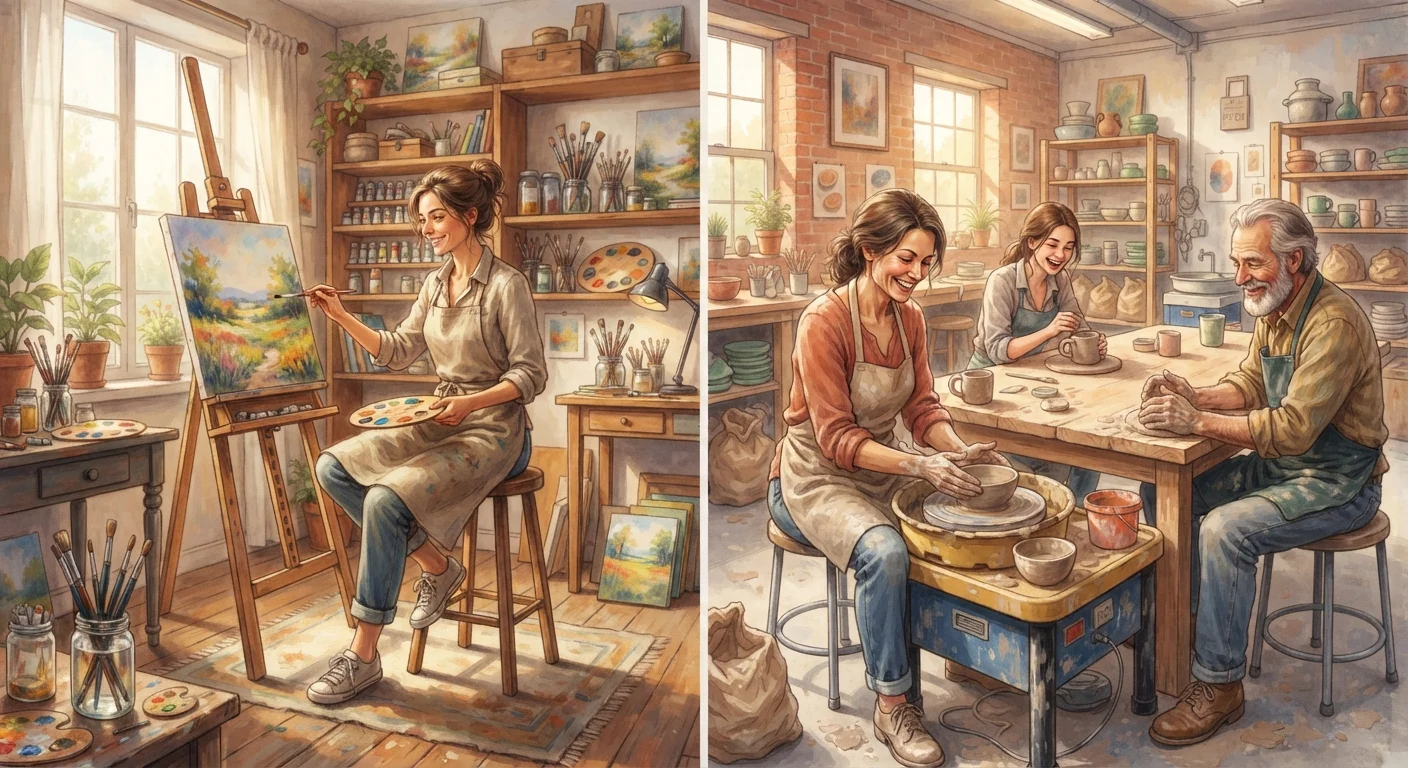
Practicing a craft at home and attending a class produce very different experiences. Here's how to weigh the trade-offs for your hobby and lifestyle.
Option A
Home Studio Practice
The self-directed, schedule-free creative sanctuary.
Best for: Adults who want maximum flexibility and a deeply personal creative space without leaving home.
Option B
Community Class
The structured, socially energized learning environment.
Best for: Those who thrive on guided instruction, peer energy, and built-in accountability to keep showing up.
Key takeaways
- Home studios offer unmatched flexibility but require strong self-motivation to sustain momentum.
- Community classes provide structured instruction and social connection that can accelerate skill development.
- Cost structures differ significantly — upfront gear investment at home vs. recurring class fees.
- Neither setting is universally superior; the best choice depends on your learning style and lifestyle.
- Many practitioners eventually blend both approaches to get the benefits of each.
The Core Tension: Freedom vs. Structure
Anyone who has pursued a creative hobby — whether painting, ceramics, knitting, woodworking, or something else entirely — eventually faces a practical question: do you build a practice at home, or do you seek out a class? On the surface it seems like a scheduling decision. In reality, it shapes the entire character of your creative life.
A home studio puts you in charge of everything: when you work, what you work on, how long you stay with a single idea before moving on. That freedom is genuinely valuable. It's also the thing that trips people up most. Without external structure, many well-intentioned hobbyists find their supplies gathering dust. As explored in strategies for sustaining hobby momentum, the absence of built-in accountability is one of the most common reasons creative pursuits quietly fade.
Community classes flip that dynamic. A weekly class on the calendar, an instructor expecting your presence, peers whose progress you can see — these create a kind of productive pressure that's surprisingly hard to replicate alone. The trade-off is less personal control over pace and direction. Understanding which trade-off you can live with is the real starting point.
What Each Setting Actually Costs
Cost comparisons between home practice and community classes are genuinely tricky because the numbers depend heavily on the craft. For fiber arts like knitting or crochet — explore the full range in this guide to fiber arts — starting at home requires minimal upfront investment. Pottery, printmaking, or stained glass are different stories: the equipment is expensive and often industrial-scale, making a community studio or class dramatically more economical for most people.
| Criterion | Home Studio | Community Class |
|---|---|---|
| Schedule flexibility | Complete — practice anytime | Fixed class times required |
| Upfront cost | Higher (equipment purchase) | Lower (fees spread over time) |
| Ongoing cost | Mainly consumables | Recurring tuition or membership |
| Instruction quality | Self-directed; tutorials online | Real-time expert feedback |
| Social connection | Minimal unless sought out | Built-in peer community |
| Equipment access | Limited to what you own | Access to studio-grade tools |
| Accountability | Self-generated only | External structure provided |
| Creative freedom | Unlimited personal direction | Shaped by class curriculum |
The home studio cost equation also shifts over time. A significant upfront investment in materials and tools may look expensive initially but often becomes cost-efficient as months accumulate — particularly compared with weekly or monthly class fees. Community classes, meanwhile, frequently bundle costs you'd otherwise pay separately: instruction, equipment access, and sometimes materials.
One underappreciated middle path: many community arts centers offer open studio time at lower rates than structured classes, giving you access to professional equipment without the full class price tag.
Learning Curves and Skill Development
Self-teaching through books, online tutorials, and simple trial and error is more viable than ever, and plenty of skilled practitioners have built impressive abilities entirely at home. But there's a meaningful gap between following a tutorial and receiving corrective feedback from someone watching you work in real time. An instructor who notices that you're holding a brush at an angle that limits your range of motion — or that your loom tension is inconsistent before it becomes a pattern — can save weeks of frustration.
This dynamic matters most in the early stages. Beginners who start in a structured class often build cleaner foundational technique than those who self-teach, simply because bad habits get addressed before they're ingrained. Once you have a working foundation, the balance shifts: home practice becomes a space to experiment and develop your own aesthetic voice, rather than learning to execute someone else's.
It's worth noting that the social dimension of learning has real cognitive benefits. Research on solo versus social leisure suggests that collaborative creative environments can sharpen focus and increase intrinsic motivation — factors that directly influence how quickly skills develop.
Your Space, Your Rules — But Space Matters
A dedicated home studio — even a modest corner of a room — does something subtle but significant: it signals to your brain that creative work happens here. That psychological cue matters more than most people expect. If your craft supplies live in a closet and require 20 minutes of setup before you can start, the activation energy needed to begin a session quietly discourages spontaneous practice.
Designing even a small, functional creative space at home can meaningfully change your relationship with a hobby. Ideas for personalizing your home's spaces can help even renters or those with limited square footage carve out something purposeful. The goal isn't a picture-perfect studio — it's a space with minimal friction between the impulse to create and actually creating.
Community classes sidestep the space problem entirely. The studio is already set up, equipped, and cleaned between sessions. For crafts that generate significant mess, smell, or noise — like oil painting, metalwork, or drum-making — this is a non-trivial advantage that home practitioners often underestimate until they're dealing with ventilation issues or noise complaints.
The Middle Ground: Community Studio Memberships
Many cities have maker spaces, ceramic studios, and arts centers that offer membership-based open studio access — separate from formal classes. These arrangements let you use professional equipment on your own schedule, often at a monthly rate. It's worth checking what's available locally before committing to either a full home setup or a structured class program, as a membership might give you the best elements of both.
Blending Both: The Approach Most Long-Term Hobbyists Land On
Ask someone who has maintained a creative practice for five or more years how they do it, and a hybrid answer appears with notable frequency. They might take a class when they want to push into new territory — a different medium, an advanced technique, an unfamiliar tradition — and then retreat to home practice to integrate what they've learned at their own pace.
This rhythm maps well onto how skill development actually works. Concentrated instruction is most valuable when you're stretching your abilities. Independent practice is most valuable when you're consolidating and personalizing. The two modes aren't competitors; they're different phases of the same creative arc.
If you're deciding where to begin, your honest answer to one question usually points the way: do you have enough internal motivation to show up for yourself without external structure? If yes, home practice may be your natural habitat. If no — and that's a perfectly honest answer — a community class gives you the scaffold to build that habit before striking out on your own. Some of the most enduring hobbies are the ones practiced in whatever setting allows you to keep returning to them, year after year.
All published content on this website is for informational and educational purposes only and should not be taken as professional advice. We recommend that readers seek expert opinion before making any decisions. The website is not responsible for any actions taken based on the information provided on this website. We are not liable for any inaccuracies, modifications, or omissions in information. Moreover, external links or third-party content are provided for convenience; we are not liable for their correctness. Users are advised to verify every piece of information before they use it for any purpose.