
Pottery, Woodworking, or Leathercraft: Choosing a Hands-On Hobby That Sticks

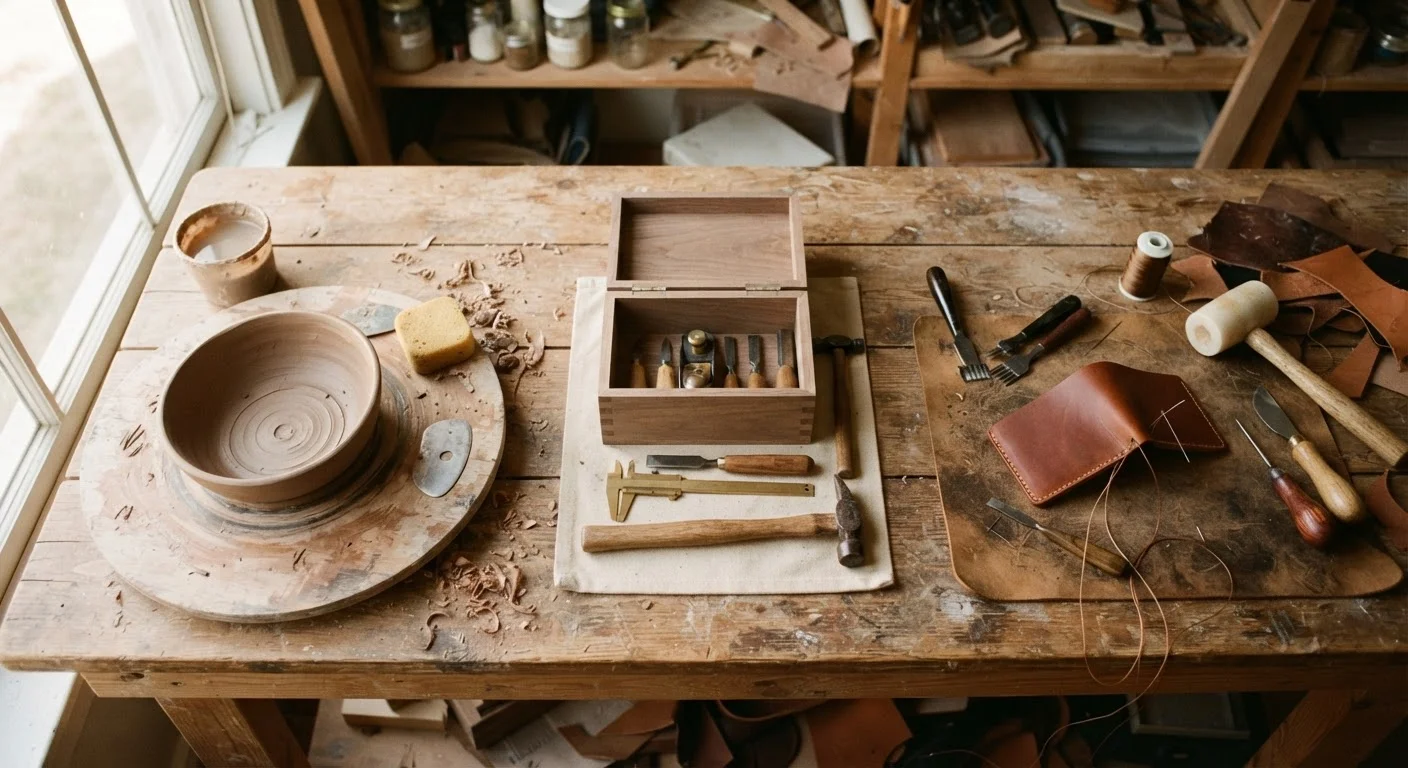
Not all craft hobbies suit the same personality or lifestyle. Weigh the costs, space needs, and learning curves before committing to one.
Our Verdict
Pottery, woodworking, and leathercraft each reward patience and practice, but they suit different personalities, living situations, and budgets. No single craft is objectively superior — the one that fits your actual life is the one most likely to stick.
| Best for | Recommended |
|---|---|
| Those drawn to tactile, meditative making with expressive results | Pottery |
| Those who want to build functional objects that last generations | Woodworking |
| Those with limited space who want immediate, portable results | Leathercraft |
| Those uncertain which craft to try first | A community class in any of the three |
Key takeaways
- Pottery, woodworking, and leathercraft each demand different space, startup costs, and physical effort.
- Your living situation and available workspace are often the most practical deciding factors.
- Leathercraft has the lowest barrier to entry; woodworking produces the most durable finished objects.
- All three crafts offer genuine meditative focus, but through very different sensory experiences.
- Community classes can significantly reduce startup costs and accelerate early skill development.
Why These Three Crafts Deserve Serious Consideration
In a leisure landscape dominated by screens, hands-on crafts offer something genuinely different: physical engagement, tangible results, and the particular satisfaction of making something that didn't exist before you touched it. Pottery, woodworking, and leathercraft are three of the most enduring maker hobbies in American culture — each with a rich tradition, an active community, and a clear learning path for newcomers.
But they are not interchangeable. The person who thrives at a pottery wheel might find a woodshop overwhelming. The leatherworker who loves precise hand-stitching might find clay's formlessness frustrating. Choosing well from the start matters — not because you can't pivot later, but because the right fit dramatically improves your odds of sticking with it. For a broader look at how leisure choices affect your overall well-being, see our piece on how solo and social hobbies shape well-being differently.
Breaking Down Each Craft: Space, Cost, and Learning Curve
Before you invest in a single tool or class, it pays to understand the practical footprint of each craft.
Pottery
Wheel-throwing pottery requires either studio access or a dedicated home setup that includes a wheel, a kiln, and clay storage — a combination that is both spatially demanding and expensive to assemble independently. A quality beginner's wheel alone can run several hundred dollars, and kilns are a significant additional investment. For most beginners, community studio memberships or adult education classes are the practical entry point, and they happen to be excellent ones. Hand-building techniques (coil, slab, pinch) require far fewer tools and can be practiced on a kitchen table, though you'll still need kiln access for firing. The learning curve is real: centering clay on a wheel is notoriously humbling for new practitioners.
Woodworking
Woodworking has a wide spectrum — from simple hand-tool joinery requiring only a workbench and a few chisels, to fully equipped power-tool shops. Hand-tool woodworking is having a genuine renaissance, partly because it's quieter, less dusty, and more apartment-friendly than its power-tool counterpart. Either path demands respect for safety: sharp tools and power equipment require focused attention and proper technique. The payoff is durability — well-made wooden objects routinely outlast their makers. Budget-wise, a solid starter hand-tool set is achievable for under $200, though quality tools are worth prioritizing over quantity.
Leathercraft
Of the three, leathercraft has arguably the lowest barrier to entry. A beginner's starter kit — swivel knife, stitching chisels, mallet, needles, thread, and a small piece of vegetable-tanned leather — can be assembled for a modest sum, and the workspace required is little more than a sturdy table. Projects like wallets, key fobs, and small pouches are achievable in early sessions, which delivers the motivating satisfaction of finished objects quickly. The craft scales gracefully: advanced leatherworkers develop skills in carving, dyeing, and complex pattern-making that take years to master.
| Pottery | Woodworking | Leathercraft | |
|---|---|---|---|
| Startup cost (home setup) | High (wheel + kiln) | Moderate to high | Low to moderate |
| Space required | Significant (or studio access) | Moderate to large | Small — table-top only |
| Initial learning curve | Steep (especially wheel) | Moderate | Gentle to moderate |
| Speed to first finished object | Days (with firing time) | Hours to days | Same session possible |
| Community / class availability | Widely available | Commonly available | Growing, but patchier |
| Durability of finished work | High (ceramic) | Very high (wood) | High (leather) |
| Portability of practice | Low | Low to moderate | High |
The Sensory and Creative Experience of Each
Practical logistics matter, but so does the felt experience of actually doing the craft. These three hobbies engage the hands — and the mind — in meaningfully different ways.
Pottery is arguably the most sensory-immersive of the three. Working wet clay demands full physical attention; you feel the material respond (or resist) in real time. Many practitioners describe a near-meditative state at the wheel, where the repetitive motion and tactile feedback quiet mental chatter. The results are also inherently variable — two identical throws will never be perfectly alike — which suits people who enjoy organic, expressive outcomes.
Woodworking tends to reward methodical thinkers. Good joinery requires precise measurement, patient fitting, and a willingness to work through problems systematically. The sensory pleasures are real — the smell of fresh-cut wood, the feel of a hand plane moving with the grain — but the craft rewards planning as much as intuition. People who enjoy puzzles and problem-solving often find woodworking deeply satisfying.
Leathercraft sits between the two in terms of structure. Patterns and measurements matter, but the craft also involves decorative choices — tooling designs, dye colors, thread selection — that allow considerable personal expression. The hand-stitching process, in particular, is rhythmic and calming in a way that many practitioners find addictive. If you're drawn to objects with a vintage or artisanal quality, leather's natural aging and patina add an extra layer of long-term satisfaction.
If you're weighing whether any hands-on craft will hold your interest over the years, it's worth reading about leisure pursuits that hold up across decades of life.
Making the Choice — and Making It Last
The most useful question isn't "which craft is best?" but "which craft fits my actual life right now?" Consider your living space honestly. A studio apartment is a realistic leathercraft studio and a workable hand-tool woodworking space, but it's a poor fit for a pottery wheel setup without external studio access. Consider your schedule: pottery studios often have set open hours, while leathercraft and hand-tool woodworking can happen in 30-minute windows at home.
Cost matters too, but it's easy to overstate the barrier. All three crafts can be explored inexpensively through community classes before any significant personal investment — and that's genuinely the recommended approach for most beginners. Trying a six-week pottery course before buying a wheel, or attending a leathercraft workshop before assembling a full kit, gives you real information that no amount of online research can replace. For more on the home-versus-class decision, see our guide on where creative hobbies thrive — home studio or community class.
Finally, the craft you choose matters less than the habits you build around it. Consistent, low-pressure practice sessions beat sporadic bursts of intense effort for skill development and long-term enjoyment alike. If you want strategies for keeping momentum after the initial enthusiasm fades, our article on keeping a hobby from becoming a forgotten phase is worth a read. And if you're curious about other tactile, object-focused hobbies, bookbinding offers a surprisingly satisfying alternative with its own distinct pleasures.
All published content on this website is for informational and educational purposes only and should not be taken as professional advice. We recommend that readers seek expert opinion before making any decisions. The website is not responsible for any actions taken based on the information provided on this website. We are not liable for any inaccuracies, modifications, or omissions in information. Moreover, external links or third-party content are provided for convenience; we are not liable for their correctness. Users are advised to verify every piece of information before they use it for any purpose.