
Solo Leisure vs. Social Hobbies: How Each Shapes Your Well-Being Differently

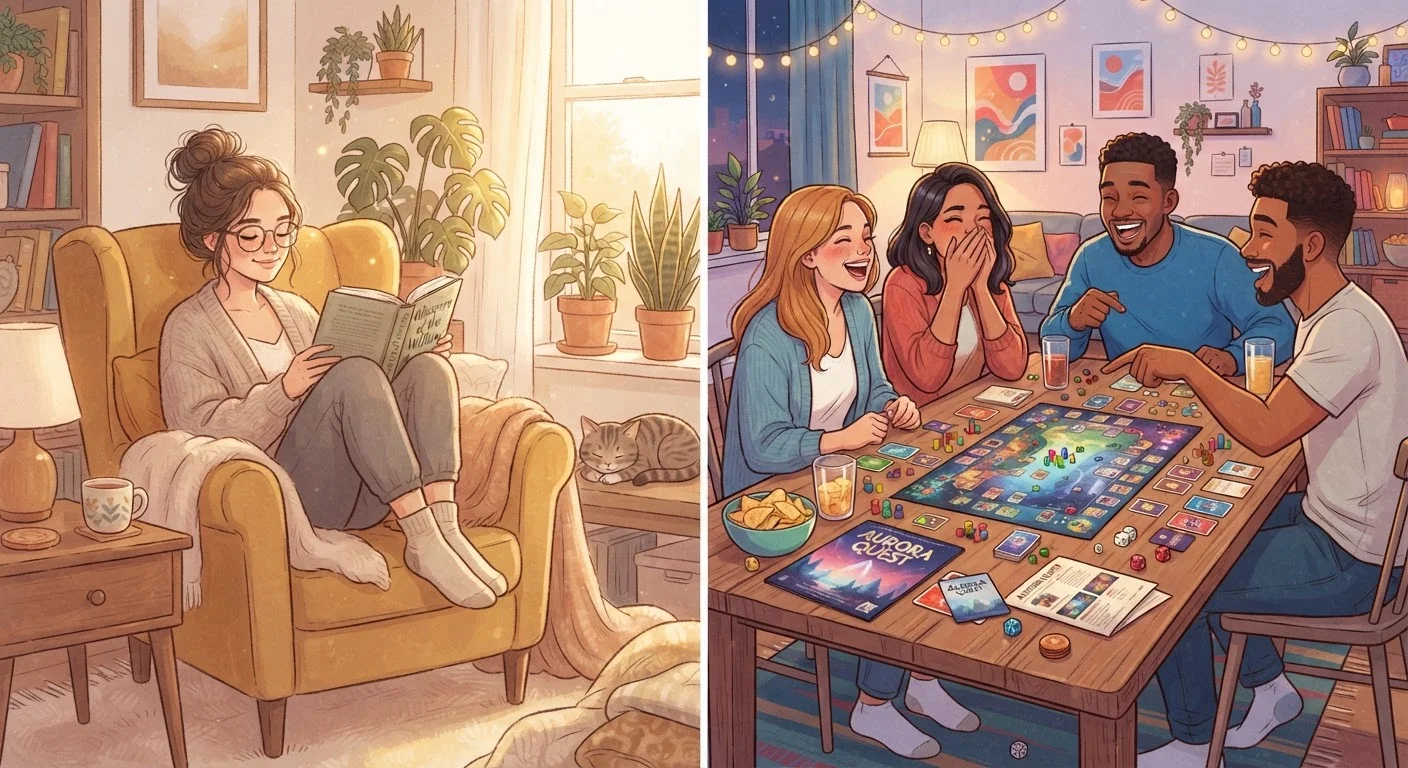
Spending free time alone or with others produces distinct psychological benefits. Understanding the difference helps you build a more balanced leisure life.
Option A
Solo Leisure
The inward-looking path to restoration and self-knowledge.
Best for: Adults who need mental decompression, creative autonomy, or deep focus time away from social demands.
Option B
Social Hobbies
The outward-facing route to belonging, accountability, and shared joy.
Best for: People seeking community, motivational structure, and the emotional lift that comes from shared experience.
Key takeaways
- Solo leisure is strongly associated with psychological restoration, self-reflection, and creative depth.
- Social hobbies build community bonds and provide accountability that sustains long-term engagement.
- Research links regular social connection to measurable improvements in mood and longevity.
- Introversion and extroversion influence how people recharge, but neither group benefits from only one mode.
- The most well-rounded leisure life typically balances both solo and social pursuits across the week.
- Switching between modes — rather than defaulting to one — is associated with greater overall life satisfaction.
The Distinct Psychology of Being Alone vs. Being Together
Not all free time works the same way on the mind. Whether you're absorbed in a novel on a Sunday afternoon or deep into a pottery class with eight other students, your brain is doing meaningfully different things — and the downstream effects on your mood, identity, and resilience differ accordingly.
Psychologists have long studied what they call "restorative experiences" — time that genuinely replenishes mental and emotional resources rather than simply filling hours. Solo leisure tends to score well on what researchers describe as "being away" and "fascination": the sense of mental distance from obligations and the effortless absorption in something engaging. Social hobbies, by contrast, tend to deliver what's described as a sense of "compatibility" — alignment between the activity and your social needs — and the motivational boost that comes from shared participation.
Understanding which kind of nourishment you're actually after on any given day is a surprisingly useful self-awareness skill — and one that most adults never explicitly develop. If you're curious about how loneliness and connection intersect with well-being more broadly, what loneliness research tells us offers a compelling deeper dive.
What Solo Leisure Actually Does for You
Solo leisure gets an unfair reputation as a fallback for the antisocial. In reality, intentional time alone — especially time spent in a chosen, absorbing activity — is associated with a distinct cluster of psychological benefits that social settings simply can't replicate.
Self-directed hobbies like journaling, solo hiking, drawing, reading, or even solo cooking encourage what psychologists call "self-authorship": the process of building identity and values from the inside out rather than in response to social cues. There's also strong evidence that creative absorption in solitary activities reduces rumination — the repetitive, unhelpful thought loops that drive anxiety and low mood.
Flow states (the deep, time-distorting engagement described by psychologist Mihaly Csikszentmihalyi) appear frequently in solo practice, precisely because the absence of social coordination allows unbroken concentration. This quality of focus is genuinely difficult to sustain in group settings, where conversation and interpersonal dynamics naturally fragment attention.
| Criterion | Solo Leisure | Social Hobbies |
|---|---|---|
| Primary psychological benefit | Restoration, self-reflection, flow | Belonging, accountability, shared joy |
| Skill development pace | Faster with focused solo practice | Peer learning can accelerate early stages |
| Schedule flexibility | Fully self-directed | Dependent on group coordination |
| Long-term consistency | Relies on personal motivation | Sustained by social accountability |
| Friendship-building potential | Low (by nature) | High — built into the format |
| Best for introverts recharging | Yes — reduces social overload | May require more recovery afterward |
| Cost and logistics | Often lower; fewer external dependencies | May involve fees, travel, or equipment |
| Sense of community | Minimal by design | Central to the experience |
For adults who already carry significant social demands in their professional or family lives, solo leisure isn't isolation — it's calibration. Hobbies that hold up across decades often turn out to be predominantly solo ones, partly because they're immune to the scheduling fragility that comes with group dependency.
What Social Hobbies Bring to the Table
Social hobbies do something fundamentally different: they embed your leisure time in a web of relationships, and that changes both the experience and the long-term outcomes significantly.
The accountability dimension alone is worth underscoring. When eight people are expecting you at Tuesday night's book club or weekend running group, you show up — even when motivation dips. That social contract provides the kind of reliable follow-through that purely personal intentions often can't sustain. This is one reason group fitness, team sports, and hobby clubs tend to produce longer-lasting engagement than solo equivalents for many people.
Beyond habit formation, social hobbies are a genuinely efficient path to friendship in adulthood — a notoriously difficult thing to build outside of school or early career environments. Repeated, low-stakes contact around a shared interest is exactly the mechanism that sociologists identify as the engine of adult friendship formation. A weekly improv class, a community choir, a hiking club — these aren't just hobbies. They're relationship infrastructure.
If you're weighing where to practice a creative hobby, home studio vs. community class breaks down the trade-offs in useful detail.
64%
Adults reporting hobby-based friendships
A Pew Research Center survey found that roughly two-thirds of U.S. adults say they have made friends through shared hobbies or leisure activities at some point in their lives.
26%
Loneliness reduction linked to group activity
A meta-analysis published in the journal Perspectives on Psychological Science found group-based leisure participation associated with meaningfully lower self-reported loneliness compared to purely solitary leisure.
3x
Flow state likelihood in solo vs. distracted settings
Research in the tradition of Csikszentmihalyi's flow theory consistently finds that uninterrupted solo engagement with a chosen activity is far more likely to produce flow than fragmented or socially coordinated settings.
Finding Your Personal Balance
The most honest answer to the solo-vs.-social question is: you probably need both, but in proportions that fit your actual life rather than some prescribed formula. Personality matters — people higher in introversion tend to find social hobbies more draining and require more solo recovery time — but even highly introverted adults benefit from regular shared activity, and even highly extroverted people need pockets of solitary absorption to develop skills and self-knowledge.
A practical approach is to audit your current leisure week honestly. Are you spending almost all discretionary time alone with screens? Adding one recurring social hobby — even something as low-key as a monthly game night or a community garden plot — can meaningfully shift your sense of connection. Conversely, if your schedule is packed with social obligations and you feel perpetually depleted, carving out protected solo leisure time isn't selfish: it's maintenance.
It's also worth challenging the assumption that your current pattern reflects your actual preferences rather than defaults. Many adults default to screen-based solo time not because it's genuinely restorative but because it requires the least activation energy. Leisure myths that hold adults back tackles exactly this kind of well-intentioned inertia, and it's a useful read before you dismiss either mode as "not for you."
The goal isn't to optimize leisure into a wellness regimen — it's to spend your free time in ways that genuinely refresh and enrich you. Sometimes that means losing yourself in a solo craft. Sometimes it means laughing with people you've grown to care about through a shared hobby. Usually, it means both.
All published content on this website is for informational and educational purposes only and should not be taken as professional advice. We recommend that readers seek expert opinion before making any decisions. The website is not responsible for any actions taken based on the information provided on this website. We are not liable for any inaccuracies, modifications, or omissions in information. Moreover, external links or third-party content are provided for convenience; we are not liable for their correctness. Users are advised to verify every piece of information before they use it for any purpose.