
DIY Maintenance vs Taking Your Car to a Garage: Knowing the Line

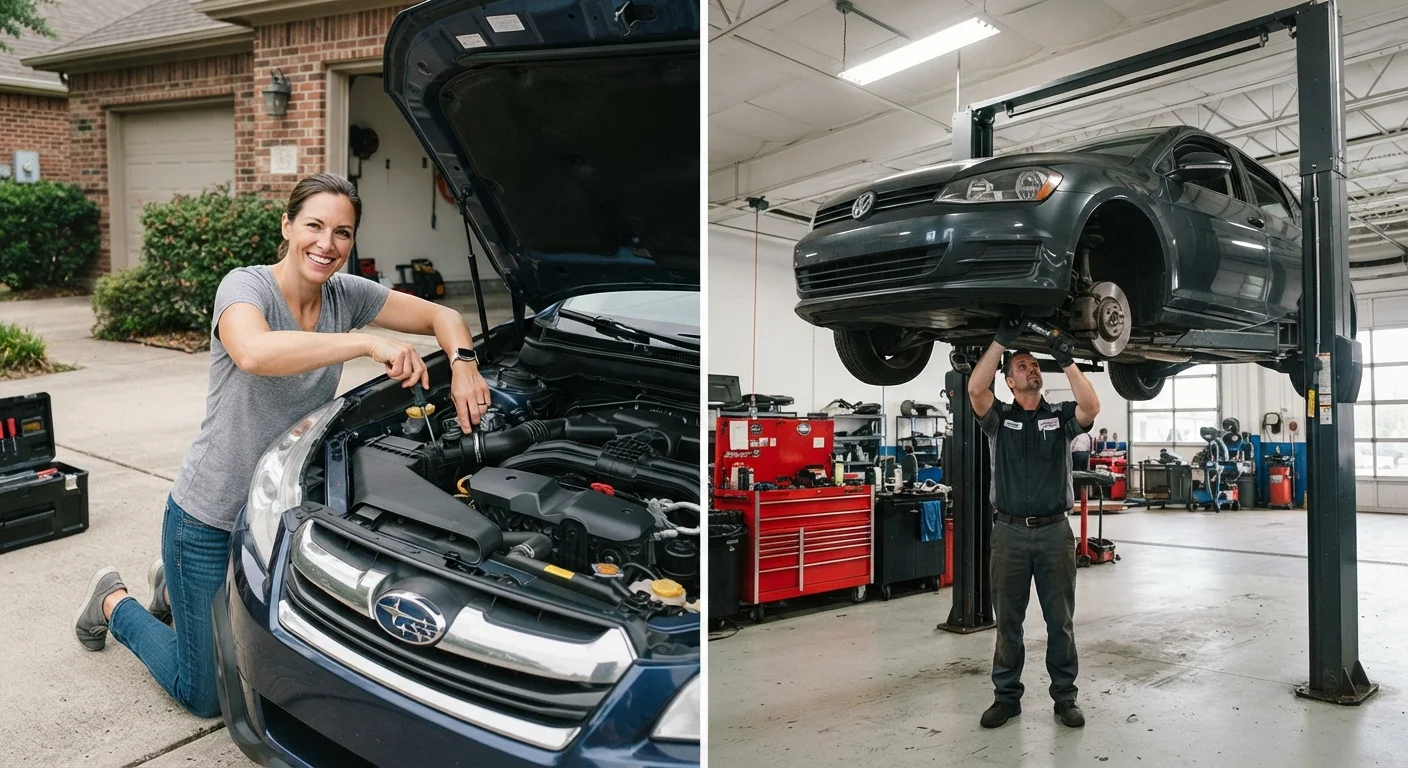
Some jobs are safe for home mechanics; others aren't. Understand which tasks you can handle yourself and when a professional is essential.
Our Verdict
DIY maintenance makes sense for straightforward, low-risk tasks that don't require specialized tools or diagnostic equipment. For anything touching safety systems, structural components, or complex electronics, a qualified mechanic is the right call. The smartest approach combines confident home maintenance with informed use of professional services.
| Best for | Recommended |
|---|---|
| Drivers comfortable with basic tools and simple checks | DIY Maintenance |
| Safety-critical repairs or jobs needing specialized equipment | Professional Garage |
| Newer vehicles with active warranties | Professional Garage |
| Routine consumable replacements on older vehicles | DIY Maintenance |
Key takeaways
- Simple tasks like air filter swaps, wiper replacements, and fluid top-offs are safe for most home mechanics.
- Brake system work, suspension repairs, and airbag-related tasks require professional tools and training.
- Your owner's manual is the single most reliable guide to what your specific vehicle needs and when.
- Doing the wrong job yourself can void warranties and create safety hazards more costly than a garage visit.
- Knowing your limits isn't a weakness — it's a smart part of vehicle ownership.
Why the DIY vs. Professional Question Matters
Car ownership comes with a long list of maintenance responsibilities, and for many drivers, the default move is to hand everything over to a mechanic. That approach is safe, but it's also often more expensive than necessary. On the flip side, tackling a job that's beyond your skill level or tools can create problems that cost far more to fix than the original service would have.
The goal isn't to turn every driver into a home mechanic — it's to help you recognize which side of the line each job falls on. As part of a broader understanding of vehicle upkeep (see our complete owner's maintenance overview), knowing when to reach for a wrench versus a phone is a genuinely valuable skill.
Two key factors determine where any job belongs: safety risk and tool requirements. Jobs that are low-risk and need only basic equipment are great DIY candidates. Jobs involving safety systems, precise torque specs, or electronic diagnostics almost always belong in a shop.
Tasks Most Drivers Can Handle at Home
Several routine maintenance items are well within reach for anyone willing to follow instructions carefully and work methodically. These tasks typically involve accessible components, commonly available parts, and low consequences for minor errors.
- Engine air filter replacement: Usually involves opening a plastic housing with clips or a few screws. Your owner's manual will specify the correct filter and replacement interval.
- Cabin air filter replacement: Often located behind the glove box and swappable in minutes with no tools required.
- Wiper blade replacement: Straightforward, with most replacement blades including instructions. A common consumable that drivers frequently overpay for at service centers.
- Fluid top-offs: Coolant reservoir, windshield washer fluid, and power steering fluid (where applicable) can be checked and refilled at home. Note: Never open a radiator cap on a hot engine.
- Tire pressure checks: A quality gauge costs a few dollars and takes two minutes. Correct inflation improves safety and fuel efficiency.
- Battery terminal cleaning: Corrosion on terminals can be safely removed with a wire brush and a baking soda solution, with the battery disconnected.
| DIY at Home | Professional Garage | |
|---|---|---|
| Upfront cost | Lower (parts only) | Higher (parts + labor) |
| Tools required | Basic hand tools | Specialized / diagnostic equipment |
| Safety risk if done wrong | Low (for listed tasks) | Managed by trained technician |
| Suitable for safety systems | No | Yes |
| Warranty compatibility | Varies — check terms | Generally maintained |
| Time investment | Varies by experience | Predictable, handled for you |
| Best for | Consumables, visual checks | Structural, electrical, brake work |
That said, even simple tasks require reading your vehicle's specifications carefully. Persistent myths about car maintenance — like always using the same oil weight regardless of season — can lead well-meaning DIYers astray.
Jobs That Belong in a Professional's Hands
Some maintenance and repair tasks carry real risk if done incorrectly — either to the vehicle, to you, or to other road users. These aren't areas where learning on the job is appropriate.
- Brake system work: Replacing brake pads is sometimes marketed as a DIY job, but proper brake work involves precise torque specs, correct bedding-in procedures, and an understanding of how hydraulic systems behave. Errors here are dangerous.
- Suspension and steering components: Worn ball joints, tie rods, and struts affect how a car handles. Improper installation or alignment can make a vehicle unpredictable at speed.
- Transmission service: Fluid changes on automatic transmissions vary widely by vehicle and often require dealership-level diagnostic equipment to perform correctly.
- Airbag and SRS system work: Airbag systems contain explosive charges that can deploy unexpectedly. Any work near these components should be done by a trained technician.
- Timing belt or chain replacement: Requires precise synchronization of engine components. Mistakes can cause catastrophic engine failure.
- Electrical diagnostics: Modern vehicles use complex control modules. Fault codes read by a consumer OBD-II scanner give a starting point, not a complete diagnosis.
Understanding what a mechanic actually examines during a service can help you ask better questions and avoid paying for work you don't need.
The Gray Areas: When to Get a Second Opinion
Not every job falls neatly into DIY or professional territory. Oil changes, for example, are technically simple but require safely lifting the vehicle, using the correct oil specification, and properly disposing of used oil — steps that trip up many first-timers. Spark plug replacement is manageable on some engines and extremely difficult on others depending on layout.
If you're uncertain, a useful rule of thumb is to ask three questions:
- Does this job involve a safety system (brakes, steering, airbags, tires)?
- Do I need specialized tools I don't own?
- Could doing this incorrectly void my warranty or damage other components?
If the answer to any of these is yes, lean toward professional service. Warranty implications are especially important on newer vehicles — some manufacturer warranties require that services be performed by qualified technicians or documented with proper records.
When in doubt, your owner's manual is the right starting point. It contains manufacturer-approved service intervals, fluid specifications, and component guidance that generic advice simply cannot replace.
This article provides general information for educational purposes only. Always consult a qualified mechanic before attempting unfamiliar repairs, particularly those involving safety-critical vehicle systems.
All published content on this website is for informational and educational purposes only and should not be taken as professional advice. We recommend that readers seek expert opinion before making any decisions. The website is not responsible for any actions taken based on the information provided on this website. We are not liable for any inaccuracies, modifications, or omissions in information. Moreover, external links or third-party content are provided for convenience; we are not liable for their correctness. Users are advised to verify every piece of information before they use it for any purpose.