
Digital Twins: The Virtual Replicas Quietly Running the Real World

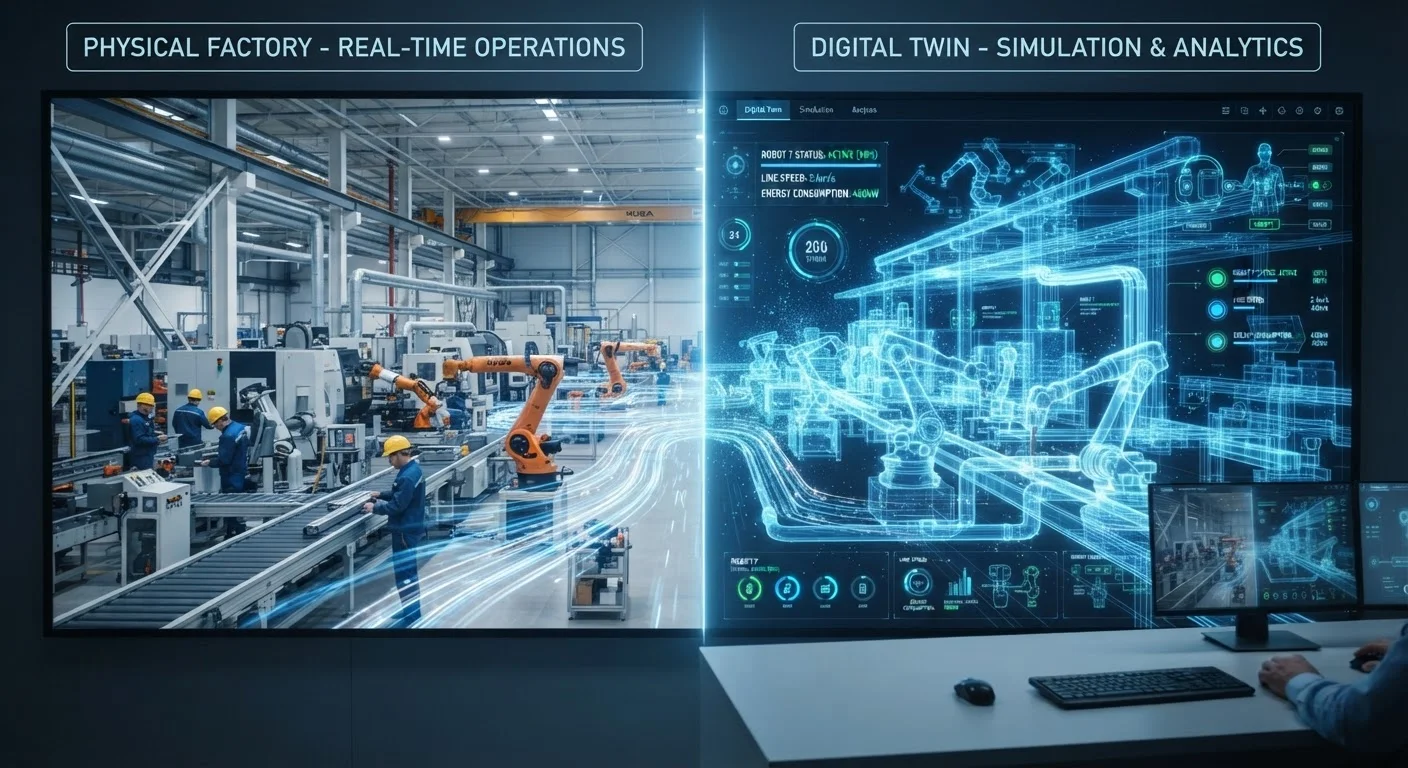
Digital twins create living simulations of physical objects and systems. Learn how industries from manufacturing to healthcare are using them today.
Key takeaways
- A digital twin is a real-time virtual copy of a physical object or system, fed by live data.
- Industries including manufacturing, healthcare, aerospace, and urban planning actively use digital twins today.
- They allow engineers to simulate failures and test fixes without disrupting real-world operations.
- Digital twins are distinct from static 3D models — they evolve as their physical counterparts change.
- Wider adoption is expected as IoT sensors become cheaper and cloud computing more accessible.
A Concept Older Than the Buzzword
Long before "digital twin" became a staple of tech conference slides, NASA was doing something remarkably similar. Engineers maintaining the Apollo 13 spacecraft used physical replicas on the ground to simulate conditions aboard the stricken vessel in real time. When an oxygen tank ruptured in 1970, those ground-based models helped mission controllers test procedures before asking the crew to perform them 200,000 miles away.
The formal term arrived decades later. Dr. Michael Grieves introduced the concept in a 2002 University of Michigan presentation on product lifecycle management, describing a virtual equivalent of a physical product that could be monitored and analyzed throughout its lifespan. The phrase "digital twin" itself came into wider use through NASA documentation in the following decade.
What's changed since then is scale, speed, and accessibility. The explosion of Internet of Things (IoT) sensors — devices embedded in machines, buildings, and infrastructure that transmit data constantly — has made it practical to keep virtual models synchronized with physical reality at a granular level. This is the infrastructure that turns an interesting concept into an operational tool. For more on how technologies like this crept into everyday life, see our look at quiet tech revolutions.
How a Digital Twin Actually Works
At its core, a digital twin needs three things: a detailed model of the physical object, a continuous stream of real-world data, and software capable of processing that data and updating the model accordingly.
Sensors attached to the physical system — measuring temperature, pressure, vibration, throughput, or whatever variables matter — transmit readings to a cloud platform or on-site computing environment. The software ingests that data and updates the virtual model to reflect current conditions. From there, operators can view dashboards, run "what if" simulations, or set automated alerts when values drift outside acceptable ranges.
The sophistication varies widely. A basic digital twin of a pump in a water treatment plant might track pressure and flow rate. A complex twin of an entire aircraft engine might incorporate thousands of sensor inputs and run computational fluid dynamics simulations to model airflow through turbine blades under different load conditions.
$73.5B
Projected global digital twin market size by 2027
According to market analysis by MarketsandMarkets, the digital twin market was valued at around $6.9 billion in 2022 and is projected to grow significantly through the latter part of the decade.
25–30%
Potential reduction in unplanned downtime
Industry analyses of predictive maintenance programs — a primary application of digital twins in manufacturing — commonly cite downtime reductions in this range, though results vary by implementation.
2002
Year the digital twin concept was formally introduced
Dr. Michael Grieves presented the foundational digital twin framework at the University of Michigan in 2002, in the context of product lifecycle management.
Crucially, the twin is a two-way relationship. Insights generated in the virtual model can be applied back to the physical system — adjusting operating parameters, scheduling maintenance, or flagging a component for replacement before it fails.
Where Digital Twins Are Making a Real Difference
Manufacturing is where digital twins are most mature. Factories use them to simulate production lines before physical assembly begins, catching design flaws that would be expensive to fix once steel is bolted together. During operation, twins monitor equipment health and predict maintenance needs — a practice called predictive maintenance that reduces unplanned downtime.
In urban planning, city governments have begun building digital twins of entire districts or infrastructure networks. Singapore has developed a city-scale twin to model traffic flow, test emergency response scenarios, and assess the impact of new construction on drainage and wind patterns. The city doesn't have to repave a road or demolish a building to understand the consequences of doing so.
Energy companies use twins to model power grids, optimizing load distribution and simulating the integration of renewable energy sources before committing to grid modifications. Offshore wind operators simulate turbine performance under different weather scenarios to schedule maintenance during low-output windows rather than peak generation periods.
Healthcare represents a frontier with significant promise. Researchers are working on organ-level twins — virtual models of a patient's heart, for instance — built from imaging data and vital sign feeds. The potential is to simulate how a specific patient's heart might respond to a surgical procedure or medication adjustment, though this remains largely in research and clinical trial settings rather than routine care.
The Limits and Trade-Offs Worth Knowing
Digital twins are not magic mirrors. A twin is only as accurate as the data feeding it. Sensor failures, calibration drift, or gaps in coverage introduce errors that compound over time. A model trained on historical data may also fail to anticipate genuinely novel conditions.
Building and maintaining a high-fidelity twin requires substantial investment — in sensors, computing infrastructure, and the specialized expertise to interpret outputs correctly. Organizations that adopt the technology without that expertise risk trusting a model they don't fully understand, which can create a false sense of certainty rather than genuine insight.
There are also questions about decision-making accountability. When an algorithm flags a component for replacement or a simulation recommends a design change, who is responsible if the recommendation turns out to be wrong? These are the kinds of governance questions that technology rarely answers on its own. A broader look at automation trade-offs covers the accountability dynamics that accompany these systems more generally.
Privacy is a related concern wherever digital twins intersect with human activity — smart buildings that model occupant movement, or healthcare twins that incorporate personal medical data. The data pipeline powering a twin is subject to the same security and privacy obligations as any other sensitive data system.
Why This Matters Beyond the Factory Floor
Digital twin technology is moving from specialized industrial deployments toward sectors that touch everyday life more directly. Hospitals, transit systems, utility grids, and even residential buildings are beginning to incorporate elements of the approach.
For the average person, the most immediate contact with digital twin principles might already be happening without any visibility. Building management systems that adjust heating and cooling based on occupancy predictions, or traffic management platforms that reroute signals in real time based on flow data, draw on the same conceptual foundation.
As IoT hardware becomes cheaper and cloud computing platforms continue to offer digital twin capabilities as a service, the barrier to entry is falling. That means smaller organizations — regional utilities, mid-sized manufacturers, local governments — are gaining access to tools that were once reserved for aerospace contractors and global automakers.
Understanding what digital twins are — and what they can and can't do — equips curious adults to make sense of the infrastructure decisions happening around them, from how their city plans its roads to how the products they use are designed and maintained. For a broader view of the practical tech shaping daily routines, explore everyday gadgets and digital tools.
Frequently Asked Questions
All published content on this website is for informational and educational purposes only and should not be taken as professional advice. We recommend that readers seek expert opinion before making any decisions. The website is not responsible for any actions taken based on the information provided on this website. We are not liable for any inaccuracies, modifications, or omissions in information. Moreover, external links or third-party content are provided for convenience; we are not liable for their correctness. Users are advised to verify every piece of information before they use it for any purpose.