
Edge Computing Explained: Why the Cloud Is Moving Closer to You

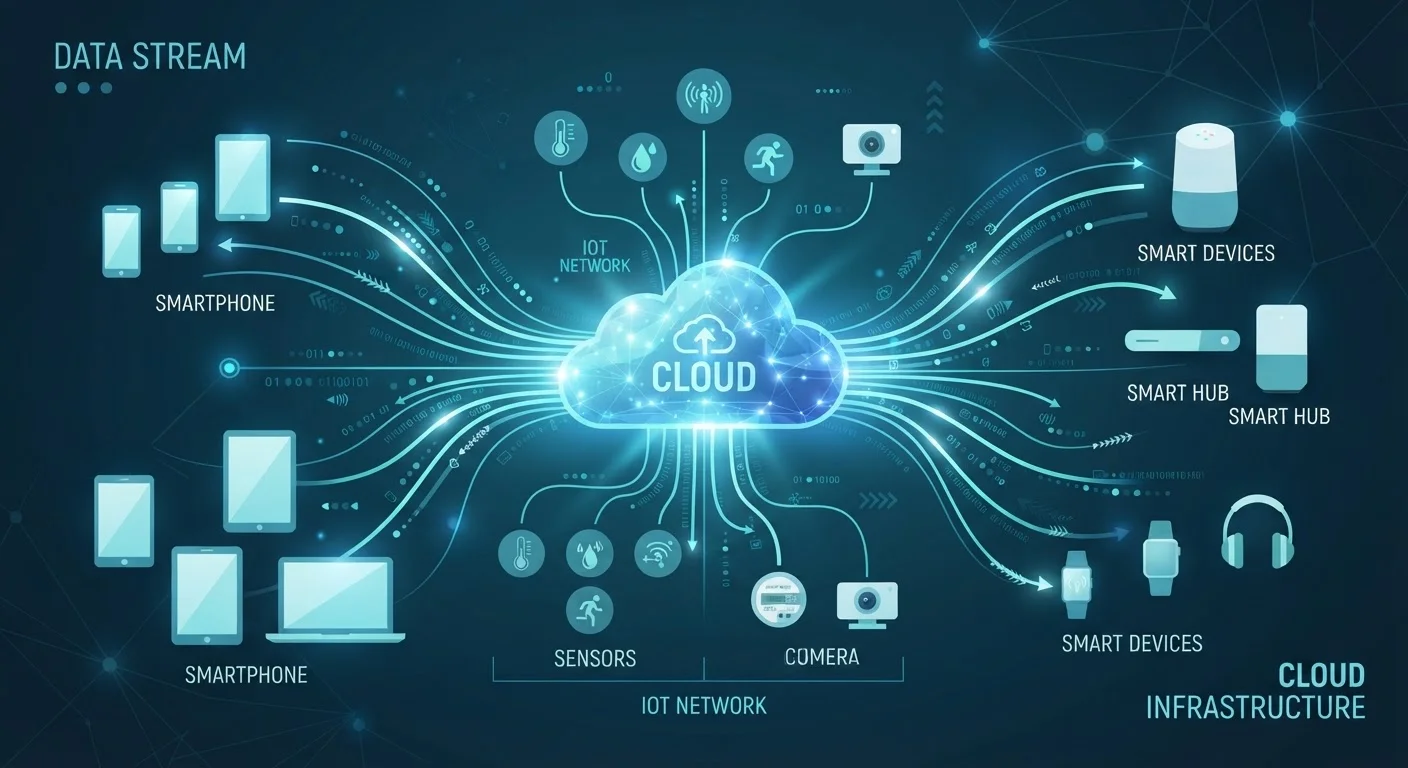
Edge computing shifts data processing away from distant servers to devices near you. Here's what that means for speed, privacy, and everyday tech.
Key takeaways
- Edge computing processes data near the source rather than in a distant data center.
- Lower latency from edge computing enables real-time responses in applications like autonomous vehicles and smart factories.
- Processing data locally can reduce privacy exposure by limiting what travels over the internet.
- Edge and cloud computing are complementary, not competing, technologies.
- Everyday devices like smartphones and smart speakers already use edge computing principles.
Why Processing Location Actually Matters
When you ask a voice assistant a question or your phone unlocks with a glance, something has to figure out what to do with that data. The question is where that figuring-out happens — and the answer is changing fast.
For most of the past decade, the dominant model has been the cloud: your device captures data, ships it over the internet to a powerful remote server, and waits for a response to come back. That round trip works fine for streaming a playlist or syncing a document. But as connected devices have multiplied and use cases have grown more demanding, the limitations of always depending on a distant server have become harder to ignore.
Latency — the delay between sending data and receiving a response — is one of the most tangible problems. Even on a fast internet connection, data traveling hundreds of miles to a data center and back introduces delays that can be unacceptable in contexts like surgical robotics, industrial safety systems, or self-driving vehicles where milliseconds matter. Edge computing addresses this by moving processing power physically closer to the data source.
To understand how this contrasts with the traditional cloud model, see what the cloud actually means for your files and apps.
75%
Enterprise data processed at the edge by 2025
Gartner projected that by 2025, roughly 75% of enterprise-generated data would be created and processed outside traditional centralized data centers — up from around 10% in 2018.
<10ms
Typical edge processing latency target
Industry architects commonly design edge computing systems to achieve single-digit to sub-10-millisecond latency for time-critical applications, compared to 50–200ms for typical cloud round trips.
55 billion
Connected IoT devices projected globally
Statista and related research firms have projected the number of Internet of Things connected devices worldwide to reach approximately 55 billion by the mid-2020s, intensifying demand for local data processing.
How Edge Computing Works in Practice
Edge computing is not a single piece of hardware or software — it's an architectural approach. The core idea is that compute resources (processors, memory, storage) are deployed at or near the point where data is created, whether that's a factory sensor, a hospital monitor, a traffic camera, or your smartphone.
These local processing nodes — sometimes called edge servers, edge gateways, or simply edge devices — handle tasks that previously required a round trip to the cloud. A modern smartphone's dedicated neural processing unit (NPU), for example, runs on-device tasks like photo enhancement, speech recognition, and face detection without sending your images to a remote server.
At a larger scale, a manufacturer might install edge servers on the factory floor to analyze machine data in real time, flagging equipment anomalies before a breakdown occurs. The edge nodes process the high-frequency sensor streams locally, sending only summarized insights — not raw gigabytes of data — to a central cloud system for longer-term analysis. This division of labor is what makes edge and cloud computing partners rather than rivals.
This convergence of software and physical infrastructure is a broader pattern worth understanding — explored in depth in our look at why software is eating physical infrastructure.
What Edge Computing Means for Privacy and Security
One underappreciated benefit of edge computing is what it keeps off the network. When a home security camera processes video locally to detect motion — rather than continuously streaming footage to a cloud server — that sensitive imagery stays within your home network. Less data in transit means fewer opportunities for interception or breach.
That said, edge computing is not a privacy guarantee on its own. A device can process data locally and still transmit results or metadata to third parties. Privacy outcomes depend on how manufacturers implement their systems and what data policies they apply. Informed consumers should still review the data practices of any connected device, regardless of whether it uses edge processing.
Security is a related consideration. Edge devices represent additional points in a network that need to be kept up to date with patches and secured against unauthorized access. The distributed nature of edge computing can expand the attack surface if devices are not properly managed.
Check Your Device's Data Settings
Even if a device advertises local or on-device processing, review its privacy settings and data-sharing policies. Look for options to limit cloud uploads of sensitive information such as voice recordings, photos, or health data. Most platforms offer granular controls in their privacy or security settings menus.
The Bigger Picture: Edge as Infrastructure
Edge computing is a foundational layer for several of the most significant technology shifts underway — from connected vehicles and smart cities to augmented reality and industrial automation. The ability to act on data immediately, without waiting for a cloud round trip, unlocks categories of applications that simply weren't practical before.
Telecommunications carriers have been rolling out multi-access edge computing (MEC) capabilities alongside 5G infrastructure, placing compute capacity inside cellular networks to reduce latency further for mobile applications. This makes edge computing not just a device-level feature but a network-level architecture.
For everyday users, the most visible effects will likely be subtler: faster device responses, more capable on-device AI features, and connected products that function reliably even when internet connectivity is spotty. Edge computing is also a stepping stone toward the kind of seamlessly integrated technology described in the quiet rise of ambient computing — where intelligent systems blend into the background of daily life.
“The future of computing is not just in the cloud — it's everywhere. As data volumes and real-time demands grow, processing must move to where data is born.”
— Satya Nadella, CEO, Microsoft — speaking broadly on distributed computing strategy
Frequently Asked Questions
All published content on this website is for informational and educational purposes only and should not be taken as professional advice. We recommend that readers seek expert opinion before making any decisions. The website is not responsible for any actions taken based on the information provided on this website. We are not liable for any inaccuracies, modifications, or omissions in information. Moreover, external links or third-party content are provided for convenience; we are not liable for their correctness. Users are advised to verify every piece of information before they use it for any purpose.