
The Complete Picture: Every Factor That Shapes Your Credit Score

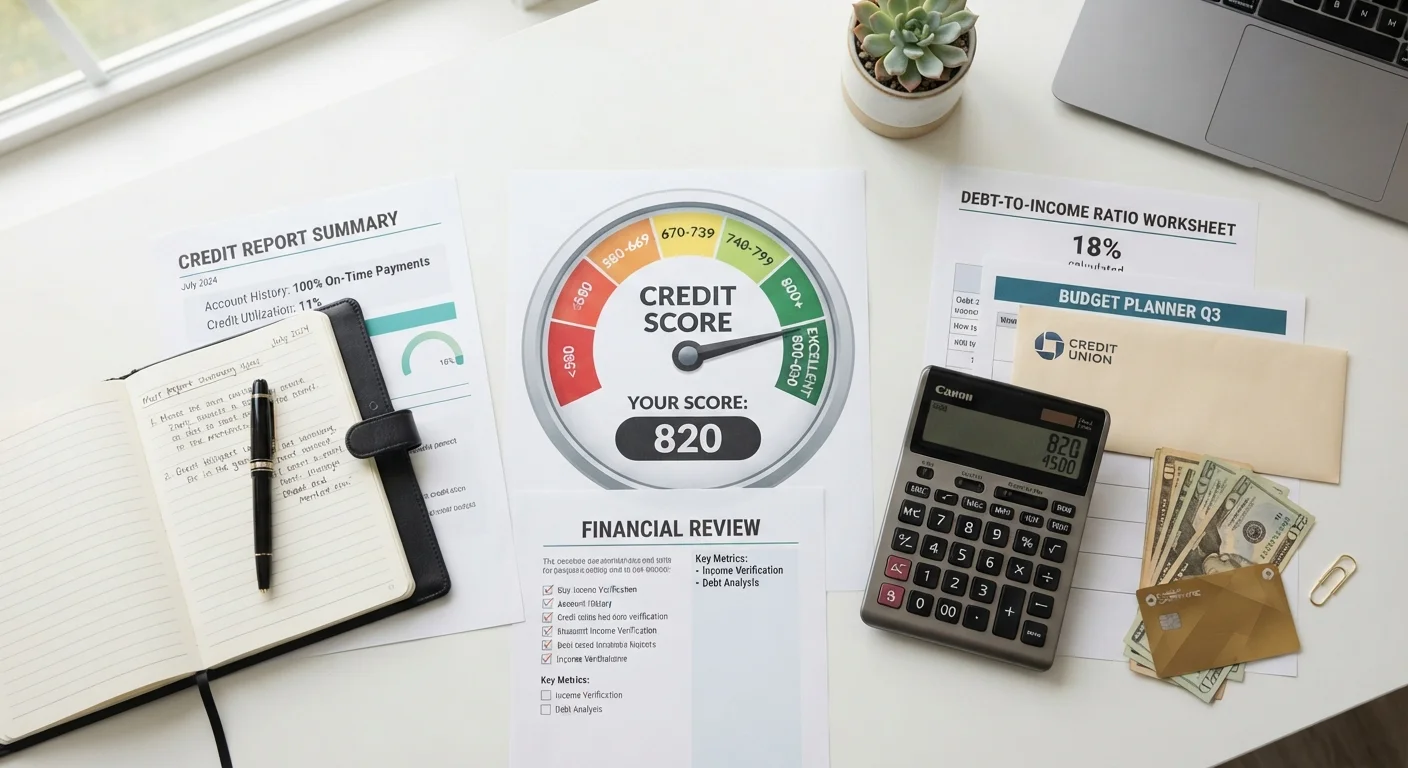
A clear reference covering the five main elements behind your credit score — from payment history to credit mix — and how each is weighted.
How Credit Scores Are Built
Your credit score is a three-digit number — typically ranging from 300 to 850 under the FICO scoring model — that condenses your borrowing history into a single, lender-readable signal. It isn't random, and it isn't a mystery. Five distinct categories of information feed into the calculation, each carrying a specific weight. Knowing what those categories are and how they interact is the first step toward managing your credit with real confidence.
This article serves as a reference guide for those five factors. If you're newer to the subject and want broader context first, the foundational guide for first-time borrowers is a useful starting point. For a deeper look at what different score ranges mean to lenders, see Credit Scores Decoded.
The Five Factors Explained
1. Payment History (35%)
The single largest factor in your score is whether you pay your bills on time. Late payments, missed payments, accounts sent to collections, bankruptcies, and foreclosures all appear here and can significantly drag your score down. Even one payment that's 30 days late can have a noticeable effect, particularly if your overall history is short. Conversely, a long record of on-time payments steadily builds the foundation of a strong score.
2. Amounts Owed — Credit Utilization (30%)
This factor looks at how much of your available revolving credit you're currently using, commonly called your credit utilization ratio. If your combined credit card limits total $10,000 and your balances add up to $3,000, your utilization is 30%. Most credit guidance suggests keeping this ratio below 30%, though lower is generally better. High utilization can signal financial stress to lenders, even if you pay your balance in full each month — because scores are often calculated at the moment a statement closes, not after payment clears.
3. Length of Credit History (15%)
Scoring models consider how long your oldest account has been open, how long your newest account has been open, and the average age of all your accounts. A longer credit history gives lenders more data to evaluate. This is why closing an old credit card account — even one you rarely use — can sometimes lower your score by reducing your average account age.
4. Credit Mix (10%)
Lenders like to see that you can responsibly manage different types of credit. The two broad categories are revolving credit (credit cards, lines of credit) and installment credit (auto loans, mortgages, student loans, personal loans). Having both types in good standing shows versatility, though this factor carries less weight than payment history or utilization. You shouldn't open accounts you don't need just to diversify your mix.
5. New Credit — Hard Inquiries (10%)
Each time you apply for a new line of credit, the lender typically performs a hard inquiry on your credit report. A single hard inquiry has a minor effect — often five points or fewer — but multiple applications in a short window can add up. Scoring models generally treat multiple mortgage or auto loan inquiries made within a short period (often 14–45 days) as a single inquiry, recognizing that consumers shop for rates. Soft inquiries, such as checking your own credit or pre-qualification checks, do not affect your score.
To see how these factors show up line by line on your actual file, reading your credit report without getting lost walks you through each section in plain terms.
Credit utilization ratio
The percentage of your available revolving credit that you are currently using. It is calculated by dividing your total balances by your total credit limits and is expressed as a percentage.
Hard inquiry
A review of your credit report triggered when you apply for new credit, such as a loan or credit card. Hard inquiries are visible to other lenders and can temporarily lower your score by a small amount.
Soft inquiry
A credit check that does not affect your score, such as checking your own credit or a lender running a pre-qualification check without your formal application.
Revolving credit
A type of credit with a variable balance and a set credit limit, such as a credit card or line of credit. You can borrow, repay, and borrow again up to your limit.
Installment credit
A loan with a fixed amount borrowed and a set repayment schedule, such as a mortgage, auto loan, student loan, or personal loan.
Payment history
A record on your credit report of whether you have paid your accounts on time, including any late payments, missed payments, collections, or public records such as bankruptcy.
What This Means for Your Financial Decisions
Understanding the five factors transforms credit management from a passive exercise into an active one. Rather than wondering why your score moved, you can trace changes back to specific behaviors: a new account lowering your average account age, a high statement balance pushing up utilization, or an old delinquency aging off your report.
A few practical takeaways worth keeping in mind:
- Prioritize payment history above all else. Automating at least the minimum payment on every account removes the risk of an accidental late mark.
- Watch your utilization closely. If you carry balances, paying them down before your statement closing date — not just the due date — can keep reported utilization lower.
- Think carefully before closing old accounts. The age factor rewards longevity; a dormant card with no annual fee is often worth keeping open.
- Apply for new credit deliberately. Each application leaves a trace. Spacing out applications over time limits the impact on your score.
It's also worth remembering that small, everyday habits can affect your score in ways that aren't immediately obvious. The less obvious behaviors that dent your credit score article covers some of those blind spots in detail.
For a comprehensive view of how all these pieces fit together across the full credit landscape, the end-to-end credit and debt resource brings everything into one place.
This article provides general financial education only and is not personalized financial or credit advice. For guidance specific to your situation, consider consulting a qualified financial professional.
All published content on this website is for informational and educational purposes only and should not be taken as professional advice. We recommend that readers seek expert opinion before making any decisions. The website is not responsible for any actions taken based on the information provided on this website. We are not liable for any inaccuracies, modifications, or omissions in information. Moreover, external links or third-party content are provided for convenience; we are not liable for their correctness. Users are advised to verify every piece of information before they use it for any purpose.