
Your First Month on a Budget: A Ground-Up Starting Point

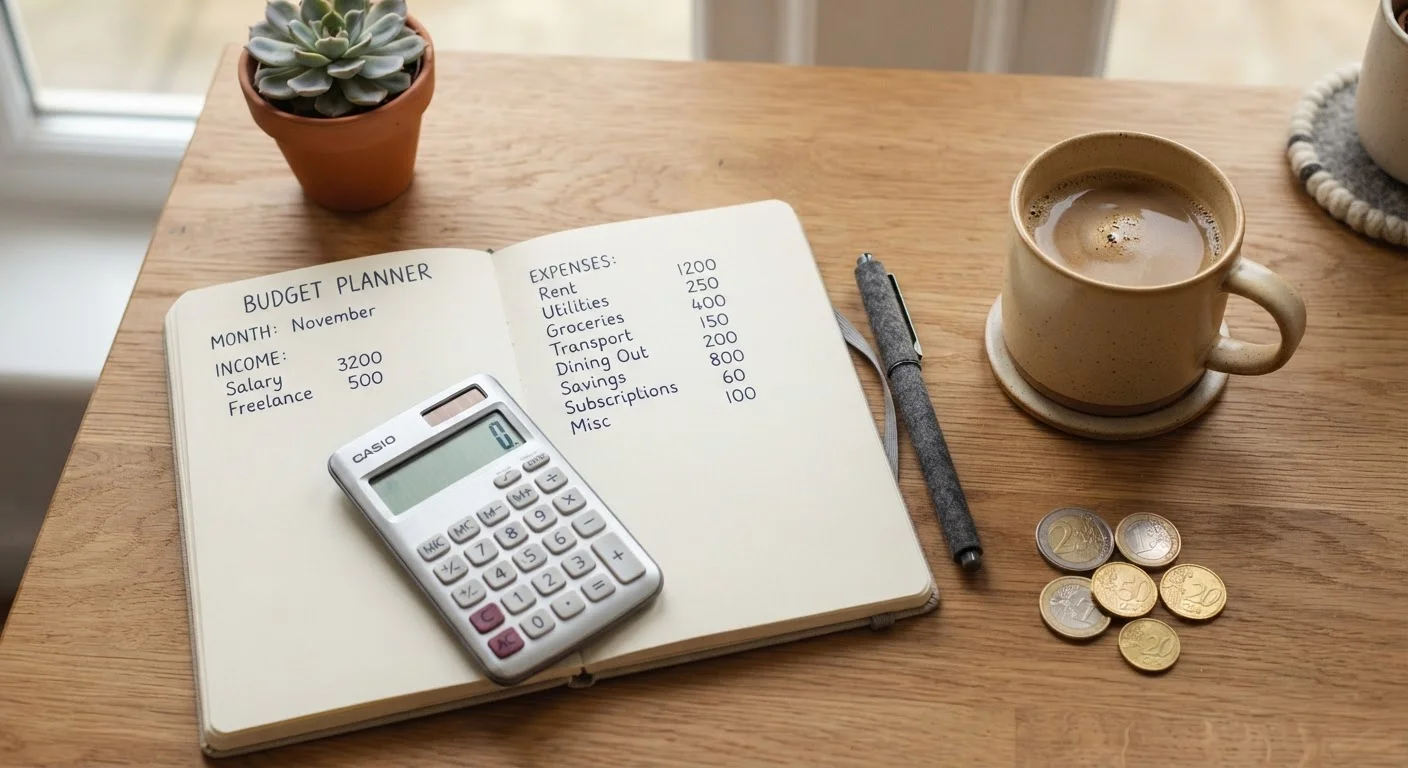
Never budgeted before? This plain-language introduction walks through every foundational concept, from income tracking to category planning.
Start here
Why the First Month Is Different
Step 1
Know Your Starting Number: Take-Home Income
Step 2
Mapping Your Expenses Into Categories
Step 3
Closing the Gap: Matching Spending to Income
Step 4
Tracking as You Go
Reflect & improve
What to Do at Month's End
Key takeaways
- Your first budget is a learning tool, not a perfect plan — expect to revise it.
- Always start with take-home (net) income, not your gross salary.
- Sorting expenses into fixed, variable, and discretionary categories makes priorities clearer.
- Tracking spending in real time prevents end-of-month surprises.
- A brief monthly review is what turns a one-time budget into a lasting habit.
Why the First Month Is Different
A first budget is not really a budget in the traditional sense — it is a financial snapshot. Before you can allocate money with any confidence, you need to understand where it is actually going. That takes at least one full month of honest observation.
Many people abandon budgeting early because they set targets before they know their own spending patterns. The goal in month one is simpler: get the numbers on paper and resist the urge to judge them. This is the foundation that every workable plan is built on. For a broader view of the entire budgeting process, this end-to-end guide covers setup through long-term habits in one place.
Know Your Starting Number: Take-Home Income
Every budget starts with one figure: how much money comes in. Use your net income — the amount deposited into your bank account after taxes, retirement contributions, and any other payroll deductions. Budgeting from gross income (the number on your offer letter) leads to shortfalls because that money was never yours to spend.
If your income varies month to month — because of freelance work, tips, or hourly hours that shift — use a conservative estimate based on your lowest typical month. Budgeting around irregular income involves a few additional steps worth reviewing if this applies to your situation.
Net income
The amount of money you actually receive after taxes and other deductions are taken out of your paycheck. This is your real spending power.
Fixed expense
A cost that stays the same every month, such as rent or a car loan payment, making it easy to predict and plan for.
Discretionary spending
Money spent on non-essential wants — dining out, entertainment, or hobbies — that can be reduced or eliminated if needed.
Sinking fund
A small amount set aside each month to cover a known future expense, such as an annual insurance renewal or holiday gifts, so it doesn't arrive as a surprise.
Budget surplus
What remains when your income is greater than your expenses for the month — money that should be assigned a deliberate purpose rather than spent by default.
Emergency fund
Savings set aside specifically for unexpected but necessary costs — like a car repair or medical bill — so they don't disrupt the rest of your budget.
If you have multiple income streams, add them all together. Side income, rental payments, and consistent freelance deposits all count — just avoid including irregular windfalls you cannot reliably predict.
Mapping Your Expenses Into Categories
Pull up two to three months of bank and credit card statements and start grouping every transaction. Three broad categories create a useful structure:
- Fixed expenses — costs that are the same every month, such as rent or mortgage, loan payments, and insurance premiums.
- Variable necessities — spending that is essential but fluctuates, like groceries, utilities, and gas.
- Discretionary spending — non-essential choices: dining out, streaming services, hobbies, clothing beyond basics.
Understanding the differences between these three types helps you see clearly which costs are truly flexible and which are not. Don't forget irregular but predictable costs — annual insurance renewals, vehicle registration, or back-to-school expenses — by dividing them by 12 and setting that monthly amount aside. This technique is sometimes called a sinking fund.
For plain definitions of terms like these, this glossary of common budget terms is a useful companion reference.
Closing the Gap: Matching Spending to Income
Once you have totaled your income and categorized your expenses, subtract total expenses from total income. Three outcomes are possible:
- Income exceeds expenses — you have a surplus. Decide deliberately where that money goes: an emergency fund, debt repayment, or a savings goal. Letting it sit unassigned often means it disappears into discretionary spending.
- Income equals expenses — you are breaking even. This is manageable short-term, but leaves no buffer for unexpected costs. Look for modest reductions in discretionary categories to create even a small cushion.
- Expenses exceed income — you are spending more than you earn. Start with discretionary categories, then variable necessities, to find adjustments. If the gap is structural, it may also point toward an income conversation.
Give Every Surplus Dollar a Job
When your income exceeds your planned expenses, assign each extra dollar to a specific purpose before the month begins — savings, debt repayment, or a sinking fund. Unassigned money has a tendency to disappear into unplanned discretionary spending. Even allocating a small surplus intentionally builds the habit of directing money rather than reacting to it.
Building even a small emergency fund belongs in any early budget — even a modest starting amount provides real protection against unexpected costs derailing your plan.
Tracking as You Go
A budget written once and forgotten provides little value. Tracking spending as it happens — rather than reconstructing it at month's end — is what makes a budget a live tool rather than a historical document.
Choose a method that fits your routine. A notes app, a simple spreadsheet, or a dedicated budgeting application all work. The only requirement is that you actually use it. Brief daily or every-other-day check-ins — reviewing recent transactions and comparing them to your category targets — catch overspending while there is still time to adjust.
Once your first month is complete, a structured monthly setup checklist can help you build this tracking into a consistent routine going forward.
What to Do at Month's End
At the end of your first month, sit down with your actual numbers and compare them to your plan. For each category, note whether you came in under, over, or on target — and try to understand why, not just what. A grocery overage caused by a pantry restock is different from one driven by daily impulse buys.
Use this review to set more realistic targets for month two. First-month budgets are almost always adjusted — that is expected and healthy. Over time, this monthly check-in becomes one of the most powerful habits that keep a budget running long after the novelty wears off.
If you are curious about different structural approaches — such as allocating percentages by category or setting savings goals first — an overview of common budgeting methods can help you find a framework that fits your style once the basics feel comfortable.
This article is for general informational and educational purposes only and does not constitute personalised financial advice. Consider consulting a qualified financial professional for guidance tailored to your individual circumstances.
Frequently Asked Questions
All published content on this website is for informational and educational purposes only and should not be taken as professional advice. We recommend that readers seek expert opinion before making any decisions. The website is not responsible for any actions taken based on the information provided on this website. We are not liable for any inaccuracies, modifications, or omissions in information. Moreover, external links or third-party content are provided for convenience; we are not liable for their correctness. Users are advised to verify every piece of information before they use it for any purpose.