
Credit Card Debt vs. Personal Loan: Choosing the Right Repayment Path

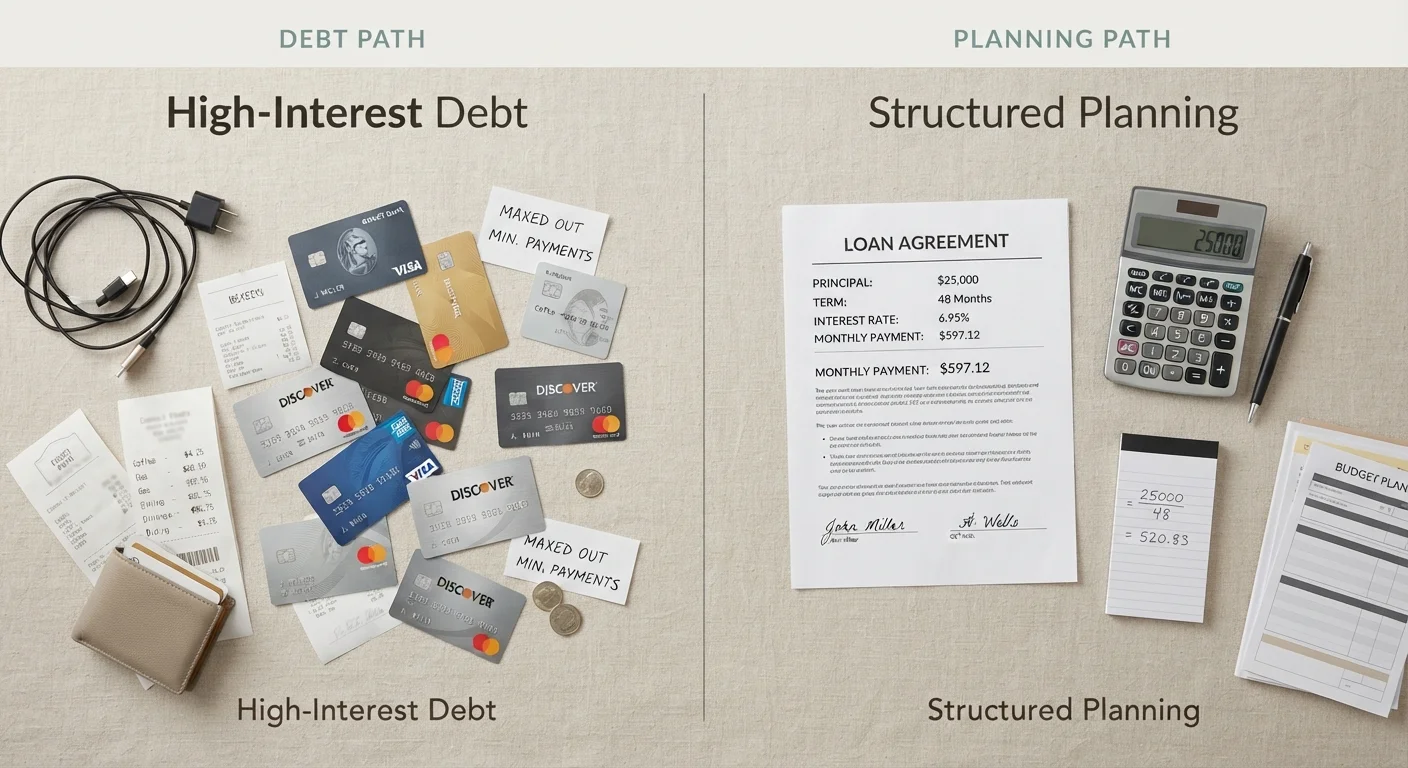
Weigh the key differences between carrying credit card debt and consolidating with a personal loan so you can approach repayment with clarity.
Our Verdict
Credit card debt and personal loans are both unsecured obligations, but they behave very differently in practice. Carrying a balance on a credit card tends to cost more over time due to higher, variable rates, while a personal loan provides structure and a clear payoff date. For many borrowers, consolidating high-rate card debt into a lower-rate personal loan can reduce interest costs — but the move only makes sense if you qualify for a meaningfully better rate and won't continue accumulating card balances.
| Best for | Recommended |
|---|---|
| Those who need flexible, short-term borrowing with the discipline to pay in full monthly | Credit card (used strategically, not carried as long-term debt) |
| Borrowers with good credit seeking to reduce interest and set a firm payoff timeline | Personal loan consolidation |
| Those who struggle with variable minimum payments and want predictable monthly obligations | Personal loan |
| Individuals with lower credit scores who may not qualify for favorable personal loan rates | Focused credit card payoff strategy (snowball or avalanche method) |
Key takeaways
- Credit card debt is revolving and typically carries variable, higher interest rates than personal loans.
- Personal loans offer fixed rates and structured payoff timelines, which can aid budgeting and planning.
- Consolidating card debt into a personal loan may reduce total interest paid, but depends on creditworthiness.
- Neither option is universally superior — the right path depends on your rate, discipline, and financial goals.
- Consulting a licensed financial adviser can help tailor a debt repayment strategy to your specific situation.
How Credit Card Debt and Personal Loans Actually Work
Before comparing these two paths, it helps to understand what makes each one distinct at its core. Understanding how debt and credit interact lays the groundwork for making any borrowing decision confidently.
Credit card debt is revolving debt. Your lender sets a credit limit, and you can borrow up to that limit, repay some or all of it, and borrow again. The minimum payment required each month is usually a small percentage of your outstanding balance — which means you can technically carry a balance indefinitely. Interest accrues on whatever balance remains after your payment due date, and the rate is typically variable, meaning it can rise or fall with benchmark rates set by the Federal Reserve.
Personal loans are installment debt. You borrow a fixed lump sum, agree to a fixed (or occasionally variable) interest rate, and repay the balance in equal monthly installments over a set term — often 24 to 60 months. Once the loan is repaid, it is closed. There is no ongoing credit line to draw from. For a deeper look at how unsecured borrowing works generally, see our overview of secured vs. unsecured debt.
Key Differences: Rate, Structure, and Cost
The most significant practical difference between carrying credit card debt and holding a personal loan is cost — specifically, the interest rate applied to your balance.
| Credit Card Debt | Personal Loan | |
|---|---|---|
| Debt type | Revolving | Installment |
| Typical interest rate | Higher; often variable | Lower for good credit; usually fixed |
| Monthly payment | Variable minimum payment | Fixed scheduled payment |
| Payoff timeline | Open-ended; no set end date | Fixed term (e.g. 24–60 months) |
| Credit utilization impact | High balances raise utilization | Does not affect revolving utilization |
| Flexibility | Can revolve balance month to month | Lump sum only; no re-borrowing |
| Risk if discipline lapses | Balance can grow indefinitely | Fixed obligation; missed payments carry penalties |
Credit card annual percentage rates (APRs) in the US have historically been among the highest of any common consumer debt product. Because rates are variable, a period of rising interest rates can increase your borrowing costs without any change in your behavior. Personal loan rates, while still dependent on your credit profile, tend to be lower on average for borrowers with good to excellent credit — and the fixed rate means your cost is locked in from the start.
Structure also matters for budgeting. A personal loan's fixed monthly payment makes it straightforward to plan around. Credit card minimum payments fluctuate as your balance changes, and making only the minimum dramatically extends repayment and inflates total interest paid. A borrower carrying a $5,000 balance at a high credit card APR, paying only minimums, could spend years repaying a debt that a personal loan might retire in two or three years at lower total cost.
When Consolidating Into a Personal Loan Makes Sense
Using a personal loan to pay off credit card balances — a form of debt consolidation — can be a genuinely effective strategy under the right conditions. The core logic is straightforward: if the personal loan carries a lower APR than your card balances, you reduce the portion of each payment consumed by interest and can pay down principal faster.
Conditions where consolidation tends to work well include:
- You qualify for a meaningfully lower rate. If the personal loan rate is only marginally better, fees (such as origination fees charged by some lenders) may offset the benefit.
- You commit to not re-accumulating card debt. Consolidation solves a cost problem, not a spending problem. Using a personal loan to clear cards and then running those cards back up doubles your debt load.
- You have a stable income. Fixed monthly loan payments leave no room for the flexibility that minimum card payments technically provide during tight months.
Check for Origination Fees Before Committing
Some personal loans charge an origination fee — typically 1% to 8% of the loan amount — deducted upfront or rolled into the balance. Always calculate the total cost of a loan (rate plus fees) rather than comparing APRs alone. A lower stated rate with a high origination fee can end up costing more than a slightly higher rate with no fee, especially on shorter loan terms.
Consolidation is not automatically the right move. Borrowers with lower credit scores may find that available personal loan rates are not significantly better than their card rates — in which case a disciplined card payoff strategy may be equally effective without the complexity of a new loan.
Credit Score Implications of Each Path
Both options affect your credit profile, but in different ways. Credit utilization — how much of your available revolving credit you're using — is a significant factor in credit scoring models. Carrying high card balances relative to your limits raises utilization and can lower your score. Paying down card balances, or eliminating them with a personal loan, typically reduces utilization and can improve your score over time.
However, taking out a personal loan creates a new account and a hard inquiry on your credit report, which can cause a small, temporary dip in your score. Over time, successfully repaying an installment loan adds a positive payment history and contributes to credit mix — both generally favorable factors.
The key point is that neither path is credit-score-neutral. What matters most is consistent on-time payment, regardless of which form your debt takes. For a broader framework on managing your full credit picture, the end-to-end credit and debt resource covers the landscape comprehensively.
Choosing Your Payoff Strategy Within Each Path
If you decide to stay with your credit cards and pay them down directly, choosing a structured method helps. The debt snowball and debt avalanche methods offer two proven frameworks. The avalanche method — targeting the highest-rate balance first — minimizes total interest paid. The snowball method — eliminating smaller balances first — provides psychological wins that help some people stay the course.
If you pursue a personal loan, your repayment strategy is largely built in: make every scheduled payment on time and consider making extra payments toward principal when cash flow allows, provided your loan has no prepayment penalty.
It's also worth stepping back and considering whether the debt itself reflects a structural budget gap or a one-time event. The concept of good versus bad debt can help frame how urgently a particular balance warrants aggressive repayment.
This article is for general informational and educational purposes only and does not constitute personalized financial, legal, or tax advice. Please consult a licensed financial adviser or credit counselor for guidance tailored to your specific circumstances.
All published content on this website is for informational and educational purposes only and should not be taken as professional advice. We recommend that readers seek expert opinion before making any decisions. The website is not responsible for any actions taken based on the information provided on this website. We are not liable for any inaccuracies, modifications, or omissions in information. Moreover, external links or third-party content are provided for convenience; we are not liable for their correctness. Users are advised to verify every piece of information before they use it for any purpose.