
Secured vs. Unsecured Debt: How Collateral Changes Everything

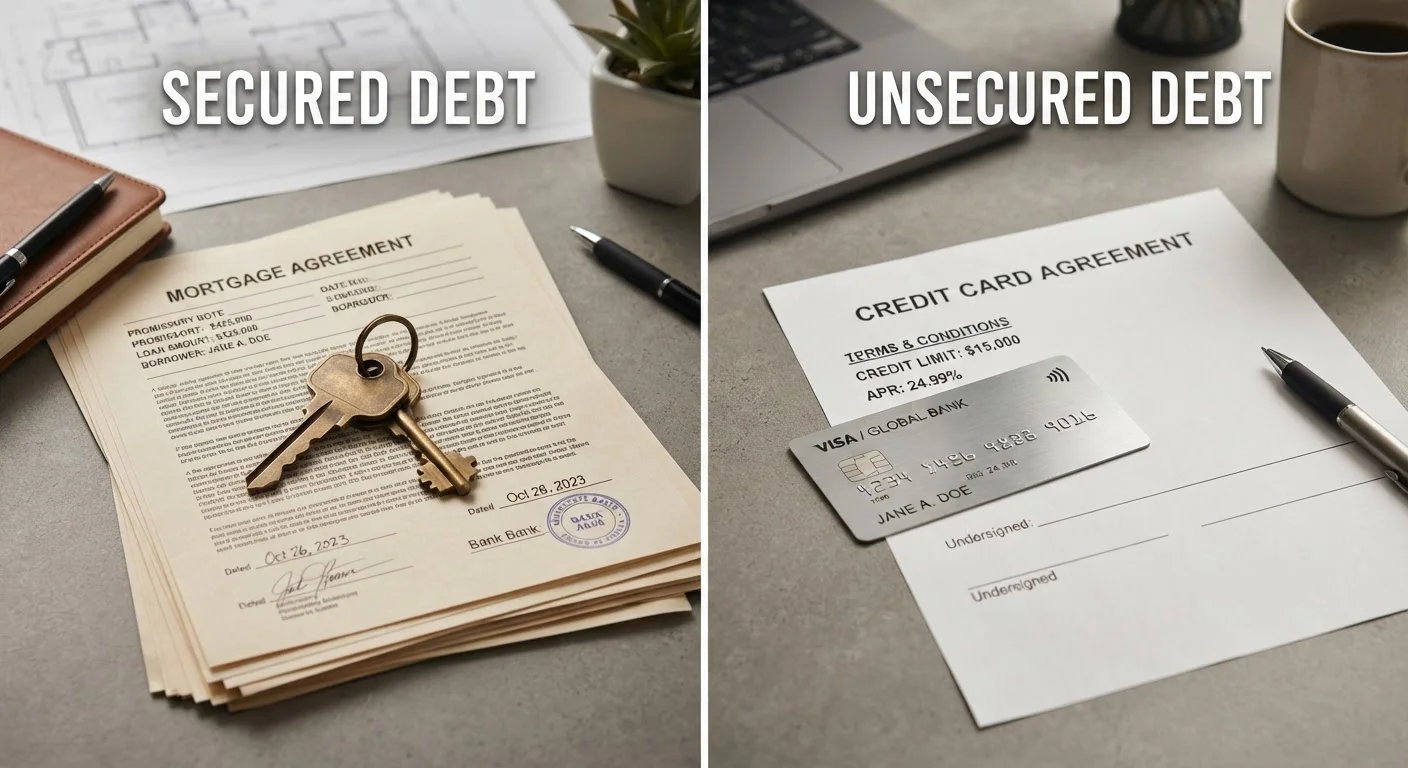
Understand what separates secured from unsecured debt, what lenders can do when payments stop, and how each type affects your credit.
Option A
Secured Debt
The collateral-backed obligation with lower rates and higher stakes.
Best for: Borrowers financing large purchases — like a home or vehicle — who can accept the risk of asset loss in exchange for more favorable terms.
Option B
Unsecured Debt
The asset-free obligation with greater flexibility and higher costs.
Best for: Borrowers seeking credit without pledging an asset, typically for everyday expenses, emergencies, or smaller personal financing needs.
Key takeaways
- Secured debt requires collateral — an asset the lender can seize if you stop paying.
- Unsecured debt carries no collateral requirement, but typically comes with higher interest rates.
- Defaulting on secured debt can result in repossession or foreclosure; unsecured default leads to collections and credit damage.
- Both debt types affect your credit score, but the consequences of default differ significantly.
- Understanding the distinction helps you evaluate risk before borrowing.
What Makes Debt 'Secured' or 'Unsecured'?
At its core, the difference between secured and unsecured debt comes down to one word: collateral. Collateral is an asset — a home, a car, savings in a specific account — that a borrower pledges to a lender as security for a loan. If payments stop, the lender has a legal claim to that asset.
With secured debt, the loan is literally secured by something of value. Mortgages are secured by the home being purchased. Auto loans are secured by the vehicle. If you default — meaning you fail to meet the terms of the loan agreement — the lender can pursue that collateral through foreclosure or repossession.
With unsecured debt, there's no specific asset attached to the obligation. Credit cards, most personal loans, student loans, and medical debt typically fall into this category. The lender extends credit based on your creditworthiness — primarily your credit history and income — rather than a pledge of property.
This fundamental structural difference shapes everything: the interest rate you're offered, what happens if you miss payments, and how difficult it is to qualify in the first place. For a broader overview of how credit and debt obligations work together, see our end-to-end guide to credit and debt.
How Lenders Price the Risk Differently
Lenders are in the business of managing risk, and the presence or absence of collateral directly influences what they charge. Because secured debt gives lenders a recovery path if things go wrong, they typically offer lower interest rates. A mortgage or auto loan rate is almost always lower than what you'd see on a credit card or unsecured personal loan for the same borrower.
Unsecured lenders, by contrast, have no asset to fall back on. If a borrower defaults, the lender's options are more limited: reporting the default to credit bureaus, selling the debt to a collection agency, or pursuing a court judgment. These remedies are slower and less certain than simply reclaiming a piece of property — so lenders charge a premium for the added risk.
| Criterion | Secured Debt | Unsecured Debt |
|---|---|---|
| Collateral required | Yes — specific asset pledged | No — based on creditworthiness |
| Typical interest rates | Generally lower | Generally higher |
| Common examples | Mortgage, auto loan, secured credit card | Credit card, personal loan, student loan |
| If you default | Lender may repossess or foreclose | Collections, credit damage, possible judgment |
| Qualification difficulty | Asset lowers barrier in some cases | Credit score and income are primary factors |
| Credit score impact | Adds installment loan to credit mix | Affects utilization ratio (revolving credit) |
Your credit score plays a more prominent role in unsecured lending than in secured lending. With a mortgage, the collateral provides a floor; with a personal loan or credit card, your credit profile is essentially the entire basis for the lender's decision. To understand exactly how lenders interpret your score, see our article on what credit score numbers actually mean.
What Happens When Payments Stop
Default consequences diverge sharply depending on the debt type, and understanding this can help you make smarter decisions about which obligations to prioritize during financial hardship.
With secured debt, the lender has a clear legal mechanism to recover the collateral. Miss enough mortgage payments — typically three to six months, though this varies by loan agreement and state law — and the lender can begin foreclosure proceedings. Miss auto loan payments and the vehicle can be repossessed, sometimes without advance warning depending on your state's laws. Losing either asset creates significant disruption and financial harm that extends well beyond the debt itself.
With unsecured debt, lenders can't seize a specific asset, but they still have meaningful tools. They will typically report the delinquency to the major credit bureaus, which can severely damage your credit score. The debt may be sold to a collection agency. And if the amount is significant, the creditor or collector may pursue a lawsuit and, if they obtain a judgment, potentially garnish wages or levy bank accounts — depending on applicable state law.
State Laws Vary on Default Remedies
The rules governing foreclosure timelines, repossession notice requirements, and wage garnishment differ significantly from state to state. For example, some states require a court process before a lender can repossess a vehicle; others do not. If you're facing difficulty making payments on any debt, contacting a nonprofit credit counselor or a consumer law attorney in your state is a practical first step to understanding your specific rights and options.
Both types of default cause lasting credit damage that can affect your ability to borrow for years. If you're comparing how lenders view different types of debt obligations, our piece on good debt versus bad debt offers useful context.
How Each Type Shapes Your Credit Profile
Both secured and unsecured debts appear on your credit report and influence your credit score — but in somewhat different ways.
Having a mix of credit types, including both installment loans (like a mortgage or auto loan) and revolving accounts (like credit cards), is a factor in how credit scoring models evaluate your profile. This is sometimes called credit mix, and while it's a relatively small component of most scoring models, it does reflect that lenders like to see experience managing different kinds of obligations.
On the utilization side, revolving unsecured credit — primarily credit cards — has a more immediate impact on your score through your credit utilization ratio, which is the percentage of your available revolving credit that you're currently using. High utilization tends to lower scores; keeping balances low relative to your credit limit is generally advisable. Secured installment loans don't factor into utilization the same way.
~$17.9T
Total US household debt (2024)
According to the Federal Reserve Bank of New York's Household Debt and Credit report, total household debt in the US reached approximately $17.9 trillion in late 2024, with mortgage debt comprising the largest secured category.
~$1.14T
US credit card debt outstanding
The Federal Reserve Bank of New York reported that US credit card balances — a primary form of unsecured revolving debt — surpassed $1 trillion and continued climbing through recent quarters.
30%
Credit utilization's weight in FICO scoring
FICO, one of the most widely used credit scoring models, attributes approximately 30% of a score to amounts owed, which includes utilization of revolving unsecured credit lines.
The bottom line: how you manage either type of debt — paying on time, keeping balances in check, not over-borrowing — matters far more than the type itself. Both secured and unsecured accounts can support a healthy credit profile when handled responsibly.
This article is for general informational and educational purposes only. It does not constitute personalized financial, legal, or tax advice. Consult a qualified financial professional before making decisions about your specific borrowing situation.
All published content on this website is for informational and educational purposes only and should not be taken as professional advice. We recommend that readers seek expert opinion before making any decisions. The website is not responsible for any actions taken based on the information provided on this website. We are not liable for any inaccuracies, modifications, or omissions in information. Moreover, external links or third-party content are provided for convenience; we are not liable for their correctness. Users are advised to verify every piece of information before they use it for any purpose.