
Debt Snowball vs. Debt Avalanche: Two Payoff Strategies Compared

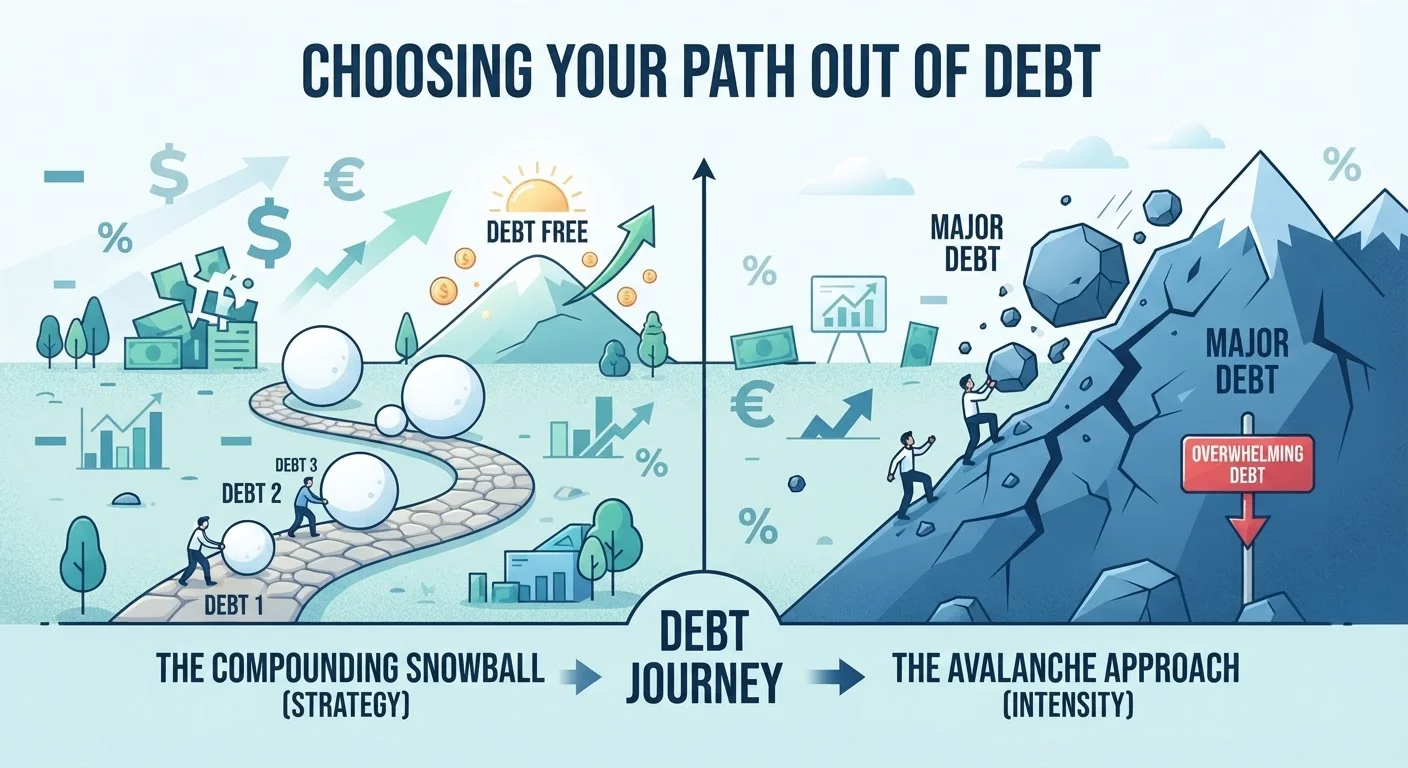
Explore how the snowball and avalanche repayment methods work, and which approach tends to suit different financial habits and goals.
Option A
Debt Snowball
The motivation-first, momentum-building approach.
Best for: People who need early wins to stay engaged and sustain long-term commitment to debt payoff.
Option B
Debt Avalanche
The mathematically optimal, interest-minimizing strategy.
Best for: People who are motivated by numbers and want to pay the least interest possible over time.
Key takeaways
- The debt snowball targets your smallest balance first; the avalanche targets your highest interest rate first.
- The avalanche method typically saves more money in total interest paid over the life of your debts.
- The snowball method can provide faster psychological wins, which may improve follow-through for some people.
- Both strategies require paying minimums on all debts while directing extra funds to one priority debt.
- Consistency matters more than method — the best strategy is the one you'll actually stick with.
- Consulting a certified financial counselor can help you tailor a repayment plan to your specific situation.
How Each Strategy Works
Both the debt snowball and the debt avalanche follow the same basic structure: pay the required minimum on every debt each month, then direct any extra money toward one specific target debt. Where they differ is how that target debt is chosen.
With the debt snowball, you rank your debts from smallest balance to largest, regardless of interest rate. Once the smallest balance is paid off entirely, you roll that freed-up payment into attacking the next smallest, and so on. The name reflects how momentum builds — each eliminated debt releases more cash to accelerate the next payoff.
With the debt avalanche, you rank your debts from highest annual percentage rate (APR) to lowest. Extra funds go toward the highest-rate debt first, since that's the one accumulating the most interest daily. Once it's gone, you redirect those funds to the next highest-rate account.
If you're newer to understanding how debt and credit interact, the foundational guide to debt and credit provides useful context before diving into repayment tactics.
| Criterion | Debt Snowball | Debt Avalanche |
|---|---|---|
| Priority order | Smallest balance first | Highest interest rate first |
| Total interest paid | Typically more over time | Typically less over time |
| Speed of first payoff | Often faster (small debts clear quickly) | Varies; may take longer for first win |
| Motivational style | Progress-driven, reward-based | Analytical, data-driven |
| Best debt composition | Many accounts at mixed rates | One or more high-rate outlier debts |
| Complexity | Simple to set up and track | Simple, but requires rate awareness |
The Math: What the Numbers Say
In purely mathematical terms, the avalanche method wins. Because high-interest debt grows faster, eliminating it first reduces the total interest that compounds across your entire debt load. Depending on your specific balances and rates, this can translate into meaningful savings — sometimes hundreds or even thousands of dollars — compared to the snowball approach.
The snowball, meanwhile, is not designed to minimize interest. It prioritizes the number of accounts closed over the dollar cost of those accounts. That means you may pay more in total interest — but you also see your list of creditors shrink faster, which can feel like real, tangible progress.
~$1,000+
Potential interest savings with avalanche vs. snowball
The exact savings vary widely by balance size, rates, and timeframe, but analyses frequently show the avalanche can save hundreds to over a thousand dollars on typical consumer debt portfolios.
77%
U.S. adults carrying some form of debt
According to Pew Research Center data, a large majority of American adults carry at least one form of debt, underscoring how broadly repayment strategies apply.
20%+
Average credit card APR in recent years
The Federal Reserve has reported average credit card interest rates exceeding 20% APR in recent periods, illustrating why rate targeting can matter significantly.
It's also worth understanding how interest actually accrues. Most consumer debts — credit cards, personal loans — charge interest on the outstanding principal each billing cycle. The higher the rate and the higher the balance, the more interest is added before you make a payment. The avalanche directly targets this dynamic.
For those weighing whether to consolidate rather than tackle each debt individually, the mechanics of debt consolidation offer an alternative lens worth exploring.
The Psychology of Payoff: Why Behavior Often Beats Math
Financial plans only work when people follow them. Research in behavioral economics consistently shows that human motivation is shaped by progress and reward — not just logic. This is the central argument for the snowball method.
When you pay off your first small debt in, say, two months, that account closure is a concrete, verifiable success. That experience can reinforce the behavior, making it more likely you'll continue. Dave Ramsey, the personal finance commentator, has long championed the snowball for exactly this reason — though it's important to note that individual outcomes vary widely depending on personal circumstances.
The avalanche, by contrast, can feel like a long slog if your highest-rate debt also happens to carry a large balance. You may be making payments for a year before that first account closes, which tests patience. For people who are highly analytical and find motivation in watching interest charges decline, the avalanche can feel equally rewarding — just in a different way.
The honest takeaway is this: the best debt repayment strategy is the one you'll actually execute consistently. Inconsistency — skipping extra payments, losing focus — erodes any mathematical advantage. Understanding what kind of borrower you are is as important as any spreadsheet calculation. For a broader look at how to frame your debts in context, see the distinction between good and bad debt.
Choosing What Works for Your Situation
Neither strategy is universally superior. Your choice should reflect your financial profile, your debt composition, and your behavioral tendencies.
Consider the snowball if you have several small balances you could clear within a few months, if you've struggled to stay motivated on debt plans before, or if reducing the number of open accounts matters to you practically (fewer payments, fewer due dates).
Consider the avalanche if you have one or two debts with dramatically higher interest rates than the others, if you're comfortable tracking numbers and find satisfaction in watching interest charges fall, or if the total dollar savings is a strong motivator for you.
Some people also use a hybrid approach: knock out one or two small debts quickly for a psychological boost, then switch to an avalanche ordering for the remaining, higher-rate accounts. This isn't a standard named method, but it reflects a pragmatic blending of both principles.
If credit card debt makes up a significant portion of what you owe, it may also be worth comparing that debt against other repayment vehicles. The comparison of credit card debt versus personal loans can help clarify whether restructuring those balances first makes sense before applying either payoff method.
Whatever path you choose, consider speaking with a nonprofit credit counselor or a certified financial planner who can help you assess your full picture without a sales agenda.
This article is for general informational and educational purposes only and does not constitute personalized financial or legal advice. For guidance tailored to your specific situation, consult a licensed financial professional.
All published content on this website is for informational and educational purposes only and should not be taken as professional advice. We recommend that readers seek expert opinion before making any decisions. The website is not responsible for any actions taken based on the information provided on this website. We are not liable for any inaccuracies, modifications, or omissions in information. Moreover, external links or third-party content are provided for convenience; we are not liable for their correctness. Users are advised to verify every piece of information before they use it for any purpose.