
The Complete Guide to Planning, Tracking, and Adjusting a Personal Budget

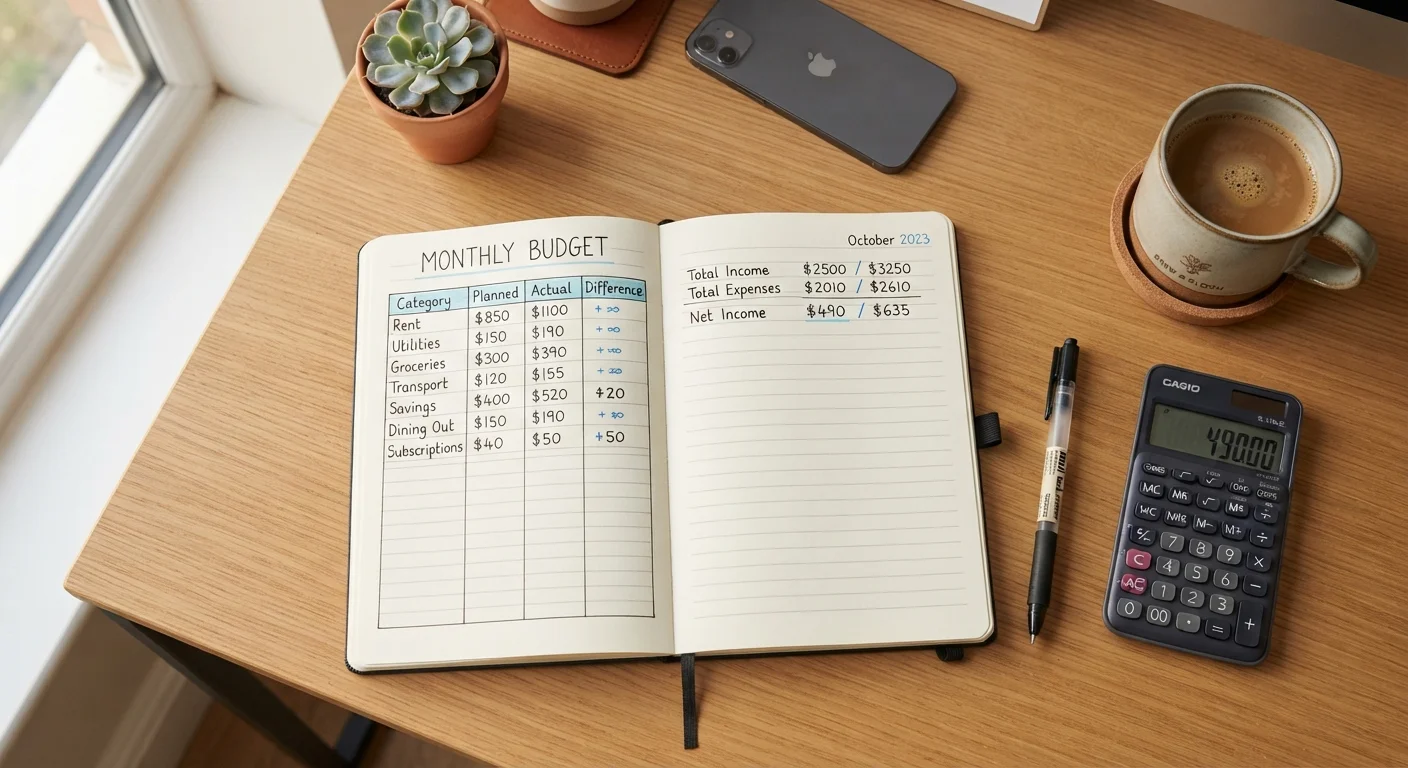
A comprehensive, end-to-end resource on personal budgeting — covering setup, tracking methods, adjustments, and long-term habits in one place.
Key takeaways
- Start with take-home pay, not gross income, to build a realistic spending plan.
- Categorizing spending reveals patterns that are invisible when you check spending ad hoc.
- The tracking method you'll actually use consistently beats the theoretically perfect one.
- Monthly budget reviews catch problems early before they become debt.
- Budgets require regular adjustment — life changes, and your plan should too.
- Connecting your budget to specific financial goals dramatically improves follow-through.
Why Budgeting Works — and Why Most People Quit
A personal budget is simply a plan for your money — a written or digital record of what comes in, where it goes, and what you intend to do differently. Yet surveys consistently suggest that fewer than half of U.S. adults maintain a formal budget. The gap between knowing budgeting helps and actually doing it comes down to one word: friction.
Most people quit budgets not because they lack discipline, but because the system they chose was too complicated, too rigid, or disconnected from anything they genuinely care about. The goal of this guide is to walk you through a realistic, end-to-end approach — from setting up your first budget to making it a durable habit — that is designed to survive contact with real life.
< 50%
U.S. adults who maintain a formal budget
Consistent findings across multiple consumer finance surveys suggest fewer than half of American adults use a written or tracked budget.
3–6 months
Income history needed for variable earners to baseline
Financial planning guidance commonly recommends averaging at least three to six months of income data before setting budget targets for irregular earners.
20%
Recommended savings and debt repayment allocation
The widely referenced 50/30/20 guideline suggests directing roughly 20% of take-home pay toward savings goals and debt repayment beyond minimums.
It is worth being clear about what a budget cannot do: it cannot eliminate every financial hardship or guarantee any specific outcome. What it can do is give you clearer information so that your decisions are intentional rather than reactive.
Step One: Know Your Real Income
Before you allocate a single dollar, you need an accurate picture of the money actually landing in your bank account — your net income, sometimes called take-home pay. This is your income after taxes, health insurance premiums, retirement contributions, and any other payroll deductions have already been removed.
Many budgets fail immediately because people plan against their gross (before-tax) salary and then feel perpetually short. Use the number on your paycheck or direct deposit, not the figure on your offer letter.
If your income is variable — you freelance, work hourly with fluctuating shifts, or receive tips or commissions — use a conservative estimate. Average your last three to six months of take-home pay and budget to the lower end. It is far easier to redirect a surplus at the end of the month than to scramble for a shortfall.
- Salaried workers: Use your net pay per pay period × number of pay periods per year ÷ 12 for a monthly figure.
- Variable earners: Total the last six months of deposits and divide by six for a working monthly baseline.
- Multiple income streams: Include all reliable sources but treat irregular windfalls (bonuses, tax refunds) separately and plan for them explicitly.
Step Two: Map Your Spending Categories
Once you know what flows in, the next step is understanding what flows out. Pull your last two to three months of bank and credit card statements and group every transaction into broad categories. Common groupings include:
- Fixed essentials — rent or mortgage, car payment, insurance premiums, loan minimums. These amounts do not change month to month.
- Variable essentials — groceries, utilities, gas, medical copays. Necessary but fluctuating.
- Discretionary spending — dining out, entertainment, subscriptions, clothing, hobbies.
- Savings and debt repayment — contributions to emergency funds, retirement accounts, or extra payments toward debt. Treating these as a spending category — rather than whatever is left over — is the key habit shift.
After categorizing, total each group and compare it to your income. Many people find this exercise genuinely surprising. Seeing three months of data removes the ability to rationalize individual purchases and reveals patterns instead.
If you want to explore structured frameworks for dividing these categories — such as the popular 50/30/20 guideline or envelope-style approaches — see our overview of widely used budgeting methods for an honest look at what each suits.
When categorizing past spending, ignore nothing — even small recurring charges add up. A $12 subscription you forgot about costs $144 a year.
Recurring small expenses are among the most common sources of silent budget leakage, and they only show up clearly when you review full statements rather than spot-checking individual purchases.
Create a dedicated "irregular expenses" category and contribute a fixed monthly amount to it — even $30–$50 — so annual costs like car registration or holiday gifts do not blow up your budget when they arrive.
Irregular but predictable costs are among the most common reasons monthly budgets fail. Pre-funding them monthly smooths out the impact and prevents the need for reactive debt.
Step Three: Choose a Tracking Method That Fits Your Life
There is no universally superior way to track a budget. The method you will realistically use every week is more valuable than any theoretically optimal system you abandon by March. Here are the main options:
Spreadsheets
A simple spreadsheet — whether in a desktop program or a browser-based tool — gives you complete control and transparency. You build exactly what you need, nothing more. The trade-off is that you must enter data manually, which takes discipline but also forces you to confront your spending in a meaningful way.
Pen and Paper
Old-fashioned and underrated. Writing down transactions by hand creates a deliberate pause that digital tools often eliminate. It works especially well for people who spend impulsively with cards but slow down when they have to record every purchase physically.
Budgeting Apps
Many apps link directly to bank and card accounts and categorize transactions automatically. This reduces friction and provides real-time visibility. The main caution: auto-categorization makes errors, and if you do not review the data regularly, you can develop a false sense of awareness without actual understanding.
Whichever method you choose, the non-negotiable is a weekly check-in — even a five-minute review of where you stand relative to your categories prevents small overages from compounding silently.
Step Four: Review and Adjust Regularly
A budget is not a document you write once and file away. It is a living plan that needs deliberate maintenance. Build two review rhythms into your routine:
Weekly Check-In (5–10 minutes)
Compare actual spending to your category targets. Flag any categories running high with enough time in the month to correct course — whether that means cooking at home more, postponing a discretionary purchase, or simply acknowledging the overage and preparing to adjust next month's allocation.
Monthly Reset (20–30 minutes)
At the end of each month, close out the numbers and set up the next month's plan. Adjust category amounts based on what you learned. Not every month is identical — irregular expenses like car registration, holiday gifts, or annual subscriptions need to be anticipated and spread across months rather than treated as surprises.
Do Not Skip the Monthly Reset
Skipping even one monthly review allows undetected overages to roll into the next month and compound. A budget that is never reconciled is little different from having no budget at all. Schedule your monthly reset as a recurring calendar event and protect that time as you would any financial obligation.
Over time, your budget will also need to reflect major life changes: a new job, a move, a new household member, or a shift in financial goals. Treat these moments as scheduled opportunities to rebuild the plan from scratch rather than patch the old one.
Managing debt and credit is often where these adjustments matter most. Our debt and credit guidance hub covers how to work debt repayment into a sustainable budget without derailing other goals.
Building Long-Term Budgeting Habits
The difference between people who budget successfully for years and those who cycle through restarts is usually not willpower — it is systems and motivation. A few practices that support consistency:
Tie Your Budget to Specific Goals
Abstract categories are easy to deprioritize. A savings line labeled "Emergency Fund: $1,000 target" is far more motivating than one labeled "Savings." Name your goals explicitly and track progress toward them in your budget document. When your goals connect to your actual life — a home purchase, paying off a specific debt, building a three-month cushion — the budget becomes a tool in service of something you want, not a constraint imposed on you.
When you are ready to take the next step beyond budgeting, explore our saving and growing hub for practical guidance on building savings and putting money to work over time.
Reduce Decision Fatigue Through Automation
Automate savings contributions and bill payments where possible so that the most important allocations happen before you have a chance to spend them. This "pay yourself first" approach removes a significant amount of daily mental overhead from budgeting.
Be Honest, Not Punishing
When you go over budget in a category — and you will, because everyone does — treat it as data, not failure. Ask what caused it, decide whether your allocation was unrealistic or whether behavior drove the overage, and adjust accordingly. A budget that accommodates real life will outlast a perfect plan that collapses the moment something goes wrong.
This article is for general informational and educational purposes only and does not constitute personalized financial advice. For guidance specific to your financial situation, consult a qualified financial professional.
All published content on this website is for informational and educational purposes only and should not be taken as professional advice. We recommend that readers seek expert opinion before making any decisions. The website is not responsible for any actions taken based on the information provided on this website. We are not liable for any inaccuracies, modifications, or omissions in information. Moreover, external links or third-party content are provided for convenience; we are not liable for their correctness. Users are advised to verify every piece of information before they use it for any purpose.