
Open Source vs Proprietary AI: What Everyday Users Should Understand

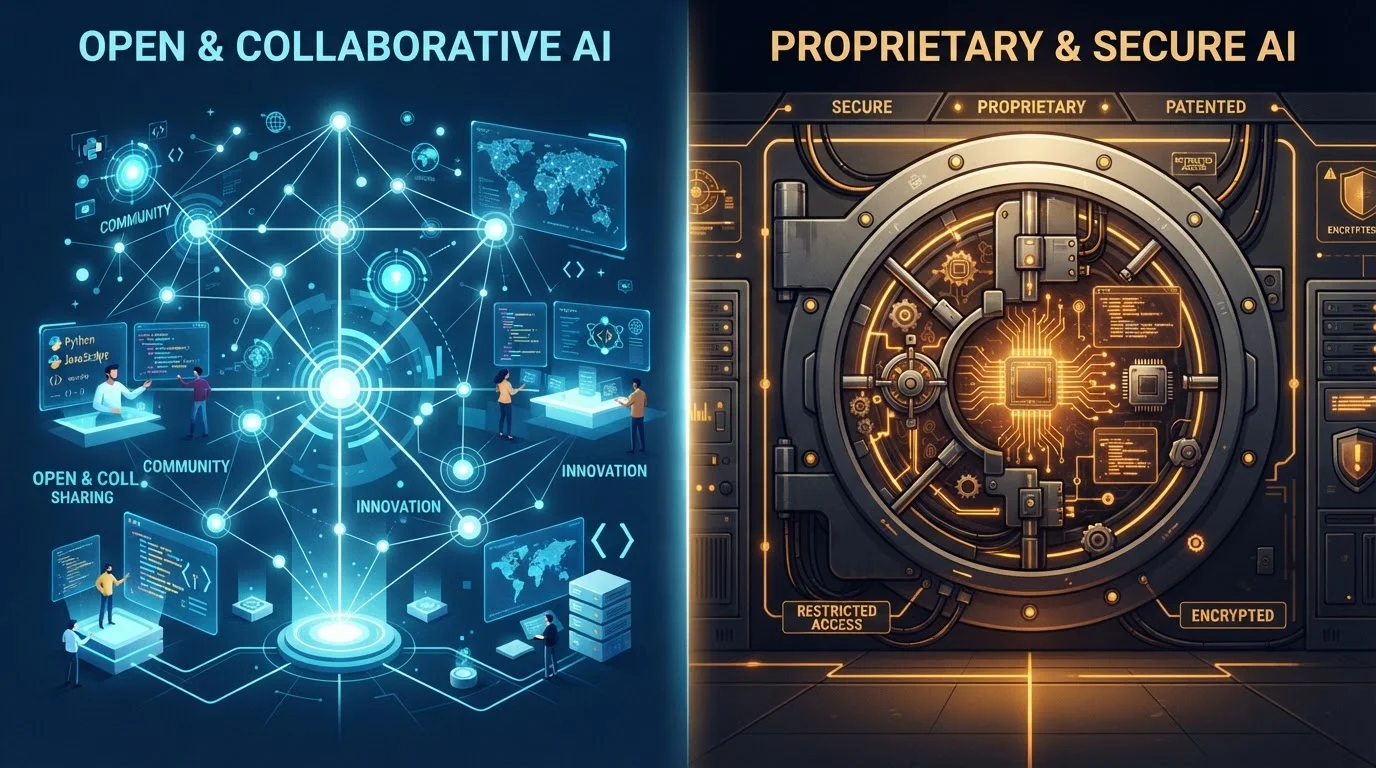
Who controls AI models matters — for privacy, access, and how tools evolve. Here's a balanced look at the trade-offs between open and closed AI development.
Option A
Open Source AI
The transparent, community-driven approach to AI development.
Best for: Developers, researchers, privacy-conscious users, and organizations that want maximum control over how AI models are deployed and modified.
Option B
Proprietary AI
The polished, managed AI experience from a single controlling organization.
Best for: Everyday users and businesses that prioritize ease of use, reliability, and access to continuously updated, well-supported AI tools.
Key takeaways
- Open source AI makes model code publicly available, allowing anyone to inspect, modify, or deploy it independently.
- Proprietary AI is developed and controlled by a single company, with access gated through products or APIs.
- Neither approach is universally safer or more capable — each carries distinct trade-offs in privacy, cost, and customization.
- For most everyday users, the choice matters more indirectly — through which tools they trust and which companies hold their data.
- Regulatory and accountability questions differ significantly between open and closed AI systems.
What 'Open' and 'Proprietary' Actually Mean in AI
When people talk about open source AI, they generally mean AI systems whose underlying model weights, code, and sometimes training details are made publicly available. Anyone can download these models, examine how they work, modify them, and — depending on the license — build products on top of them. Well-known examples include Meta's LLaMA family of models and the Mistral series.
Proprietary AI works differently. The model is developed internally by a company, and users interact with it only through an interface or API that the company controls. The model's architecture, training data, and weights are not publicly disclosed. OpenAI's GPT-4, Google's Gemini, and Anthropic's Claude are examples of this approach.
It is worth noting that open source can mean different things across different AI releases. Some models release weights but not training code or data; others release everything. The licensing terms behind a given AI release determine exactly what users can and cannot do with it — a nuance that matters considerably for anyone building on top of these systems.
| Criterion | Open Source AI | Proprietary AI |
|---|---|---|
| Code & model access | Publicly available (varies by license) | Not disclosed; access via API or product |
| Data privacy | Can run locally; no third-party data transfer | Data processed on provider's servers |
| Customization | High — fine-tuning and modification possible | Limited to what the provider permits |
| Ease of use | Requires technical setup in most cases | Polished interfaces; minimal setup needed |
| Safety oversight | Community-distributed; no central authority | Centralized safety teams and controls |
| Cost structure | Free to use; infrastructure costs on user | Subscription or usage-based pricing typical |
| Regulatory accountability | Diffuse; harder to assign responsibility | Single identifiable organization accountable |
Privacy, Control, and Who Holds Your Data
For everyday users, one of the most practical distinctions involves data handling. When you use a proprietary AI service — whether through a consumer app or a business API — your prompts and outputs typically pass through the provider's servers. The provider's privacy policy governs what happens to that data, including whether it may be used to improve future models.
Open source models, when run locally or on infrastructure you control, shift that dynamic. Your inputs do not leave your own environment. This is why some healthcare providers, legal teams, and privacy-focused individuals have shown interest in self-hosted open models — not necessarily because the models are more accurate, but because the data governance picture is clearer.
The trade-off is technical burden. Running a capable open model locally requires meaningful hardware investment, and keeping up with updates and security patches falls on the user or organization rather than a central provider. For most consumers, that overhead isn't practical.
As AI confidence and accuracy can diverge regardless of who built the model, the underlying development model does not automatically resolve questions of reliability — both open and proprietary systems can produce confident-sounding errors.
Innovation, Safety, and Accountability
Supporters of open AI development argue that transparency accelerates progress. When researchers worldwide can inspect, test, and improve a model, problems — including safety issues — can be identified faster and by a broader community. Open models also prevent any single organization from holding monopoly control over increasingly powerful technology.
Critics raise a legitimate counterpoint: once a powerful model is publicly released, it cannot be recalled. A proprietary system can push safety patches, restrict harmful capabilities, or throttle access; an open model that has already been downloaded thousands of times cannot be meaningfully controlled after release. This asymmetry is a genuine policy challenge, not simply a talking point from one side.
Proprietary providers, for their part, typically invest in dedicated safety teams, red-teaming, and ongoing monitoring. They can also be held accountable more directly — regulators know exactly which organization to engage. Open ecosystems distribute both innovation and accountability across many actors, which complicates regulatory oversight.
These tensions are part of the broader conversation explored in the trade-offs behind a fully automated world — questions about who bears responsibility when automated systems cause harm are no simpler in AI than in other domains.
What This Means for Curious Everyday Users
Most people will never directly choose between open and proprietary AI — they will simply use the tools available to them through apps, search engines, or workplace software. But understanding the distinction helps you ask better questions about those tools.
When you use an AI feature embedded in a consumer product, it is worth asking: Who built the underlying model? What does the provider's privacy policy say about your inputs? Is there an option to opt out of data collection for model training?
If you are curious about exploring open AI systems, many platforms now allow users to run or interact with open models without advanced technical skills — though the polished experience of a proprietary product usually isn't replicated exactly. Generative AI's real capabilities are often overstated in either direction; neither open nor proprietary systems are magic, and both have meaningful limitations.
The honest answer is that neither model is universally superior. Open source AI offers transparency, control, and the ability to customize — at the cost of complexity and shared responsibility for safety. Proprietary AI offers convenience, support, and centralized accountability — at the cost of opacity and dependency on a single provider's decisions. Knowing which trade-offs matter to you is the first step to engaging with AI tools on your own terms.
All published content on this website is for informational and educational purposes only and should not be taken as professional advice. We recommend that readers seek expert opinion before making any decisions. The website is not responsible for any actions taken based on the information provided on this website. We are not liable for any inaccuracies, modifications, or omissions in information. Moreover, external links or third-party content are provided for convenience; we are not liable for their correctness. Users are advised to verify every piece of information before they use it for any purpose.