
Quantum Computing vs Classical Computing: What the Difference Actually Means

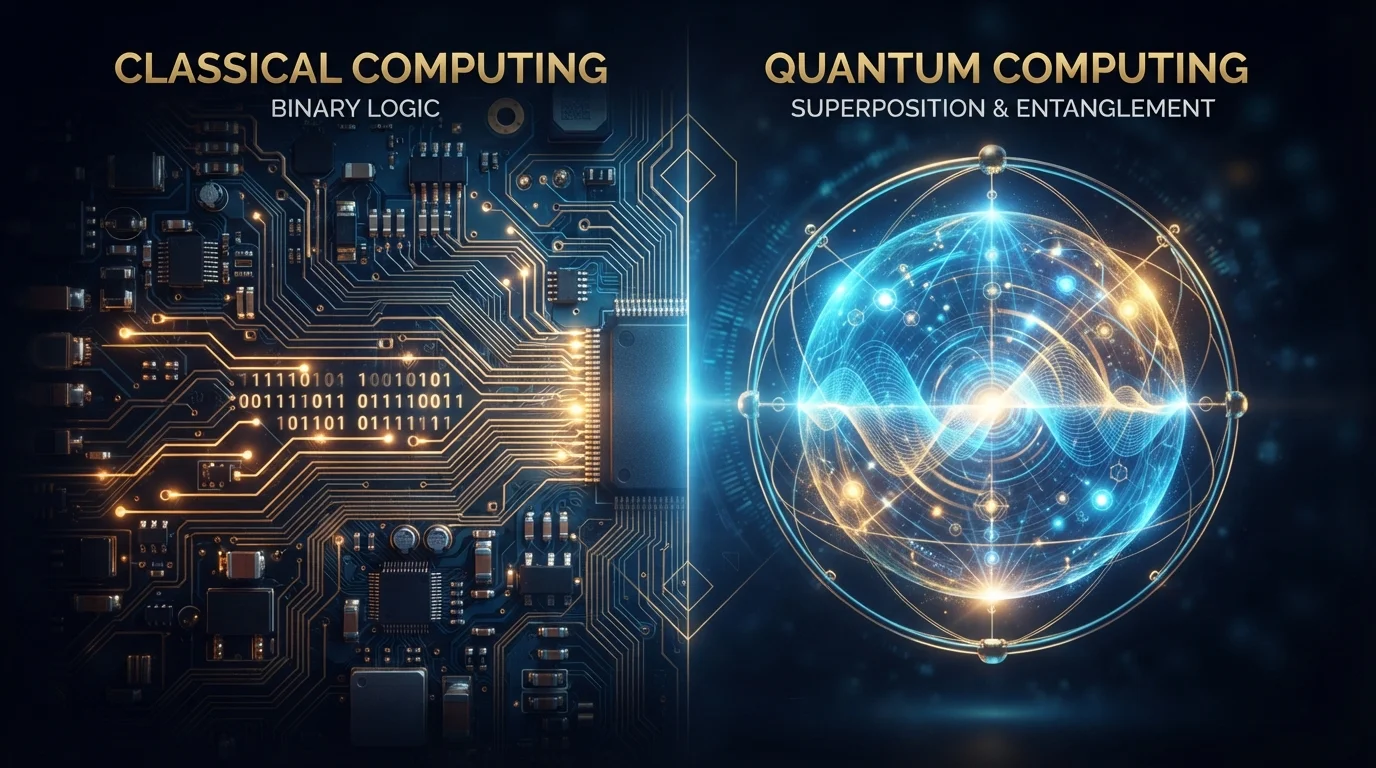
Quantum computers aren't just faster classical machines. Here's what sets them apart, where they currently stand, and why it matters for the future.
Option A
Classical Computing
The established, universal workhorse of modern technology.
Best for: Everyday tasks, business software, browsing, gaming, and most real-world computing problems people and organizations face today.
Option B
Quantum Computing
The emerging, specialized approach rewriting the rules of computation.
Best for: Solving specific, extraordinarily complex problems in science, cryptography, and optimization that overwhelm even the most powerful classical machines.
Key takeaways
- Classical computers use bits (0 or 1); quantum computers use qubits, which can exist in multiple states simultaneously.
- Quantum computers are not universally faster — they excel at a narrow class of problems classical machines struggle with.
- Most practical quantum computers are still experimental and require extreme cooling conditions to function.
- Quantum computing poses a long-term risk to current encryption methods, prompting active research into quantum-safe security.
- For everyday consumers, classical computing remains the relevant technology for the foreseeable future.
The Core Difference: Bits vs. Qubits
Every classical computer — from your laptop to the servers running the internet — processes information as bits. A bit is always either a 0 or a 1. Think of it as a light switch: it's either off or on. All classical computation, no matter how sophisticated, is built from billions of these simple binary decisions happening at extraordinary speed.
Quantum computers work on an entirely different foundation. Instead of bits, they use qubits (quantum bits). Thanks to a quantum physics property called superposition, a qubit can represent 0, 1, or any combination of both states simultaneously — until it's measured and "collapses" to a definite value. A second key property, entanglement, allows qubits to be correlated in ways that have no classical equivalent, letting quantum systems coordinate information across multiple qubits at once.
The practical result: a quantum computer with enough stable qubits can theoretically explore many possible solutions to a problem at the same time, rather than checking each one sequentially. That's not the same as being universally faster — it means quantum computers are structurally better suited to certain types of problems where the number of possible combinations explodes rapidly.
Where Each Approach Actually Excels
Classical computers are unmatched for deterministic, sequential tasks: running operating systems, rendering graphics, processing financial transactions, streaming video, or executing the logic of any standard application. The entire modern digital world runs on classical architecture, and that won't change any time soon.
Quantum computers, by contrast, are being developed to tackle specific problem categories where classical machines hit hard limits. Key areas of active research include:
- Molecular simulation: Modeling the behavior of molecules for drug development or materials science, where the quantum nature of electrons makes classical simulation exponentially expensive.
- Optimization: Finding the best solution among an astronomical number of variables, such as logistics routing or financial portfolio modeling.
- Cryptography: Quantum algorithms — particularly Shor's algorithm — could theoretically factor large numbers far more efficiently than classical computers, which has significant implications for current encryption standards.
- Machine learning research: Certain quantum approaches may accelerate specific training or data-pattern tasks, though this remains an active and contested area of research.
| Criterion | Classical Computing | Quantum Computing |
|---|---|---|
| Basic unit of information | Bit (0 or 1) | Qubit (0, 1, or superposition) |
| Operating environment | Room temperature | Near absolute zero (~0.015 Kelvin) |
| General-purpose use | Yes — handles virtually all tasks | No — specialized problem types only |
| Error rates | Extremely low, highly reliable | Currently high; active research area |
| Encryption threat | No threat to current standards | Long-term theoretical threat to RSA/ECC |
| Commercial availability | Universally available | Limited to research/cloud platforms |
| Best problem type | Sequential, deterministic tasks | Combinatorial, simulation, optimization |
Importantly, quantum computers are not plug-and-play replacements for classical ones. They require near absolute-zero temperatures (colder than outer space), sophisticated error-correction techniques, and highly specialized programming models. Most current systems are available only through cloud-based research platforms and are not commercially deployable for general use.
Where Quantum Computing Actually Stands Today
The state of quantum computing is best understood as promising but early-stage. Researchers commonly use the term NISQ era — Noisy Intermediate-Scale Quantum — to describe where the technology sits. Current quantum processors have enough qubits to perform interesting experiments but still suffer from high error rates and decoherence (the tendency for qubits to lose their quantum state before a calculation completes).
What 'Quantum Supremacy' Actually Means
You may have seen headlines claiming a quantum computer achieved 'quantum supremacy' or 'quantum advantage.' These terms mean a quantum system completed a specific, carefully chosen benchmark task faster than a classical computer could — not that quantum computers are generally superior. Critics have noted that some benchmark tasks were designed specifically to favor quantum architectures and have limited real-world utility. Treat such claims as research milestones, not proof of broad commercial readiness.
Major research institutions and technology companies are investing heavily in increasing qubit counts, improving error correction, and extending coherence times. However, the quantum computers capable of breaking modern encryption or definitively outperforming classical supercomputers at practical tasks — sometimes called fault-tolerant quantum computers — remain a research goal rather than a present reality.
For everyday people, the immediate impact of quantum computing is indirect: advances will likely filter through industries like pharmaceuticals, logistics, and cybersecurity before they touch consumer technology. The most tangible near-term effect may be the push to update encryption standards — work that the U.S. National Institute of Standards and Technology (NIST) formalized in 2024 with the release of its first post-quantum cryptography standards.
All published content on this website is for informational and educational purposes only and should not be taken as professional advice. We recommend that readers seek expert opinion before making any decisions. The website is not responsible for any actions taken based on the information provided on this website. We are not liable for any inaccuracies, modifications, or omissions in information. Moreover, external links or third-party content are provided for convenience; we are not liable for their correctness. Users are advised to verify every piece of information before they use it for any purpose.