
Building Your First Real Budget: A Practical Starting Point

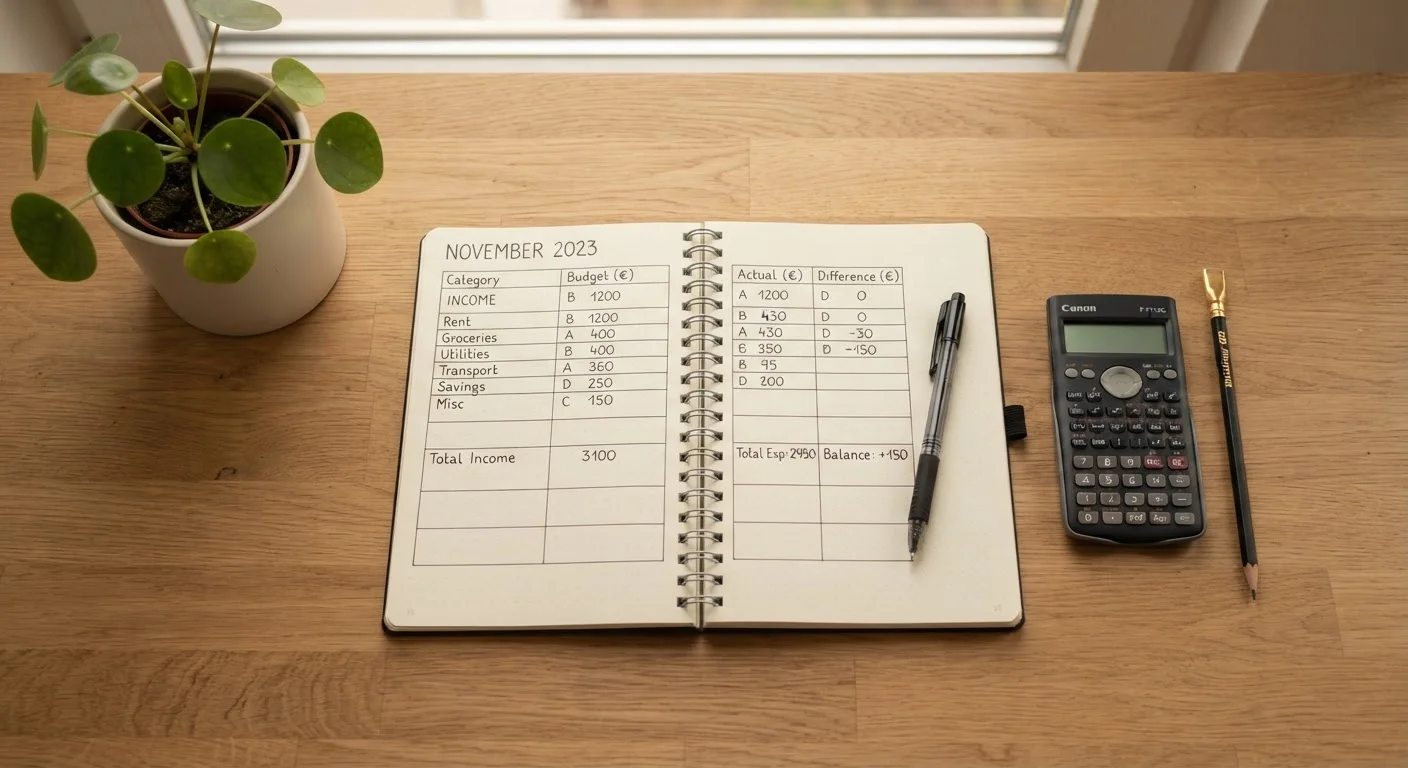
A clear, beginner-friendly introduction to budgeting — from tracking income to allocating money with purpose.
Start here
Why Budgeting Is Worth Starting Now
Foundation
Step One: Know Your Real Take-Home Income
Build
Step Two: Map Out Where Your Money Goes
Allocate
Step Three: Assign Every Dollar a Job
Choose your approach
Choosing a Budgeting Method That Fits Your Life
Stay consistent
Making Your Budget Stick Month After Month
Key takeaways
- A budget works by giving every dollar a purpose before the month begins.
- Your after-tax take-home pay — not gross income — is the correct starting figure.
- Tracking actual spending for one month reveals patterns you can't guess from memory.
- No single budgeting method suits everyone; the best one is the one you'll use.
- Small, consistent adjustments outperform a perfect plan you abandon after two weeks.
Why Budgeting Is Worth Starting Now
Most people who avoid budgeting aren't careless — they're uncertain where to begin. A budget isn't a punishment for spending too much or a tool reserved for people drowning in debt. It's simply a plan that tells your money where to go before the month gets a chance to spend it for you.
Without a plan, spending tends to expand quietly to fill whatever income is available. At the end of the month, there's often a vague sense that more should have been saved, but no clear picture of why. A budget replaces that vagueness with visibility. It also creates the foundation for larger goals — an emergency fund, a home purchase, or eventually, financial independence.
If you've wondered whether budgets are realistic or whether common assumptions about them hold up, our article on budgeting myths that keep people from starting addresses those doubts directly. This guide focuses on the practical mechanics: how to build one that actually works for your life.
This article provides general financial education and is not personalized financial advice. Consider consulting a qualified financial professional for guidance specific to your situation.
Step One: Know Your Real Take-Home Income
Every budget starts with one honest number: how much money actually arrives in your account each month. This is your net income — your pay after taxes, health insurance premiums, retirement contributions, and any other automatic deductions. It is not your salary or your hourly rate multiplied out. Using the wrong figure here throws off every category that follows.
If you receive a consistent paycheck, this number is straightforward to find on your pay stub. If your income varies — due to freelance work, tips, or irregular hours — build your baseline from your lowest reliable month rather than an average. That way, your budget holds even in a slower period. Our dedicated guide on budgeting around an irregular income goes deeper on that scenario.
Net income
The amount of money you actually receive after taxes and other deductions are taken out of your paycheck. This is the figure you should use as your budget's starting point.
Gross income
Your total earnings before any taxes or deductions are removed. This number is always higher than net income and should not be used as the base for your budget.
Fixed expenses
Bills and payments that stay the same every month, such as rent, a car loan payment, or a fixed-rate insurance premium. These are easy to predict and should be the first items allocated in any budget.
Discretionary spending
Money spent on non-essential items and experiences — dining out, entertainment, subscriptions, or hobbies. This is usually the most flexible category in a budget.
Zero-based budgeting
A budgeting method where every dollar of income is assigned to a specific category so that income minus all allocations equals zero. Every dollar has a designated purpose.
Emergency fund
A dedicated pool of savings set aside to cover unexpected expenses — such as a car repair or medical bill — without derailing your regular budget or going into debt.
Once you have your monthly net income confirmed, write it at the top of your budget. Every allocation you make comes out of that number — nothing more.
Step Two: Map Out Where Your Money Goes
Before you can plan spending, you need to understand your actual spending. Pull up one to three months of bank and credit card statements and categorize every transaction. Common categories include:
- Fixed essentials: Rent or mortgage, utilities, loan payments, insurance premiums — amounts that don't change month to month.
- Variable essentials: Groceries, gas, prescriptions — necessary but fluctuating.
- Discretionary spending: Dining out, subscriptions, entertainment, clothing — spending that reflects choices rather than obligations.
- Savings and debt repayment: Any money directed toward a savings account, emergency fund, or debt beyond the minimum payment.
Total each category. Most people find at least one area where spending is noticeably higher than expected. That's not a reason to feel bad — it's the point of the exercise. Knowing is the prerequisite to changing.
For plain definitions of terms like discretionary spending, cash flow, and sinking fund, see our plain-language budget glossary.
Step Three: Assign Every Dollar a Job
With your income at the top and your spending categories mapped, you can now build the actual budget. The goal is straightforward: every dollar of income should be assigned to a category — including savings — so that income minus all allocations equals zero. This doesn't mean spending every dollar; it means accounting for every dollar intentionally.
Start with your non-negotiable fixed expenses. Subtract those from your net income. Then allocate for variable essentials based on realistic averages from your spending review. What remains is available for discretionary spending and savings goals.
Build savings in as a non-negotiable line item
One of the most common budgeting mistakes is treating savings as whatever is left at the end of the month. Instead, list savings as a fixed category alongside rent and groceries. Even a modest regular contribution builds momentum over time and makes the habit automatic.
If your total allocations exceed your income, you have two levers: reduce spending in flexible categories or look for ways to increase income over time. If there's money left unassigned, direct it with purpose — toward an emergency fund, a specific savings goal, or accelerated debt repayment. Leaving it unassigned tends to result in it disappearing without a trace.
For a step-by-step structured approach to this process, the monthly budget setup checklist offers a practical walkthrough.
Choosing a Budgeting Method That Fits Your Life
No single budgeting framework is universally superior. What matters is finding an approach that matches your habits and your level of detail preference. A few widely recognized methods worth understanding:
- 50/30/20
- Allocates roughly 50% of take-home pay to needs, 30% to wants, and 20% to savings and debt repayment. Simple to apply and flexible enough for most situations.
- Zero-based budgeting
- Every dollar of income is assigned a category so that income minus allocations equals zero. Provides maximum visibility and control.
- Pay-yourself-first
- Savings are transferred out automatically at the start of each month before any other spending occurs. Effective for people who find it hard to save what's left over at month's end.
- Envelope or category-based budgeting
- Spending categories have firm caps; once a category is exhausted, spending stops until the next month. Works well for people prone to overspending in specific areas.
Our overview of budgeting methods covers each approach in more depth, including honest notes on who each tends to suit. Trying one method for a full month before deciding it doesn't work is a reasonable policy — early awkwardness is normal.
Making Your Budget Stick Month After Month
A budget built once and never revisited stops being useful quickly. Life changes — income shifts, bills arrive unexpectedly, goals evolve. The habit that matters most is a brief monthly review: compare what you planned to spend against what you actually spent, adjust categories that need it, and carry forward what you learned.
A few practices that help with consistency:
- Schedule a recurring budget date. Treat it like a bill — the first Saturday of each month, for example. Fifteen minutes is usually enough for a simple review.
- Don't quit after a bad month. Overspending in a category is information, not failure. Adjust the category or the behavior and continue.
- Automate where possible. Automatic transfers to savings accounts remove the friction of a manual decision each month.
- Keep it visible. A budget you can't easily access is a budget you won't check.
For a more detailed first-month walkthrough — including what to expect when things don't go to plan — see your first month on a budget. And if you want a comprehensive end-to-end resource that covers everything from setup through long-term habits, the complete personal budgeting guide is a natural next step.
The measure of a good budget isn't perfection — it's whether you understand your money better this month than last. That's the real starting point.
Frequently Asked Questions
All published content on this website is for informational and educational purposes only and should not be taken as professional advice. We recommend that readers seek expert opinion before making any decisions. The website is not responsible for any actions taken based on the information provided on this website. We are not liable for any inaccuracies, modifications, or omissions in information. Moreover, external links or third-party content are provided for convenience; we are not liable for their correctness. Users are advised to verify every piece of information before they use it for any purpose.