
How Parking Costs Shape Commute Decisions More Than People Realize

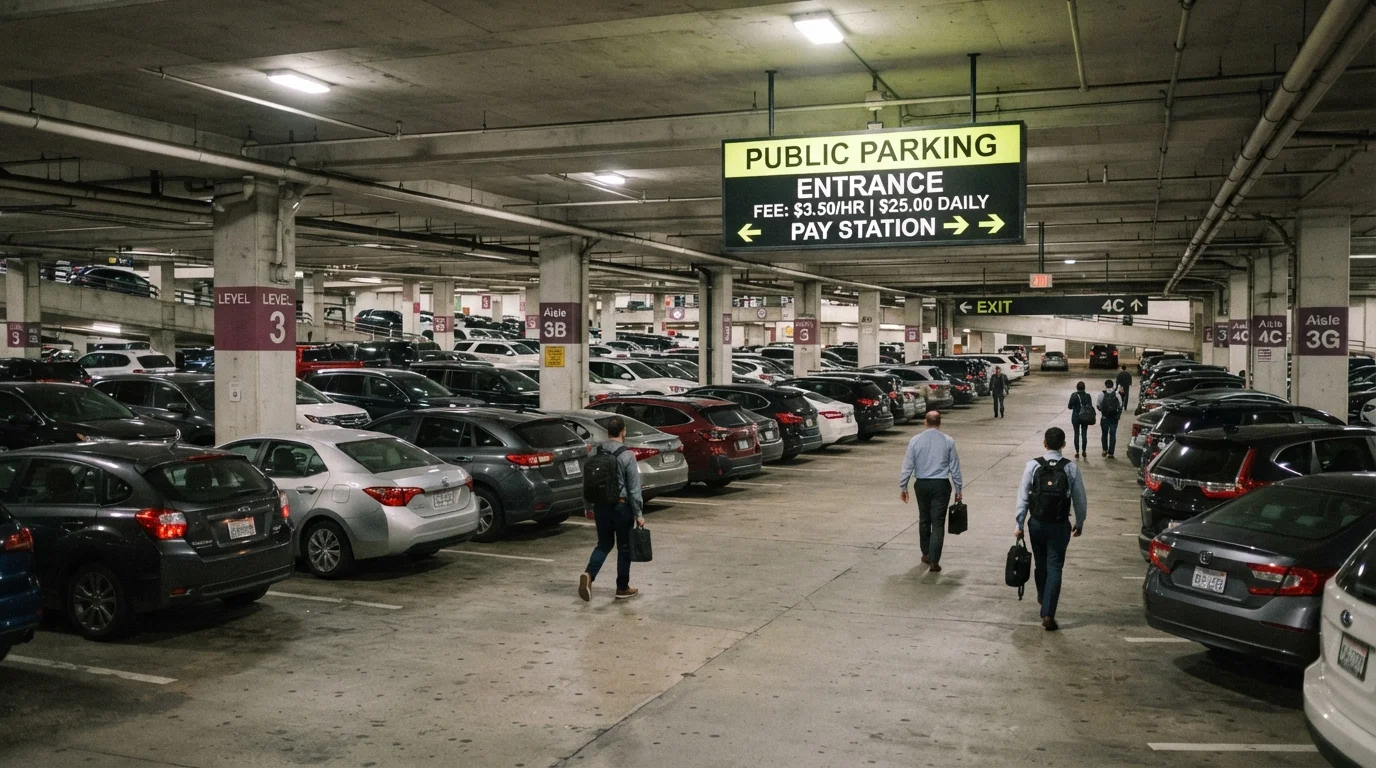
Parking fees quietly consume a significant chunk of commuter budgets. Here's how to factor them into any honest commuting comparison.
Key takeaways
- Parking fees routinely exceed $2,000–$5,000 per year in mid-to-large American cities when calculated over a full work year.
- Most commuters undercount parking costs because they think in daily increments rather than annual totals.
- Employer-subsidized parking above IRS limits may be treated as taxable income, reducing its apparent value.
- Switching modes or using park-and-ride can eliminate or drastically reduce parking exposure.
- Parking cost transparency is essential for any honest apples-to-apples commute comparison.
The Hidden Math Most Commuters Skip
Ask most drivers what their commute costs and they'll quote you a gas figure. Parking — the fee they hand over every single workday — rarely makes the mental shortlist. Yet for millions of Americans commuting into dense employment centers, parking charges quietly become the second or third largest recurring commute expense, often surpassing fuel.
The disconnect is largely psychological. A $20 daily parking fee feels like a small, routine transaction. Multiplied across roughly 250 workdays, it becomes $5,000 per year — a figure that would stop most people cold if it appeared as a single annual invoice. This is what behavioral economists call the disaggregation effect: small, frequent payments feel less significant than equivalent lump sums, which leads people to chronically undercount them in household budgets.
For a more complete picture of everything that accumulates when you drive to work, see The Real Cost of Driving to Work Every Day, which walks through fuel, insurance, and wear costs alongside parking.
$5,000+
Typical annual parking cost in major US urban cores
At common daily garage rates of $20–$25 across 250 workdays, parking can easily exceed $5,000 per year for full-time downtown commuters.
17%
Share of US workers offered employer parking subsidies
Federal commuter benefit survey data indicates that a minority of workers receive any employer parking subsidy, leaving most to bear the full cost themselves.
30 min
Average time US commuters spend searching for parking
Studies on urban parking behavior suggest drivers in congested areas spend significant time circling — time that compounds the effective cost of parking beyond the fee itself.
Why Parking Costs Vary So Dramatically
Parking pricing follows the same supply-and-demand logic as real estate. In the urban cores of cities like New York, San Francisco, Boston, and Chicago, monthly parking contracts in private garages can run $400–$700 or more. Mid-tier cities — think Nashville, Denver, or Austin — often see monthly rates of $100–$250 in central business districts. Suburban office parks with surface lots may charge nothing or a nominal monthly fee.
Several factors influence what you actually pay:
- Location proximity to employment density: The closer the lot to high-demand office districts, the higher the rate.
- Lot type: Surface lots are almost always cheaper than covered garages; reserved spots command premiums over general parking.
- Timing: Early-bird rates, monthly contracts, and evening-flat-rate pricing can each produce different effective per-day costs depending on your schedule.
- Employer subsidy: Some employers pay part or all of parking costs as a benefit — though that benefit has tax implications above IRS exclusion thresholds.
Commuters who park inconsistently — working from home some days, traveling others — often pay daily transient rates rather than monthly contracts, which can be disproportionately expensive on a per-day basis.
How Parking Shapes Mode Decisions Without People Noticing
Here is where parking costs become genuinely interesting from a behavioral standpoint: they often tip the commute math in favor of alternatives more decisively than gas prices do, yet receive far less attention. When gas prices spike, it makes headlines. When parking rates increase by $30 a month, most commuters just absorb the change.
Research on commuter behavior consistently shows that the combination of parking price and transit availability drives mode shift more reliably than either factor alone. A commuter facing $25/day parking in a city with a $120/month transit pass has an annual savings opportunity of roughly $3,000 by switching — before accounting for reduced fuel and vehicle wear. That spread is often large enough to cover a transit commute and still leave money in the budget.
This is also why park-and-ride arrangements attract a specific type of commuter: someone who lives too far from transit to walk or bike to a station but wants to escape the highest-cost downtown parking by leaving their car at a suburban lot and riding the rest of the way.
For commuters reconsidering their options more broadly, Why So Many Commuters Underestimate Their Transit Options is a useful companion read on how assumptions about alternatives often don't hold up when examined closely.
Building an Honest Commute Cost Comparison
The only way to evaluate your commute honestly is to annualize every cost — parking included — and compare alternatives on the same basis. A practical framework:
- Calculate your current annual parking spend. Take your average daily or monthly parking fee and multiply by actual days parked, not theoretical workdays.
- Add it to other driving costs. Fuel, insurance allocable to commuting miles, and a wear-and-tear estimate (the IRS mileage rate exists partly to approximate this) give you a full driving-cost picture.
- Price realistic alternatives. Annual transit passes, monthly rail or bus fares, or a hybrid approach (drive two days, transit three) each produce a different annual number.
- Factor in time. A transit option that costs $1,800 less per year but adds 30 minutes daily represents about 125 hours annually — worth pricing in terms of your own time.
Driving Alone vs. Carpooling: A Practical Trade-Off Analysis applies this same comparative logic specifically to the solo-versus-shared-ride question, including how parking cost-splitting changes the math.
Parking cost awareness also connects to broader household budgeting. If you are building or refining a monthly spending plan, Budgeting Basics offers a grounding framework for making transportation a visible, managed line item rather than a background expense.
And for a comprehensive reference on commute terminology, tax benefits, and transit pass structures, Planning a Smarter Commute consolidates the key concepts in one place. Parking, it turns out, is just one variable — but it is often the most overlooked one.
Frequently Asked Questions
All published content on this website is for informational and educational purposes only and should not be taken as professional advice. We recommend that readers seek expert opinion before making any decisions. The website is not responsible for any actions taken based on the information provided on this website. We are not liable for any inaccuracies, modifications, or omissions in information. Moreover, external links or third-party content are provided for convenience; we are not liable for their correctness. Users are advised to verify every piece of information before they use it for any purpose.