
Why So Many Commuters Underestimate Their Transit Options

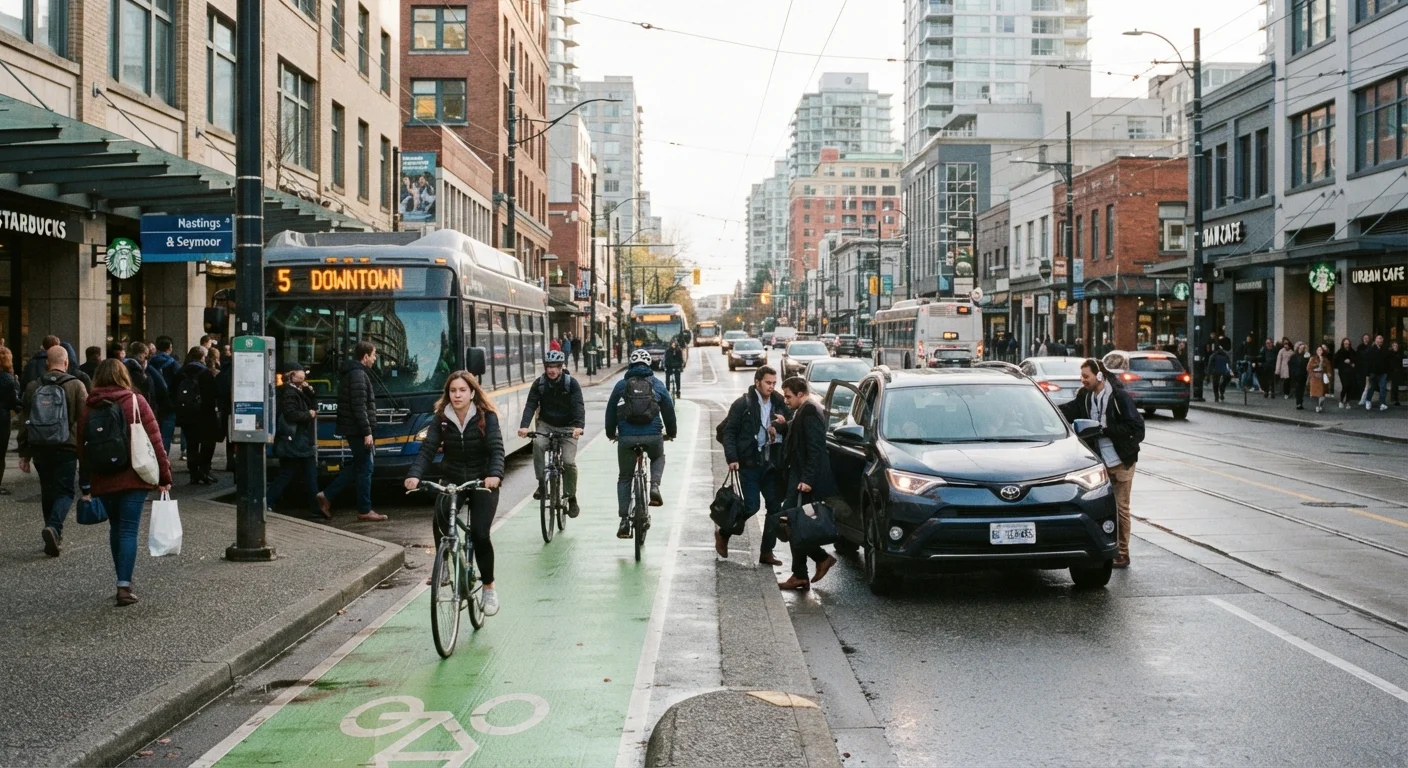
Assumptions about public transit, biking, and carpooling often don't hold up to scrutiny. Here's what the evidence actually shows.
Key takeaways
- Driving alone is rarely as cheap as commuters assume once all costs are honestly tallied.
- Public transit networks in mid-sized and large US cities are more extensive than many residents know.
- Carpooling and e-bikes remove practical barriers that once made car-free commuting impractical for many workers.
- Employer commuter benefits can offset transit and parking costs, yet many eligible workers never claim them.
- Commute stress is closely linked to mode of travel, not just distance or time.
The Gap Between Assumption and Reality
Most American commuters settle into a routine early in their working lives and rarely revisit it. The car becomes the default not always because it's the best option, but because it's the familiar one. Research on commuting behavior consistently finds that people overestimate how inconvenient alternatives are and underestimate the true cost — in time, money, and stress — of driving alone every day.
This article addresses five of the most persistent misconceptions head-on. The goal isn't to push any single commuting mode, but to give you an accurate baseline so your commuting choices are actually informed ones. If you're considering a change, a practical primer on public transit commuting can help you avoid rookie mistakes.
Myth
Driving is almost always faster than taking public transit, so there's no real reason to switch.
Fact
In dense urban corridors, transit is often competitive with driving once traffic, parking search time, and walking to the car are factored in.
Door-to-door travel time comparisons consistently show that drivers undercount the minutes spent circling for parking, walking from a garage, and sitting in stop-and-go traffic. A Texas A&M Transportation Institute study of major US metros found that peak-hour commuters lose dozens of hours per year to congestion — time that transit riders often spend reading, working, or simply sitting still. In city cores where rail or bus rapid transit runs in dedicated lanes, the transit option can match or beat driving on elapsed time alone.
Myth
Public transit only works if you live in a big city like New York or Chicago.
Fact
Many mid-sized US metros — including cities like Salt Lake City, Denver, and Charlotte — have invested heavily in rail and bus rapid transit networks that serve a broad suburban geography.
The assumption that transit is a coastal, big-city phenomenon ignores significant investment in Sunbelt and Mountain West metros over the past two decades. Commuter rail, light rail, and bus rapid transit systems now operate in dozens of American cities with populations well under a million. That said, frequency and coverage vary widely, so the honest approach is to check your regional transit authority's current maps rather than relying on decade-old impressions. For a breakdown of how these systems differ, see how commuter rail, light rail, and bus rapid transit compare.
Myth
Carpooling is a logistical nightmare that only works for people with identical schedules.
Fact
Flexible carpool apps and employer-organized vanpool programs have made coordinating shared rides significantly more manageable for workers with varied hours.
Traditional carpooling did require tight schedule alignment, but that's no longer the only model. Many large employers run subsidized vanpool programs that accommodate shift variation. Regional rideshare matching platforms allow drivers and riders to coordinate one-way trips rather than committing to a fixed daily arrangement. Even informal carpooling within a neighborhood or workplace can be coordinated with a shared calendar. The trade-offs between solo driving and carpooling go beyond schedule fit — fuel savings and reduced wear on a single vehicle are also worth calculating.
Myth
Cycling to work is only realistic for young, fit people who live very close to the office.
Fact
E-bikes have extended the practical commuting range for cycling to 10–20 miles for many riders, including those who don't consider themselves athletic.
Traditional bike commuting does have real fitness and distance limits for most people. E-bikes change that calculus meaningfully: pedal-assist motors reduce exertion, flatten hills, and allow riders to arrive without being soaked in sweat. Range, cost, and safety considerations still matter — what e-bikes can and can't do as a commuting tool is worth understanding before making any purchase decisions. Weather, secure parking at the destination, and route safety remain genuine constraints, but they eliminate cycling for far fewer workers than conventional wisdom suggests.
Myth
Switching from driving to transit will cost roughly the same or more once you add up all the fares.
Fact
When total car costs — loan payments, insurance, fuel, maintenance, parking, and depreciation — are compared against transit fares, transit is almost always substantially cheaper per mile.
The IRS mileage rate, which is updated periodically and reflects average vehicle operating costs, gives a useful reference point: owning and operating a personal vehicle costs well over 50 cents per mile in most scenarios. A typical urban transit commuter who uses monthly passes and employer pre-tax benefits can spend a fraction of that figure. Parking costs alone frequently tip the comparison decisively toward transit in downtown-adjacent workplaces. For commuters whose employers offer pre-tax commuter benefit accounts, the savings widen further — understanding employer commuter benefits is a practical starting point.
What an Honest Commute Comparison Actually Looks Like
The myths above share a common thread: they each involve an incomplete comparison. Drivers tend to compare the best version of their own commute — smooth traffic, easy parking — against a worst-case version of transit or cycling. A fair comparison accounts for the same variables on both sides.
Start with total cost, not just fuel. Factor in depreciation, insurance, loan interest if applicable, maintenance, and parking — common traps that inflate commuting costs walks through the line items that most drivers overlook. Then compare door-to-door time, not just in-vehicle time. Finally, consider stress: studies on commuter well-being, including work published in journals focused on urban transport, have found that commute mode predicts stress and life satisfaction more reliably than commute length alone. Driving in congestion is among the most stressful daily activities measured — bus and train riders report significantly lower commute-related stress on average.
For a full reference covering transit pass types, carpool rules, mileage rates, and commuter tax benefits in one place, see the complete commuter reference for American travelers.
54%
US workers who never explored transit alternatives
A Federal Highway Administration travel behavior survey found the majority of solo drivers had not seriously evaluated any alternative commute mode in the previous year.
$10,000+
Average annual cost of owning and operating a vehicle
AAA's annual 'Your Driving Costs' study consistently estimates total vehicle ownership costs above $10,000 per year for average American drivers, covering depreciation, insurance, fuel, and maintenance.
38 hours
Average congestion delay per year in large US metros
The Texas A&M Transportation Institute's Urban Mobility Report estimates peak-hour commuters in large metros lose roughly 38 hours annually to traffic congestion.
All published content on this website is for informational and educational purposes only and should not be taken as professional advice. We recommend that readers seek expert opinion before making any decisions. The website is not responsible for any actions taken based on the information provided on this website. We are not liable for any inaccuracies, modifications, or omissions in information. Moreover, external links or third-party content are provided for convenience; we are not liable for their correctness. Users are advised to verify every piece of information before they use it for any purpose.