
Solid Hardwood, Engineered Wood, and Laminate Flooring Compared

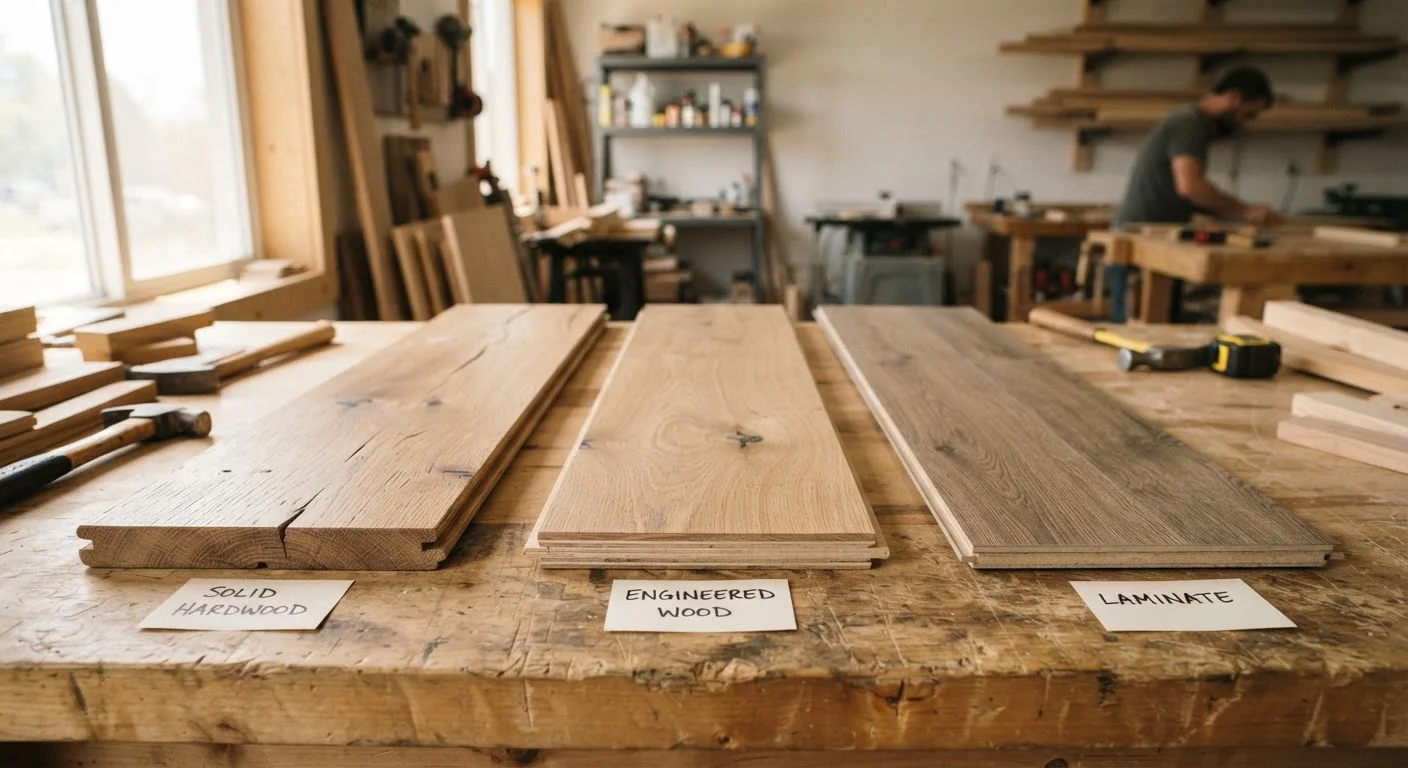
Three flooring types that look similar but behave very differently over time. A practical comparison across durability, moisture tolerance, and refinishability.
Our Verdict
Solid hardwood wins on longevity and refinishability for above-grade, stable-humidity rooms, but it demands the highest upfront investment and careful moisture management. Engineered wood strikes a practical middle ground — genuine wood aesthetics with broader installation flexibility. Laminate suits budget-conscious homeowners or high-traffic, splash-prone spaces where looks matter more than wood authenticity.
| Best for | Recommended |
|---|---|
| Living rooms and bedrooms with stable humidity | Solid Hardwood |
| Basements, kitchens, or homes in humid climates | Engineered Wood |
| High-traffic areas or tight renovation budgets | Laminate |
| Homeowners wanting real wood they can refinish repeatedly | Solid Hardwood |
Key takeaways
- Solid hardwood can be sanded and refinished multiple times, extending its lifespan by decades.
- Engineered wood handles humidity fluctuations better than solid hardwood due to its cross-ply core construction.
- Laminate contains no real wood veneer and cannot be refinished, but it is typically the most moisture-resistant of the three.
- Installation method, subfloor condition, and room location are the biggest factors in choosing the right flooring type.
- All three options can mimic similar wood aesthetics, so durability and budget should drive the decision.
How Each Flooring Type Is Built
Understanding construction explains nearly every performance difference between these three options.
Solid hardwood is milled from a single piece of timber — typically ¾ inch thick. Because it's one continuous material from top to bottom, it can be sanded down and refinished repeatedly over its lifetime. Species choice matters: harder woods like white oak and maple resist denting better than softer species like pine.
Engineered wood uses a thin real-wood veneer bonded over multiple layers of plywood or high-density fiberboard (HDF). The cross-ply construction — layers oriented in alternating directions — significantly reduces the natural expansion and contraction that solid wood undergoes when humidity changes. The veneer is genuine wood, so it looks identical to solid hardwood once installed.
Laminate has no real wood layer at all. Its visual layer is a high-resolution photographic image of wood grain printed on paper, protected by a clear wear layer. Beneath that sits an HDF core, and at the bottom a moisture-barrier backing. Modern laminate photography is convincing, but the surface cannot be sanded or stained.
| Solid Hardwood | Engineered Wood | Laminate | |
|---|---|---|---|
| Core material | Single-piece timber | Real wood veneer over plywood/HDF | Photographic layer over HDF |
| Refinishable | Yes, many times | Once or twice (veneer dependent) | No |
| Moisture tolerance | Low — avoid below grade | Moderate — check product specs | Surface-resistant, not waterproof |
| Installation methods | Nail/staple only, wood subfloor | Nail, glue, or float | Floating click-lock only |
| DIY friendliness | Low — professional recommended | Moderate | High |
| Typical lifespan | 50–100+ years | 25–50 years | 15–25 years |
| Relative material cost | Highest | Mid-range | Lowest |
Durability and Everyday Wear
For everyday scuffs and foot traffic, all three options perform reasonably well when properly maintained — but they fail differently under stress.
Solid hardwood dents and scratches over time, but those imperfections can be sanded out during refinishing. This makes it a genuinely long-term investment: a well-maintained solid hardwood floor can last 80–100 years or more in the right conditions.
Engineered wood's wear layer — typically 2–6 mm of real wood — can be lightly sanded once or twice depending on veneer thickness. Thicker-veneer products give you more refinishing potential. Thinner veneers, while more affordable, offer little room for sanding and should be treated more like laminate in terms of scratch management.
Laminate's wear layer is rated by an AC rating system (AC1 through AC5). AC3 is generally suitable for residential use throughout the home; AC4 and AC5 are rated for commercial traffic. When the wear layer is scratched through, replacement is the only fix — individual boards can be swapped out in floating-floor installations, but color-matching older laminate can be difficult.
Moisture Tolerance and Where Each Floor Can Go
Moisture is the decisive factor when choosing flooring for kitchens, bathrooms, basements, or humid regions.
Solid hardwood and water are a difficult combination. Wood swells when it absorbs moisture and shrinks when it dries out. Solid planks installed in areas with seasonal humidity swings will gap in winter and cup or buckle in summer if not acclimated and sealed properly. Most flooring professionals advise against solid hardwood in basements or below-grade spaces entirely.
Engineered wood's cross-ply core absorbs and releases moisture more evenly across its layers, meaning it moves less dramatically. Many engineered products are approved for below-grade and on-grade installations, though standing water is still damaging to any wood-based product. Always check the manufacturer's installation guidelines for moisture thresholds.
Laminate is the most water-resistant of the three in ordinary conditions, but it is not waterproof. Water that seeps into the seams will cause the HDF core to swell and delaminate. Many newer laminate products carry water-resistance ratings for surface spills, but bathrooms with frequent floor-level moisture generally call for tile or luxury vinyl plank instead.
Installation Methods and Subfloor Requirements
Each flooring type supports different installation methods, and your subfloor will determine what's feasible.
- Solid hardwood must be nailed or stapled to a wood subfloor — it cannot float and cannot be glued directly to concrete. The subfloor must be level, dry, and structurally sound. Solid hardwood also requires an acclimation period (typically 3–5 days in the room where it will be installed) before installation begins.
- Engineered wood can be nailed, stapled, glued, or floated over concrete or wood subfloors, depending on the product. This versatility makes it a practical choice for slab-on-grade homes or renovated basements where nailing isn't possible.
- Laminate almost always uses a floating click-lock installation — planks lock together without adhesive and rest on an underlayment pad. It goes over concrete, existing tile, or wood subfloors and is one of the more approachable DIY installations available. Subfloor flatness is still critical; any high spots will cause planks to flex and joints to pop over time.
Cost Considerations Across the Lifetime of the Floor
Upfront material cost is only part of the financial picture. Installation labor, long-term maintenance, and eventual replacement all factor into true cost of ownership.
Solid hardwood carries the highest material and installation cost among the three. However, its refinishability means a properly maintained floor may never need full replacement — periodic sanding and recoating extends its life significantly. When you spread that cost over 50 or more years, the per-year expense often compares favorably.
Engineered wood sits in the middle range. Thicker-veneer products cost more but offer refinishing options. Installation is often faster than solid hardwood, which can reduce labor costs if hiring a professional.
Laminate is generally the lowest-cost option for materials, and its click-lock system makes DIY installation realistic for homeowners with basic tools and patience. The trade-off is longevity: laminate typically has an expected lifespan of 15–25 years before replacement becomes necessary, meaning the per-year cost advantage narrows over time.
Note: Flooring costs vary significantly by region, product grade, and current material prices. Always obtain local quotes before budgeting a flooring project.
All published content on this website is for informational and educational purposes only and should not be taken as professional advice. We recommend that readers seek expert opinion before making any decisions. The website is not responsible for any actions taken based on the information provided on this website. We are not liable for any inaccuracies, modifications, or omissions in information. Moreover, external links or third-party content are provided for convenience; we are not liable for their correctness. Users are advised to verify every piece of information before they use it for any purpose.