
Tabletop Gaming Formats Explained: Board Games, RPGs, Wargames, and Card Games

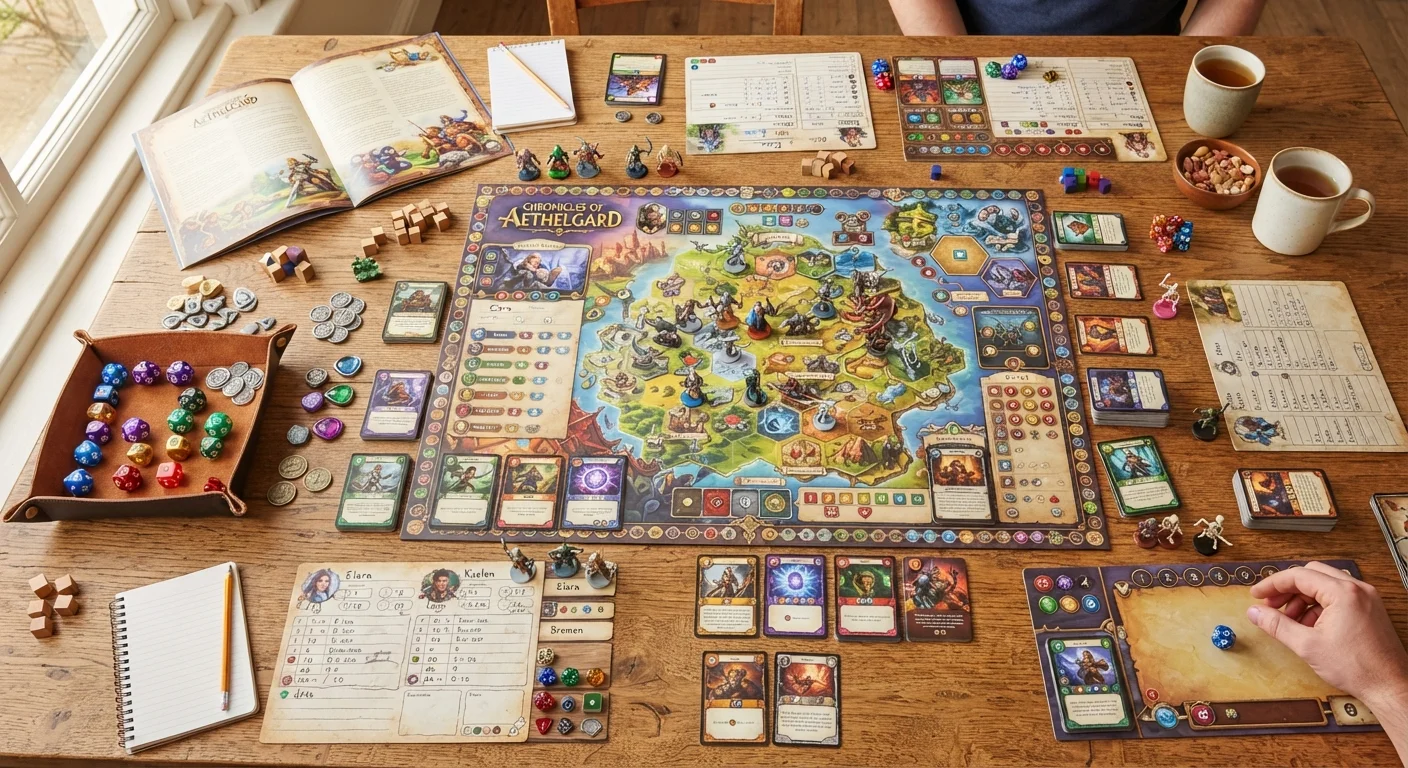
The tabletop hobby world is much wider than it looks. This reference breaks down the major formats, how they work, and who tends to enjoy each.
Why Tabletop Gaming Is Bigger Than You Think
Walk into any dedicated game shop and the sheer variety can be dizzying — stacks of boxed board games tower next to shelves of rulebooks, hand-painted miniatures, and shrink-wrapped card packs. The tabletop hobby isn't a single thing; it's a family of related but genuinely distinct formats, each with its own culture, learning curve, and appeal.
For adults looking to invest leisure time in something social, tactile, and screen-free, understanding the landscape before diving in makes all the difference. Whether you prefer tight strategy, collaborative storytelling, competitive tournament play, or the meditative satisfaction of painting a miniature army, there's a format built for that. This reference breaks down the four major categories — board games, roleplaying games (RPGs), wargames, and card games — so you can find your corner of the hobby.
| Major tabletop formats | 4 core categories: board games, RPGs, wargames, card games |
| Global tabletop market size | Estimated at over $12 billion USD (Mordor Intelligence, 2023 estimate) |
| Typical board game session | 60–120 minutes for mid-weight games |
| RPG minimum players | 2 (one GM, one player); typical groups are 4–6 |
| Oldest tabletop format | Board and tile games — examples date back thousands of years |
| Solo-friendly formats | Many modern board games include official solo modes |
Board Games: Strategy, Luck, and Everything Between
Modern board games bear little resemblance to the roll-and-move games many adults grew up with. The contemporary board game market encompasses worker-placement games, deck-builders, cooperative puzzles, social deduction titles, and sprawling legacy campaigns that evolve across sessions.
Who plays them: Board games are the most accessible entry point for newcomers. A group of two to six players can usually learn a mid-weight game in under thirty minutes. Families, friend groups, and couples find them especially useful because no single person needs prior hobby knowledge — the rulebook levels the table.
Session length: Ranges from fifteen minutes for a filler game to six or more hours for a heavy strategy title. Most popular games sit comfortably in the ninety-minute range.
Space and cost: A single box fits on a shelf. Entry costs vary widely, but a well-regarded mid-range game typically falls below the price of a concert ticket and gets replayed dozens of times.
Roleplaying Games: Collaborative Storytelling at the Table
In a tabletop RPG, one player — the Game Master (GM), Dungeon Master, Storyteller, or Keeper, depending on the system — facilitates a shared narrative while the other players each inhabit a single character they've created. Dice determine outcomes; imagination determines the rest.
The genre stretches from high-fantasy dungeon crawls (the archetype popularized by Dungeons & Dragons) to noir crime thrillers, cosmic horror, space opera, and slice-of-life drama. Rules-light systems exist for beginners who want to emphasize freeform storytelling, while crunchy systems reward players who enjoy deep mechanical mastery.
Who plays them: RPGs appeal strongly to creative, narrative-minded people. They're also deeply social — a committed group might play a single campaign for months or years, building a shared story that becomes genuinely meaningful. The genre rewards investment.
Learning curve: Higher than board games for the GM role, but many modern systems are designed to get a first session running in under two hours. Players generally need only understand their own character's rules at the start.
Game Master (GM)
The player in an RPG who facilitates the story, controls non-player characters, and adjudicates rules. Known by different titles across different systems, such as Dungeon Master or Storyteller.
Living Card Game (LCG)
A card game format where expansions are sold as complete, fully known sets rather than randomized packs. Players know exactly which cards they're buying before they purchase.
Collectible Card Game (CCG)
A card game format where additional cards are sold in randomized booster packs. Deck-building involves both strategy and the unpredictability of what you pull from packs.
Worker Placement
A board game mechanism where players assign tokens to limited action spaces on the board to gather resources or trigger effects, often competing for the same spaces.
Legacy Game
A board game designed to permanently change between sessions — players write on components, tear up cards, or open sealed boxes as the campaign progresses, creating a unique play history.
Hex-and-Counter
A wargame format using hexagonal grids and cardboard counter tokens rather than painted miniatures to represent units on a map. Common in historical simulation wargaming.
Wargames: Tactical Simulation on the Tabletop
Wargaming is where hobby miniatures and competitive strategy converge. Players build and paint armies of scale figures, then maneuver them across terrain boards according to rulebooks that simulate combat — historical, fantasy, or science fiction. Games like Warhammer 40,000 have made the format globally recognizable, but the genre includes everything from ancient naval battles to abstract hex-and-counter simulations played with paper maps.
Who plays them: Wargames attract hobbyists who enjoy multiple layers of engagement — the modeling and painting craft, the strategic depth of army-building, and the competitive or cooperative play itself. Many players describe painting miniatures as a form of mindfulness, comparable in some ways to the craft hobbies explored in hands-on hobby guides.
Investment level: This is the most resource-intensive tabletop format. A starter army, paints, and tools represent a meaningful upfront cost, and the hobby grows with you. Many enthusiasts treat the painting and modeling as their primary enjoyment, with games as a satisfying bonus.
Wargaming Doesn't Require Painting
While painting miniatures is a beloved part of wargaming culture, it's rarely a strict requirement for play. Many local game stores and clubs welcome unpainted or primed miniatures at the table, especially for beginners still building their collections. Starting with a small starter set lets you learn the rules and decide how deep into the modeling craft you want to go before committing to a full army.
Card Games: Portable, Deep, and Highly Competitive
Card games occupy a broad spectrum. At one end sit traditional trick-taking games and classic sets that need no purchase beyond a standard deck. At the other end are collectible card games (CCGs) like Magic: The Gathering and living card games (LCGs), which feature expandable card pools, deck-construction meta-gaming, and organized competitive play at local and national levels.
Key distinction — CCGs vs. LCGs: CCGs sell cards in randomized booster packs, meaning collecting is partly a game of chance. LCGs release fully known card sets, giving players complete information before purchasing. Both models have enthusiastic communities; your preference for predictability versus the hunt will guide which suits you.
Who plays them: Card game fans often love the puzzle of deck construction almost as much as play itself. The format skews competitive but has strong casual communities too. Portability is a genuine advantage — a sleeved deck fits in a jacket pocket.
Getting started: Most major card games publish introductory starter decks designed to teach the core rules in a single session. Local game stores frequently run beginner nights, which are one of the most reliable ways to find an instant playgroup and get honest advice without any pressure.
Choosing Your Format: A Quick Guide
No single format is objectively superior — the best one is the one that fits your life. A few practical questions help narrow it down:
- Do you have a consistent group? RPGs and campaign board games reward commitment. Solo-friendly games and card game formats work better for irregular schedules.
- How much space do you have? Card games and small-box board games require almost none. Wargaming terrain and armies need dedicated storage.
- Are you drawn to narrative or systems? If story pulls you in, RPGs are likely your door. If you love optimizing and competing, card games or wargames may be the stronger pull.
- What's your tolerance for upfront investment? Board games and RPG rulebooks offer the most contained entry costs; wargaming and CCGs can grow significantly with the hobby.
The tabletop hobby rewards curiosity. Many enthusiasts eventually play across multiple formats — a Sunday board game afternoon doesn't preclude a biweekly RPG campaign. Start somewhere, find your people, and let the hobby grow from there.
35M+
Adults who play tabletop games regularly in the US
Hobby consumer research cited by the Toy Association has placed regular board game participation among tens of millions of US adults.
3,000+
New board game titles published annually
Industry tracking data from BoardGameGeek consistently shows thousands of new titles added to the hobby database each year.
50+ years
Age of Dungeons & Dragons as a genre foundation
D&D was first published in 1974, establishing the modern tabletop RPG format that continues to inspire hundreds of subsequent systems.
All published content on this website is for informational and educational purposes only and should not be taken as professional advice. We recommend that readers seek expert opinion before making any decisions. The website is not responsible for any actions taken based on the information provided on this website. We are not liable for any inaccuracies, modifications, or omissions in information. Moreover, external links or third-party content are provided for convenience; we are not liable for their correctness. Users are advised to verify every piece of information before they use it for any purpose.