
Why Meetings Go Wrong and What Structured Agendas Actually Fix

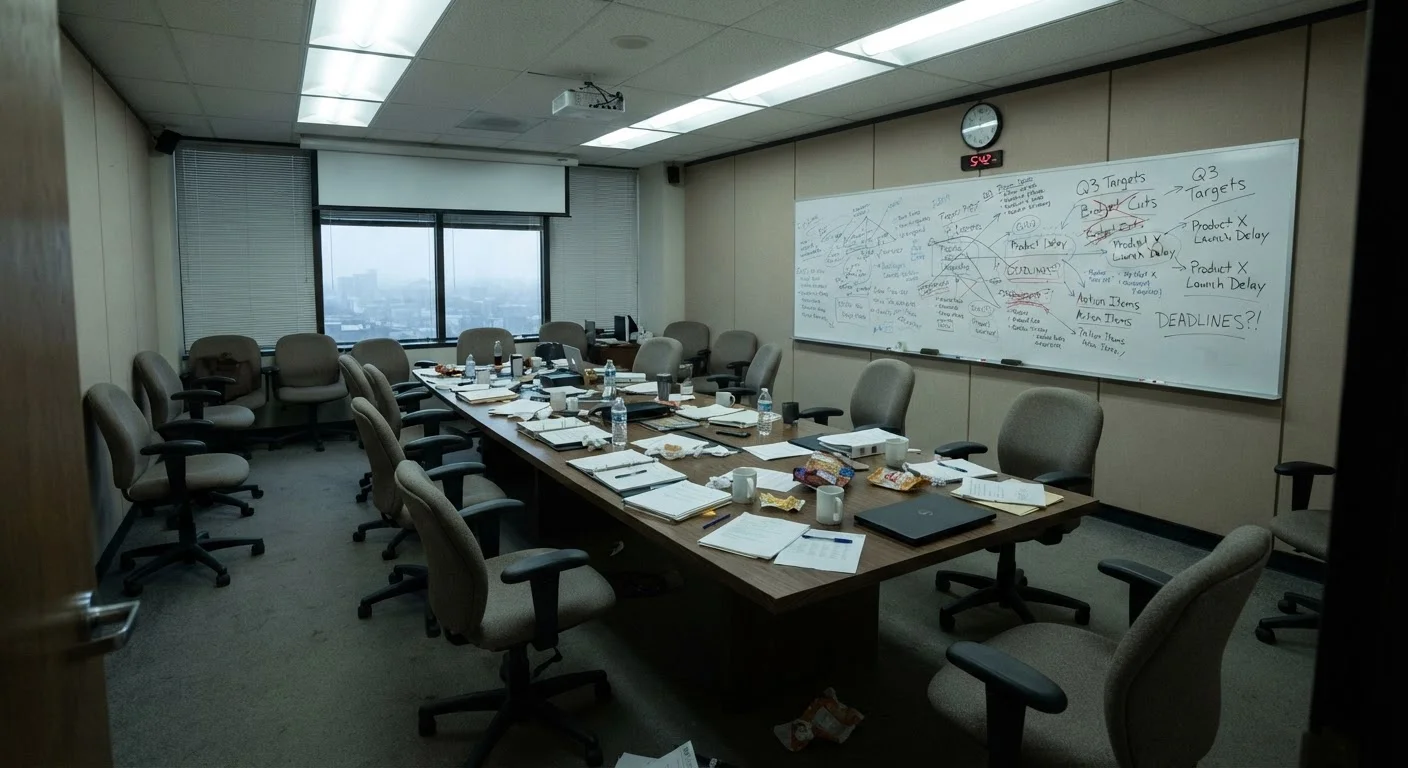
Unproductive meetings waste time and erode trust. Explore the common structural failures and the habits that make collaboration more purposeful.
Key takeaways
- Meetings without clear objectives consistently produce confusion, not decisions.
- Inviting too many attendees dilutes accountability and slows group decision-making.
- A structured agenda shared in advance reduces wasted time and off-topic tangents.
- Every meeting should end with documented action items assigned to specific owners.
- Many meetings can be replaced entirely by a well-written asynchronous update.
The Real Cost of a Poorly Run Meeting
A one-hour meeting with eight people doesn't cost one hour — it costs eight hours of combined productive time. Multiply that across an organization running multiple meetings daily, and the drain becomes significant. Research from organizations like Harvard Business Review has consistently found that executives consider a large share of their meetings unproductive, yet most workers continue scheduling them reflexively, as if attendance itself constitutes progress.
The problem is rarely about people being lazy or disengaged. It's structural. Meetings go wrong in predictable, repeatable ways — and understanding those patterns is the first step toward fixing them. For anyone wrestling with how synchronous time competes with focused work, it's worth reading how synchronous vs. asynchronous work styles affect your day.
Common Mistakes That Derail Meetings
The following mistakes aren't rare edge cases — they show up in teams of every size and industry. Recognizing them in your own meetings is the starting point for meaningful change.
Scheduling a meeting without a defined objective.
Why it happens: Meetings are often called as a default response to uncertainty — when someone doesn't know how to move forward, gathering people feels productive even without a clear goal.
Inviting everyone who might be tangentially interested rather than only those who are necessary.
Why it happens: Organizers worry about leaving someone out, creating resentment or information silos — so they over-invite as a form of social risk management.
Allowing the first voice in the room to set the direction before others have processed the question.
Why it happens: Facilitators often mistake early participation for good group dynamics, but dominant early contributions anchor the conversation and crowd out more considered input.
Ending the meeting without documented next steps or assigned owners.
Why it happens: By the end of a meeting, energy is low and people are already mentally moving on. Action items feel like an afterthought rather than the main deliverable.
Treating status updates as meeting-worthy when they could be handled asynchronously.
Why it happens: Status update rituals are easy to institutionalize and hard to question because they feel like necessary coordination, even when the information could be shared via a written update.
Addressing these patterns also pays dividends beyond the meeting room. Teams that communicate more clearly tend to experience fewer interpersonal tensions — a dynamic explored further in navigating conflict at work without escalating it.
What a Structured Agenda Actually Does
A structured agenda isn't a formality or a box to check — it's a decision-making tool. When distributed at least 24 hours before a meeting, a well-built agenda does several things at once: it signals to attendees what decisions need to be made (not just discussed), it allows people to prepare rather than react, and it gives the facilitator a legitimate basis for redirecting off-topic threads.
Effective agendas include three elements most weak ones omit: a stated goal for each item (decision, update, or brainstorm), a time allocation, and a named owner responsible for leading that segment. This structure shifts meetings from open-ended conversations to purposeful work sessions.
~$37B
Estimated annual cost of unproductive meetings in the U.S.
Figures cited across multiple workplace productivity studies suggest unproductive meetings cost U.S. businesses tens of billions annually in lost work time.
71%
Managers who say meetings are unproductive
A survey published by Harvard Business Review found that 71% of senior managers considered meetings unproductive and inefficient.
Different communication styles also interact with meeting structure in important ways. People who process information more slowly, or who prefer written input over verbal sparring, are systematically disadvantaged by unstructured meetings. Working with colleagues who have very different communication styles requires deliberate structural choices — and a good agenda is one of them.
Building Better Habits Around Meetings
Fixing meetings isn't a one-time intervention — it's a set of habits that need to become team norms. A few practices with an outsized impact:
- Default to shorter time blocks. A 25-minute meeting forces prioritization in ways a 60-minute slot rarely does. Parkinson's Law — work expanding to fill available time — applies directly here.
- End with a written action list. Before anyone leaves, confirm: who is doing what, by when. Send a summary within the hour. This single habit closes the gap between discussion and follow-through.
- Audit recurring meetings quarterly. Most recurring meetings outlive their original purpose. A brief quarterly review — does this still need to happen, and does this group still need to be in it? — eliminates a surprising amount of calendar weight.
- Normalize declining or delegating. Attendance culture pressures people to accept every invite. Creating team permission to decline meetings that don't require their input frees focused work time without damaging relationships.
These habits compound. Teams that run tighter meetings tend to have clearer role boundaries, stronger accountability, and less of the slow-burn frustration that comes from feeling like your time isn't respected. That kind of frustration, left unaddressed, erodes team trust in ways that spill outside the conference room entirely.
All published content on this website is for informational and educational purposes only and should not be taken as professional advice. We recommend that readers seek expert opinion before making any decisions. The website is not responsible for any actions taken based on the information provided on this website. We are not liable for any inaccuracies, modifications, or omissions in information. Moreover, external links or third-party content are provided for convenience; we are not liable for their correctness. Users are advised to verify every piece of information before they use it for any purpose.