
Synchronous vs Asynchronous Work: Which Style Actually Protects Your Time?

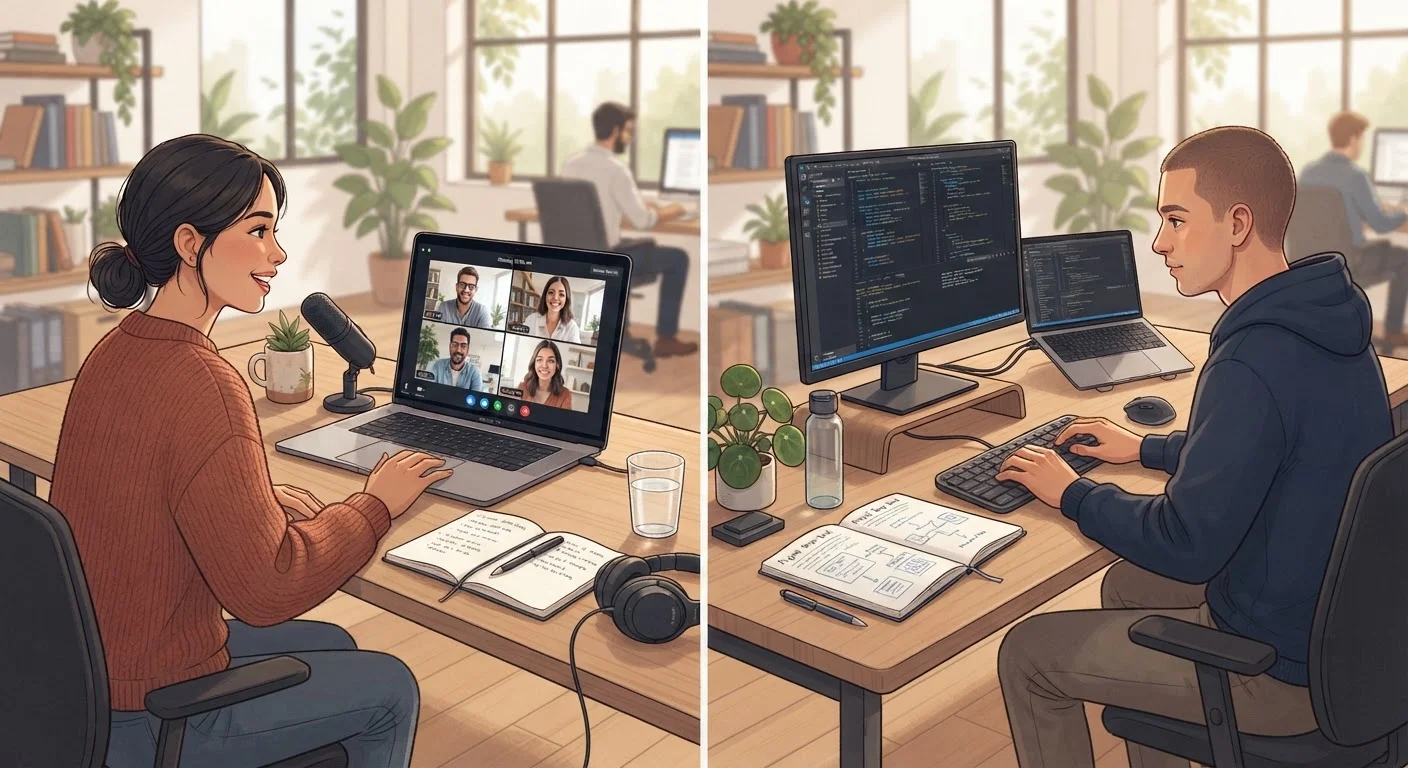
Real-time meetings or flexible deep work? Weigh the trade-offs between synchronous and asynchronous work styles and what each means for your day.
Option A
Synchronous Work
The real-time, always-connected collaboration model.
Best for: Teams needing rapid decision-making, creative brainstorming, or high-touch relationship-building across members.
Option B
Asynchronous Work
The flexible, self-directed approach to getting things done.
Best for: Individuals and teams who need sustained focus time, span multiple time zones, or thrive on structured autonomy.
Key takeaways
- Synchronous work enables faster feedback loops but regularly fragments your focus and calendar.
- Asynchronous work protects deep concentration but can slow decisions and create communication gaps.
- Most modern workers benefit from a deliberate blend rather than committing entirely to one style.
- Your role, team culture, and personal energy patterns all influence which mode serves you best.
- Neither style inherently produces better outcomes — intentional use of each is what matters.
What These Two Work Styles Actually Mean
Synchronous work means everyone is present and communicating at the same time — live meetings, phone calls, instant messaging threads where a quick reply is expected. Asynchronous work (often shortened to "async") means communication and collaboration happen on each person's own schedule — recorded video updates, email, shared documents, or project management threads where replies arrive hours later.
The distinction matters more than it might seem at first. How your day is structured — and who controls that structure — shapes your energy, output quality, and sense of autonomy in real, measurable ways. Research in cognitive psychology consistently shows that switching between tasks, especially in response to interruptions, carries a cost: it can take over 20 minutes to return to deep focus after a disruption, according to work by researcher Gloria Mark at UC Irvine. That's not a personality quirk; it's how human attention works.
Understanding these two modes isn't just an abstract productivity exercise. For anyone trying to navigate genuine work-life balance, the question of when you're expected to be "on" versus when you can work at your own pace is central to whether work feels sustainable.
The Real Costs and Benefits of Synchronous Work
Synchronous communication has obvious strengths. Live conversation resolves ambiguity quickly, builds personal rapport, and allows for the kind of spontaneous creative sparking that's genuinely harder to replicate in writing. When stakes are high — conflict resolution, complex problem-solving, onboarding new colleagues — real-time interaction often produces better outcomes faster.
But the hidden cost is fragmentation. A day packed with back-to-back meetings doesn't just reduce the time available for heads-down work; it changes the quality of whatever work fits between those slots. Short gaps between meetings rarely allow the kind of sustained thinking that complex tasks require. Many professionals report feeling simultaneously busy and unproductive — a sign that synchronous overload may be at play.
Poorly structured meetings compound this problem. When meetings lack clear agendas or defined outcomes, they become time drains that sap motivation without advancing work. Synchronous work is only as good as the discipline applied to it.
| Criterion | Synchronous Work | Asynchronous Work |
|---|---|---|
| Response speed | Immediate, real-time | Delayed, on own schedule |
| Focus protection | Low — frequent interruptions | High — fewer live demands |
| Decision-making pace | Fast — real-time resolution | Slower — awaits replies |
| Relationship-building | Stronger through live interaction | Harder to maintain over time |
| Time zone flexibility | Low — requires overlap | High — no overlap needed |
| Documentation trail | Weak unless notes are taken | Strong — written by default |
| Self-discipline required | Lower — structure is external | Higher — self-managed pacing |
| Energy cost | High — social presence demand | Lower — engage when ready |
What Asynchronous Work Gives You — and What It Quietly Takes Away
The appeal of async work is real. When you control when you engage with communication, you can protect extended blocks for focused thinking, work at the time of day when your energy peaks, and craft more considered, thoughtful responses rather than reacting in the moment. For people managing caregiving responsibilities, health needs, or simply a workload that requires sustained concentration, async can be genuinely life-changing.
The trade-offs are equally real. Async communication introduces latency — decisions that could take five minutes in a meeting can take two days of back-and-forth emails. Social cohesion is harder to maintain when colleagues rarely interact in real time. Nuance gets lost in text; tone is misread; misunderstandings accumulate. For teams navigating sensitive dynamics, heavy reliance on async can actually slow trust-building rather than support it.
There's also a self-discipline dimension that's easy to underestimate. The freedom of async requires that you actively manage your own time rather than having structure imposed externally. If that skill isn't yet developed, async can quietly lead to procrastination or isolation. Our look at remote work discipline explores this tension in more depth.
How to Find Your Workable Balance
For most people in most roles, the answer isn't choosing one style and abandoning the other — it's being intentional about when each mode applies. Some practical frameworks worth considering:
- Match mode to task type. Creative brainstorming, sensitive conversations, and fast-moving decisions often benefit from synchronous interaction. Documentation, status updates, and non-urgent feedback are natural candidates for async.
- Set communication norms explicitly. On teams where expectations around response time are unclear, anxiety fills the gap. Being explicit — "I check messages twice daily" or "flag urgent items differently" — reduces the ambient pressure to be always-on.
- Protect focus time structurally. Async intentions don't protect themselves. Time-blocking strategies can help you carve out dedicated heads-down periods that survive calendar pressure.
- Acknowledge your own patterns. Some people genuinely thrive in high-interaction environments; others lose themselves there. Neither preference is wrong, but self-awareness helps you advocate for what you need.
If your work involves any shift toward remote or hybrid arrangements, the sync/async question intersects with commute and schedule decisions in ways worth thinking through. Our piece on hybrid schedules and commute trade-offs addresses how those pieces connect.
The goal isn't to optimize every minute — it's to create a working rhythm that sustains both your output and your wellbeing over time. Getting that balance right is ongoing work, not a one-time fix. For a complementary perspective on what remote work genuinely offers and costs, see our piece on remote work and balance.
All published content on this website is for informational and educational purposes only and should not be taken as professional advice. We recommend that readers seek expert opinion before making any decisions. The website is not responsible for any actions taken based on the information provided on this website. We are not liable for any inaccuracies, modifications, or omissions in information. Moreover, external links or third-party content are provided for convenience; we are not liable for their correctness. Users are advised to verify every piece of information before they use it for any purpose.