
Air Purifiers vs Humidifiers: Which One Does Your Home Actually Need?

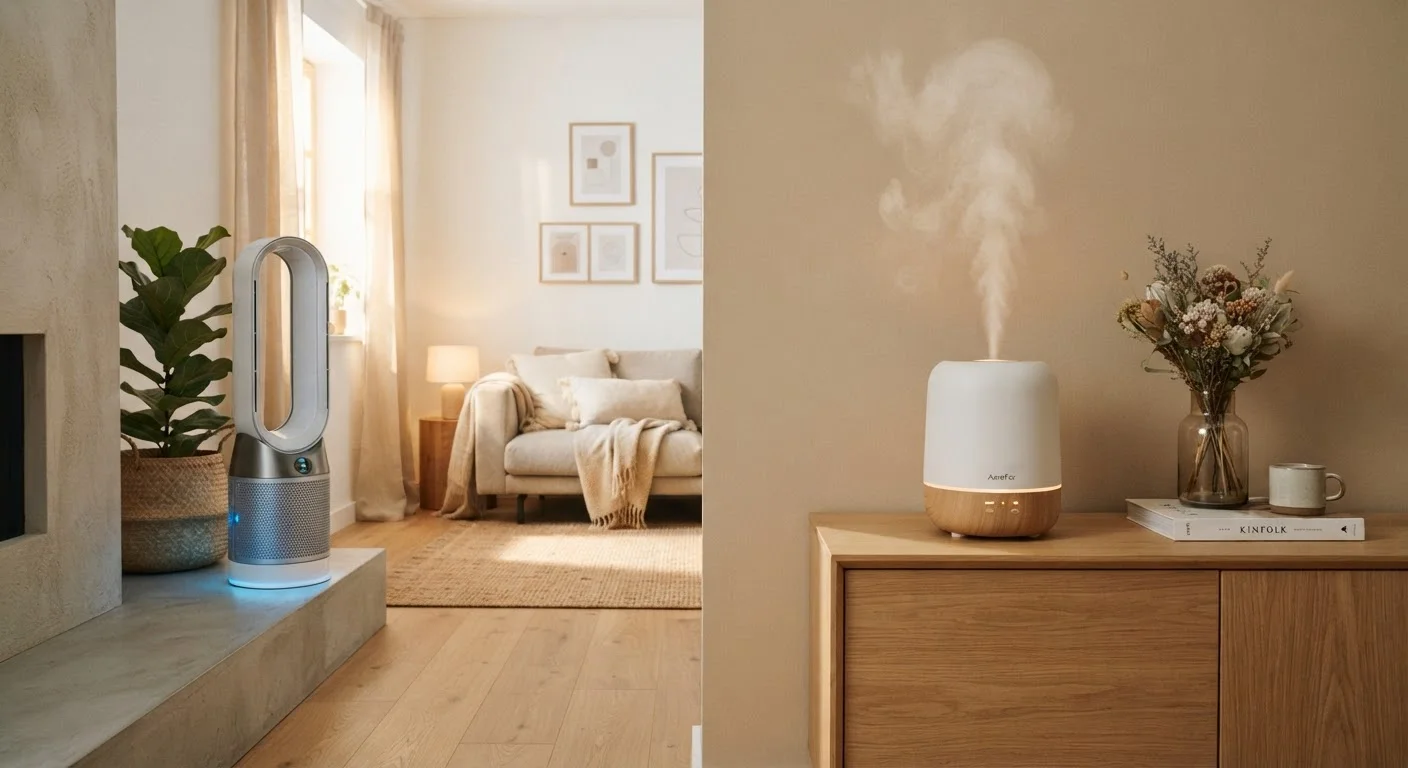
These two devices often get confused. Understand what each one does, how they differ, and which environmental problem each is designed to solve.
Option A
Air Purifier
The contaminant-fighter that cleans what you breathe.
Best for: Homes dealing with dust, pet dander, smoke, mold spores, allergens, or other airborne particles and odors.
Option B
Humidifier
The moisture-restorer that combats dry indoor air.
Best for: Households experiencing low humidity levels, especially during winter heating season or in arid climates.
Key takeaways
- Air purifiers remove airborne contaminants like dust, pollen, and smoke; humidifiers add moisture to dry air.
- These devices solve completely different problems and cannot substitute for each other.
- Humidity levels below 30% typically call for a humidifier; persistent allergens or odors call for an air purifier.
- Using either device incorrectly — such as over-humidifying — can worsen indoor air quality.
- Some homes may genuinely benefit from both devices used together, targeting separate issues simultaneously.
What Each Device Actually Does
These two gadgets are frequently grouped together in home wellness conversations, but they operate on entirely different principles and solve unrelated problems.
An air purifier draws room air through a series of filters — most commonly a HEPA (High-Efficiency Particulate Air) filter, which is rated to capture at least 99.97% of airborne particles 0.3 microns or larger. That includes dust, pollen, mold spores, pet dander, and certain bacteria. Many units also include activated carbon filters to absorb gases, volatile organic compounds (VOCs), and odors. The purified air is then circulated back into the room. The device does not change the humidity level, temperature, or moisture content of the air in any meaningful way.
A humidifier does the opposite kind of work: it introduces water vapor into the air to raise the relative humidity of a room or an entire home. Different types — including evaporative, ultrasonic, and steam humidifiers — achieve this through different mechanisms, but the goal is identical: counteract air that has become uncomfortably or harmfully dry. A humidifier has no filtration capability and cannot remove particles, odors, or contaminants.
Understanding this distinction upfront prevents a common and costly mistake: buying one device hoping it will do the job of the other.
Head-to-Head: Key Differences at a Glance
Before deciding which device fits your situation, it helps to see how they compare across the dimensions that matter most for everyday home use.
| Criterion | Air Purifier | Humidifier |
|---|---|---|
| Primary function | Removes airborne particles and odors | Adds moisture to dry indoor air |
| Core technology | HEPA and/or carbon filtration | Evaporative, ultrasonic, or steam |
| Addresses allergies/asthma | Yes — captures allergen particles | No direct effect on allergens |
| Addresses dry air discomfort | No | Yes — raises relative humidity |
| Ongoing maintenance | Filter replacement every 6–12 months | Frequent tank cleaning required |
| Risk if misused | Low — reduced filtration if filters clog | Higher — over-humidifying promotes mold |
| Useful year-round | Yes, in most climates | Primarily in dry or cold seasons |
One detail worth noting: air purifiers require regular filter replacement — typically every 6 to 12 months depending on usage and filter type — which adds to ongoing costs. Humidifiers require frequent cleaning to prevent mold and bacteria growth inside the water tank, making maintenance discipline equally important for both devices.
How to Diagnose Your Home's Actual Problem
The fastest way to make the right call is to identify the specific symptom your home is showing.
Signs you likely need an air purifier:
- Allergy or asthma symptoms that worsen indoors compared to outdoors
- Visible dust accumulation on surfaces shortly after cleaning
- Persistent pet odors, cooking smells, or smoke that lingers
- A household member who is immunocompromised or has a diagnosed respiratory condition
- Homes in areas with wildfire smoke or high outdoor pollution
Signs you likely need a humidifier:
- Frequent static electricity shocks when touching objects or people
- Dry, cracked skin, chapped lips, or irritated nasal passages — especially in winter
- Wood floors, furniture, or musical instruments showing cracks or warping
- Indoor relative humidity readings below 30% (a basic hygrometer, available for a few dollars, can measure this)
- Waking up with a dry throat or nosebleeds with no other medical explanation
If your home is showing symptoms from both lists, the two devices can be used simultaneously — they do not interfere with each other when both are maintained properly.
A Simple Tool: The Hygrometer
A hygrometer is an inexpensive device that measures your home's relative humidity. Most indoor air quality experts consider 40–60% relative humidity to be the comfortable and health-supportive range. Readings consistently below 30% point toward a humidifier; readings above 60% can indicate a need for a dehumidifier or improved ventilation. Knowing your actual number removes the guesswork entirely.
Common Misconceptions to Avoid
A few widespread myths complicate purchasing decisions and can lead to genuine indoor air quality problems.
Myth: A humidifier cleans the air. Adding moisture to a room does not remove particles, allergens, or odors. In fact, if indoor humidity climbs above 60%, it can actively encourage mold growth and dust mite proliferation — worsening the very conditions an air purifier is designed to combat.
Myth: An air purifier will fix dry air. Filtration removes particles; it does not add or remove moisture. Dry air requires moisture, and no amount of purification addresses that deficit.
Myth: Either device eliminates the need for regular cleaning. Both devices supplement — they do not replace — routine vacuuming, dusting, and ventilation. An air purifier reduces airborne particles but does not clean surfaces. A humidifier raises moisture levels but does not sanitize.
Approaching either device with realistic expectations leads to better outcomes and avoids the frustration of feeling like a purchase didn't deliver what was promised.
All published content on this website is for informational and educational purposes only and should not be taken as professional advice. We recommend that readers seek expert opinion before making any decisions. The website is not responsible for any actions taken based on the information provided on this website. We are not liable for any inaccuracies, modifications, or omissions in information. Moreover, external links or third-party content are provided for convenience; we are not liable for their correctness. Users are advised to verify every piece of information before they use it for any purpose.