
Annual Percentage Rate: Why APR Is the Number That Really Matters

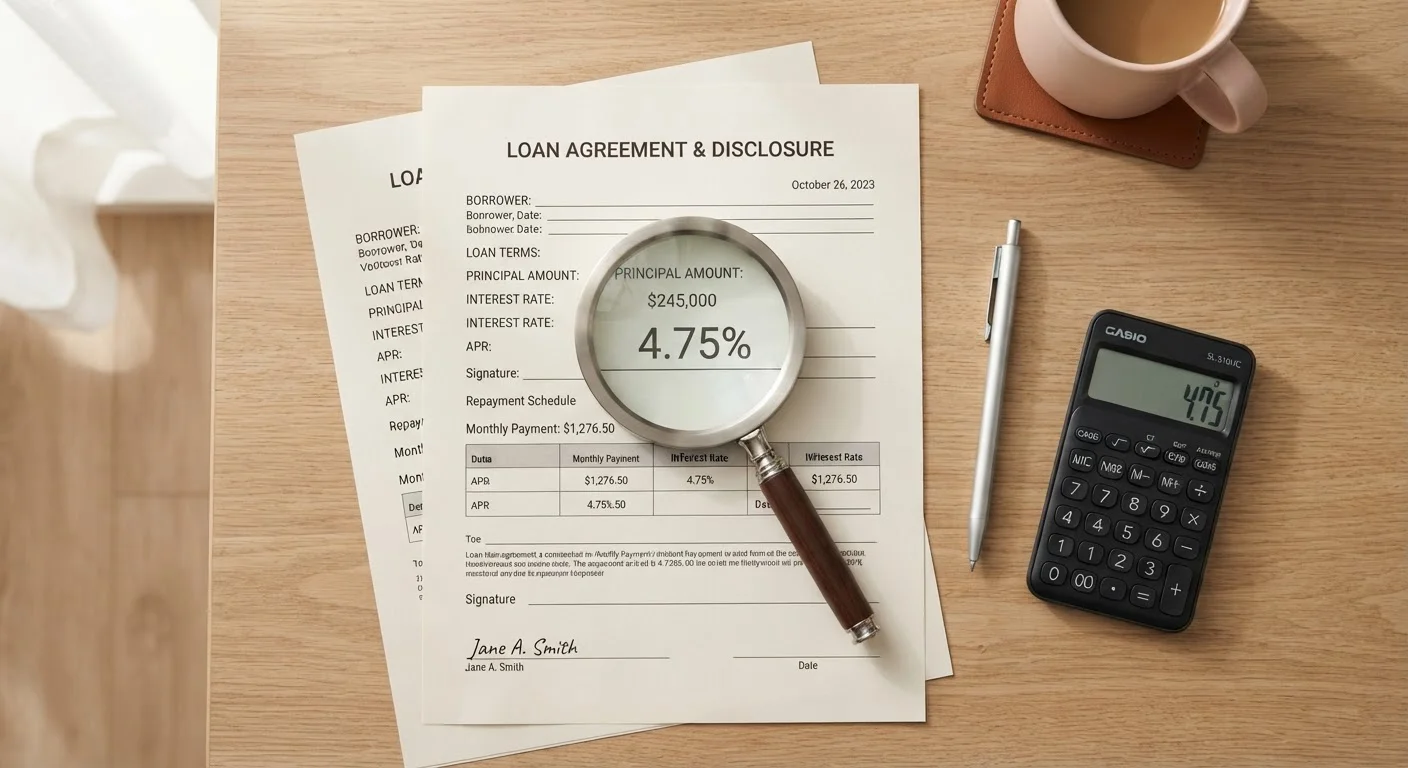
Interest rates and APRs look similar but aren't interchangeable. Understand the difference and how APR affects the true cost of borrowing.
Key takeaways
- APR includes fees the interest rate alone doesn't show, making it a more accurate cost measure.
- A lower advertised interest rate can come with higher fees, resulting in a higher APR.
- Credit cards typically express APR and interest rate the same way — fees are usually separate.
- Your credit score significantly influences the APR lenders offer you.
- Always compare APRs — not just interest rates — when evaluating loan or credit card offers.
Why the Interest Rate Alone Doesn't Tell the Whole Story
When you apply for a loan or credit card, lenders typically advertise an interest rate front and center. It's a simple, clean number — and it's also incomplete. The interest rate only reflects the cost of the borrowed principal; it leaves out origination fees, broker fees, discount points, and other charges that can meaningfully increase what you actually pay.
That's where APR comes in. By rolling most of those additional costs into a single annualized percentage, APR gives you a standardized way to evaluate the real price of credit. Federal law under the Truth in Lending Act (TILA) requires lenders to disclose APR precisely so consumers can make informed comparisons rather than being misled by stripped-down rate figures.
Think of the interest rate as a sticker price and the APR as what you'll realistically pay after all the standard charges are added — it's a much more honest starting point for comparison.
What's Actually Included in APR
APR typically incorporates the following costs alongside the base interest rate:
- Origination fees — charges the lender collects for processing your application and funding the loan
- Discount points — upfront payments that lower your interest rate over the loan's life, common in mortgages
- Mortgage broker fees — compensation paid to a broker who arranges the loan
- Certain closing costs — depending on the loan type and lender
Not every fee makes it into the APR calculation. Third-party costs like appraisal fees, title insurance, or credit report fees are sometimes excluded, depending on the lender and loan product. This is why reviewing the full loan estimate or disclosure document — not just the APR — remains important.
Credit Cards Handle APR Differently
For credit cards, APR and the interest rate are typically the same number. Annual fees, late fees, and balance transfer fees are disclosed separately and generally don't affect the stated APR. This makes card-to-card APR comparisons straightforward when you plan to carry a balance.
For credit cards, APR and the interest rate are typically the same number. Annual fees, late fees, and balance transfer fees are disclosed separately and generally don't affect the stated APR. This makes card-to-card APR comparisons straightforward when you plan to carry a balance.
Fixed vs. Variable APR: Knowing the Difference
APR can be structured in two ways, and understanding which type you're agreeing to matters considerably over time.
Fixed APR stays constant for the life of the loan or credit agreement. Your monthly payment is predictable, and you're insulated from rate swings in the broader market. Personal loans and most auto loans commonly offer fixed APRs.
Variable APR is tied to an underlying benchmark — often the U.S. prime rate — and can move up or down as that benchmark changes. Many credit cards and some home equity lines of credit (HELOCs) carry variable APRs. When market rates rise, so does your cost of carrying a balance.
There's no universally right choice between the two; it depends on your financial situation, how long you plan to hold the debt, and your tolerance for payment variability. A variable APR might start lower but carries the risk of increasing — something worth factoring in before you sign.
How APR Connects to Your Credit Profile
The APR you're offered isn't fixed in the universe — it's largely a reflection of how lenders perceive your creditworthiness. Borrowers with strong credit histories and high scores typically receive the most favorable APRs. Those with limited credit history or past financial difficulties often face higher rates, which can substantially increase the total cost of borrowing over time.
~3–5%
Typical APR gap between best and worst credit tiers
Lenders across loan categories commonly offer APRs several percentage points higher to borrowers with lower credit scores compared to those with excellent credit.
$1,000+
Extra interest cost from a 2% higher APR on a $20,000 auto loan
On a five-year, $20,000 auto loan, a 2 percentage point APR difference can translate to over $1,000 in additional interest paid over the life of the loan.
This is one reason understanding your credit score is so closely linked to managing debt effectively. See how scores are structured and what they signal to lenders in our guide to credit scores decoded.
Even a difference of a few percentage points in APR can add hundreds or thousands of dollars to the cost of a multi-year loan. Before applying for significant credit, it's worth reviewing your credit report, addressing any errors, and taking steps to strengthen your profile if possible.
Putting APR to Work When Comparing Offers
APR's core value is in comparison. When you're evaluating two or more loan offers, lining up the APRs gives you a consistent unit of measurement. A loan advertised at a 6% interest rate but carrying a 7.8% APR may actually cost more than a loan advertised at 6.5% with a 7.1% APR — the fees embedded in the first offer close that gap quickly.
Some practical points to keep in mind when comparing:
- Same loan term, same APR basis — comparing a 30-year mortgage APR to a 15-year mortgage APR isn't an apples-to-apples exercise; use both figures alongside total interest paid
- Short loan terms can distort APR — upfront fees spread over a shorter period inflate the APR figure more than the same fee on a longer loan
- Ask what's excluded — request a full itemized fee list and the loan estimate, and ask specifically which fees were omitted from the APR calculation
Understanding how money compounds over time also sharpens your sense of what a given APR means in practice. Our explainer on compound interest walks through the mechanics in plain terms.
This article is for general informational and educational purposes only and does not constitute personalized financial or legal advice. Consult a qualified financial professional for guidance specific to your situation.
Frequently Asked Questions
All published content on this website is for informational and educational purposes only and should not be taken as professional advice. We recommend that readers seek expert opinion before making any decisions. The website is not responsible for any actions taken based on the information provided on this website. We are not liable for any inaccuracies, modifications, or omissions in information. Moreover, external links or third-party content are provided for convenience; we are not liable for their correctness. Users are advised to verify every piece of information before they use it for any purpose.