
Journaling for Self-Awareness: Formats, Prompts, and What to Do with What You Write

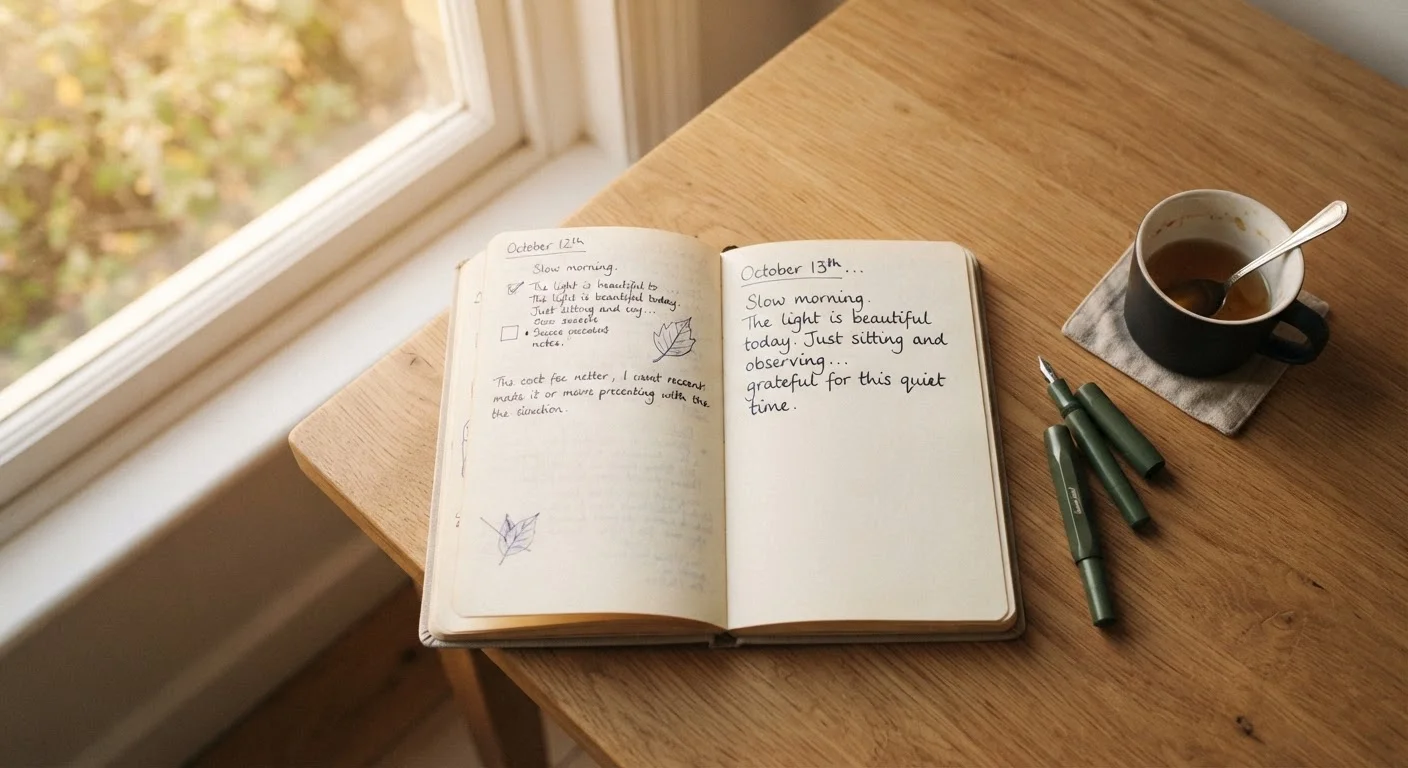
An overview of journaling approaches — from freewriting to structured prompts — and how each can support clearer thinking and personal insight.
Key takeaways
- Different journaling formats serve different goals — freewriting builds emotional clarity, structured prompts build self-knowledge.
- You don't need writing talent or large blocks of time; consistency matters far more than length.
- Reading back your entries is where the real insight lives — treat it as its own practice.
- Journaling is a tool for reflection, not a performance; there is no wrong way to do it.
- Pairing journaling with a regular self-check routine amplifies both practices.
Why Format Actually Matters
Journaling is one of those practices that sounds simple until you sit down with a blank page and feel absolutely nothing. Often, what's missing isn't motivation — it's structure. Different formats unlock different kinds of self-awareness, and choosing one that fits your current need makes the difference between a habit that sticks and a notebook that collects dust.
Broadly, journaling formats fall into two camps: open-ended and structured. Neither is better. They serve different purposes, and many people find value in alternating between them depending on the day.
- Freewriting — Set a timer for 10–15 minutes and write without editing, pausing, or censoring. The goal is to bypass your internal critic and let whatever is underneath the surface come up. Research in expressive writing, associated with psychologist James Pennebaker's work, suggests that putting unfiltered thoughts into words can help process emotional experiences. This format works especially well when you feel mentally cluttered or emotionally stuck.
- Prompted journaling — A specific question or sentence stem guides each entry. This is useful when you want to think carefully about a particular area of your life — your goals, your relationships, your reactions. It gives freewriting a container.
- Gratitude journaling — Noting things you're genuinely grateful for, rather than listing them mechanically, has been associated in psychological studies with improved mood and a broader sense of perspective. The key word is genuine — a rote list loses its effect quickly.
- Reflective or review journaling — Reviewing the past week, month, or quarter: what happened, what you felt, what you'd do differently. This pairs naturally with a structured self-check practice like the one in a weekly wellbeing audit.
You don't have to pick just one. Think of these as tools in a kit — useful to know, easy to rotate.
What you will need
Prompts That Actually Open Something Up
A good prompt doesn't ask you to summarize your day. It asks you to notice something you usually walk past. Below are prompts organized by what they're designed to surface:
For emotional clarity
- What am I carrying today that I haven't named yet?
- When did I feel most like myself this week — and least?
- What would I say if I knew no one would read this?
For understanding patterns
- What situations tend to bring out my worst reactions — and what do they have in common?
- Where am I saying yes when I mean no?
- What have I been avoiding, and what might that be protecting me from?
For values and direction
- If I'm honest, what do I actually want more of right now — not what I think I should want?
- What would I do differently if I trusted myself more?
- What does a genuinely good day look like for me, practically speaking?
When you notice your inner critic dismissing or editing as you write, that's worth naming on the page too. It's often pointing at something. For more on working constructively with self-critical thinking, rethinking your inner critic offers a grounded framework.
What to Do with What You Write
Most journaling guides stop at the writing. But reading back is where the real return on investment lives. Without it, your journal is a release valve — useful, but limited. With it, it becomes a record of how you actually think and change over time.
Reading Back Is a Separate Skill
Many people treat reading their own journal entries as optional or even uncomfortable. It helps to approach it with the same curiosity you'd bring to reading a letter from a close friend. You're not judging past-you — you're learning from them. Try scheduling this as its own distinct session, separate from your writing time.
Build in a reading-back ritual
Once a month, set aside 20 minutes to read the previous month's entries. You're not judging what you wrote — you're looking for patterns. Notice:
- What themes or words keep recurring?
- Are there complaints that have persisted, or ones that dissolved on their own?
- Where did your predictions about yourself turn out to be wrong?
- What did you figure out that you've since forgotten?
Turn insight into intention — lightly
If a pattern becomes clear — say, you notice you consistently feel drained after certain types of interactions — you don't need to make a sweeping life change. A small, testable shift is enough: adjusting one boundary, having one conversation, trying one different response. This approach mirrors the goal-setting philosophy in accountability without self-punishment: growth as a direction, not a performance.
Keep what's useful, let the rest go
Not every entry yields an insight. Some are just exhaust — and that's fine. The practice of writing regularly creates the conditions for insight; it doesn't manufacture it on demand. If a week's worth of entries feels like noise, that's not failure. It may mean you were processing something that needed space, not analysis.
If you're curious about how other adults are weaving this kind of reflection into a realistic weekly schedule, how journaling fits into a busy week is worth a look.
This article is for general informational and educational purposes only. It is not a substitute for advice from a qualified mental health professional. If you are experiencing significant distress, please reach out to a licensed counselor or therapist.
All published content on this website is for informational and educational purposes only and should not be taken as professional advice. We recommend that readers seek expert opinion before making any decisions. The website is not responsible for any actions taken based on the information provided on this website. We are not liable for any inaccuracies, modifications, or omissions in information. Moreover, external links or third-party content are provided for convenience; we are not liable for their correctness. Users are advised to verify every piece of information before they use it for any purpose.