
Your Weekly Wellbeing Audit: A Practical Self-Check Framework

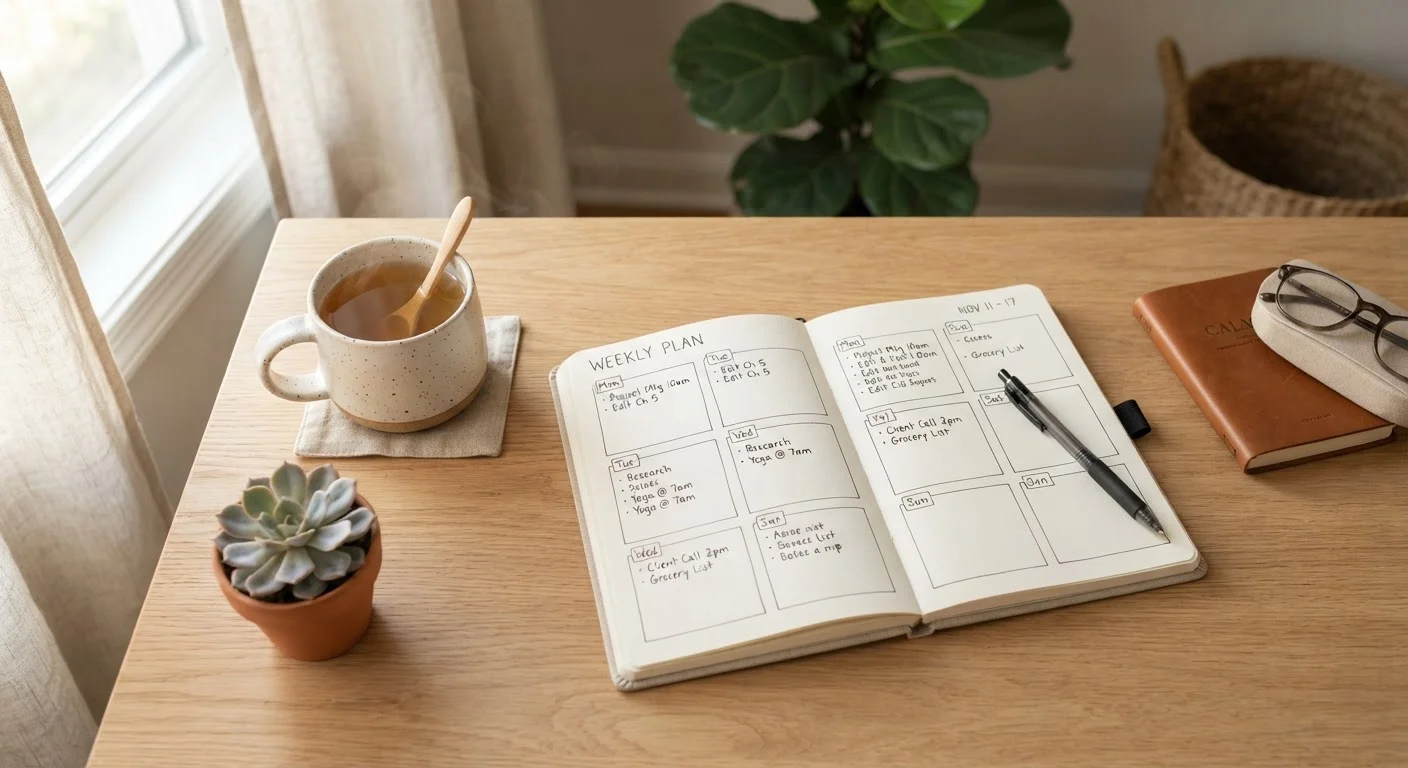
A structured weekly check-in covering sleep, movement, nutrition, and stress to help you spot patterns before they become problems.
Summary
22 items · 15–30 minutes
Key takeaways
- A weekly self-check helps you spot emerging imbalances before they become entrenched patterns.
- Covering sleep, movement, nutrition, stress, and connection gives you a complete picture of your wellbeing.
- You don't need perfect scores — you need honest ones, so you can adjust with intention.
- Consistency matters more than thoroughness; a quick weekly review beats an exhaustive monthly one.
- This checklist is general information, not a substitute for professional medical advice.
Why a Weekly Wellbeing Audit Works
Most of us notice something is wrong only after it's been wrong for a while. Fatigue accumulates quietly. Stress layers on top of stress. Meals get skipped, movement disappears, and social connection shrinks — often without a clear moment we can point to and say, that's when things shifted.
A weekly wellbeing audit interrupts that drift. Think of it as a brief, structured check-in with yourself — not a performance review, not a guilt spiral, but a simple scan to see where things actually stand. Research in behavioral science consistently supports the value of self-monitoring: when we pay deliberate attention to our habits, we're better positioned to make small, timely corrections rather than big, exhausting overhauls.
This framework covers five core domains — sleep, movement, nutrition, stress, and social connection — because each one influences the others. Poor sleep amplifies stress. Chronic stress disrupts appetite. Isolation erodes resilience. Treating them as a system, even briefly once a week, gives you a more honest read than focusing on any single area alone.
For a deeper look at the habits underlying each domain, the complete guide to healthy habits is a useful companion to this audit. And if you want to extend the same reflective thinking to your schedule and energy more broadly, the weekly reset framework pairs naturally with this one.
This article is for general informational purposes only and is not a substitute for professional medical or mental health advice. If you have concerns about your health, please consult a qualified healthcare provider.
What You'll Need
The good news: you don't need an app, a wearable, or a complicated system. A notebook, a pen, and about 15 to 30 minutes of uninterrupted time are all it takes. Some people find a consistent time slot — Sunday evening, Saturday morning — helps the habit stick.
Notebook or journal
Record your weekly ratings, observations, and patterns in a dedicated space so you can track trends over time.
Pen or pencil
Handwriting your responses has been linked to better reflection and retention than typing for short personal reviews.
Simple rating scale (1–5)
Gives each domain a consistent, comparable score week over week without requiring elaborate tracking systems.
Calendar or planner
Helps you recall how the week actually unfolded — activity levels, late nights, stressful events — rather than relying on vague impressions.
Health or sleep tracking app
Provides objective data on sleep duration and movement to cross-reference against your subjective ratings.
If you already journal for self-reflection, this audit slots in naturally. The journaling formats and prompts guide can help you build a more intentional writing practice around your findings. Alternatively, practical journaling methods for busy adults shows how even a few focused minutes can yield real insight.
The Weekly Wellbeing Checklist
Work through each group honestly. You're not aiming for a perfect week — you're looking for signal. A cluster of "no" answers in one area is useful information, not a verdict on your character.
Sleep
Movement
Nutrition & Hydration
Stress & Mental State
Social Connection & Boundaries
Overall Patterns & Next Steps
Low scores in the same area, week after week
If you notice that one domain — especially mood, sleep quality, or stress — consistently scores at the low end for three or more weeks running, that's a signal worth taking seriously. This checklist is a self-awareness tool, not a diagnostic one. Persistent patterns that are affecting your daily functioning are best discussed with a qualified healthcare professional, not managed through self-monitoring alone.
Notice patterns over several weeks, not just one. A single rough week tells you less than three consecutive ones. If you spot a persistent gap — especially around sleep quality, mood, or energy — that's worth discussing with a healthcare professional rather than trying to self-correct indefinitely.
Making This a Sustainable Habit
The most common reason self-check routines fade is that they start too ambitious. If 22 items feels like too much on a hectic week, narrow it down: pick one question per domain and spend five minutes. A shorter, consistent audit will always outperform a thorough one you abandon after three weeks.
It also helps to tie the audit to something already in your routine — a Sunday wind-down, a Monday morning coffee, a Friday lunch break. What balance looks like across different life stages is a good reminder that your ideal week will shift as your circumstances evolve — and your audit should shift with it.
Finally, this kind of structured self-reflection is a complement to, not a replacement for, professional guidance. If your check-ins consistently flag low mood, disrupted sleep, or chronic stress, please reach out to a qualified healthcare provider. The audit can help you arrive at that conversation with clearer, more specific information about what's been happening — and that's genuinely valuable.
Curious how this kind of regular wellbeing review compares to an annual financial health review? The same principle applies: small, frequent check-ins prevent bigger problems. See how that looks in the annual financial health check for a parallel approach to your money.
All published content on this website is for informational and educational purposes only and should not be taken as professional advice. We recommend that readers seek expert opinion before making any decisions. The website is not responsible for any actions taken based on the information provided on this website. We are not liable for any inaccuracies, modifications, or omissions in information. Moreover, external links or third-party content are provided for convenience; we are not liable for their correctness. Users are advised to verify every piece of information before they use it for any purpose.