
The Difference Between a Business Idea and a Business Model

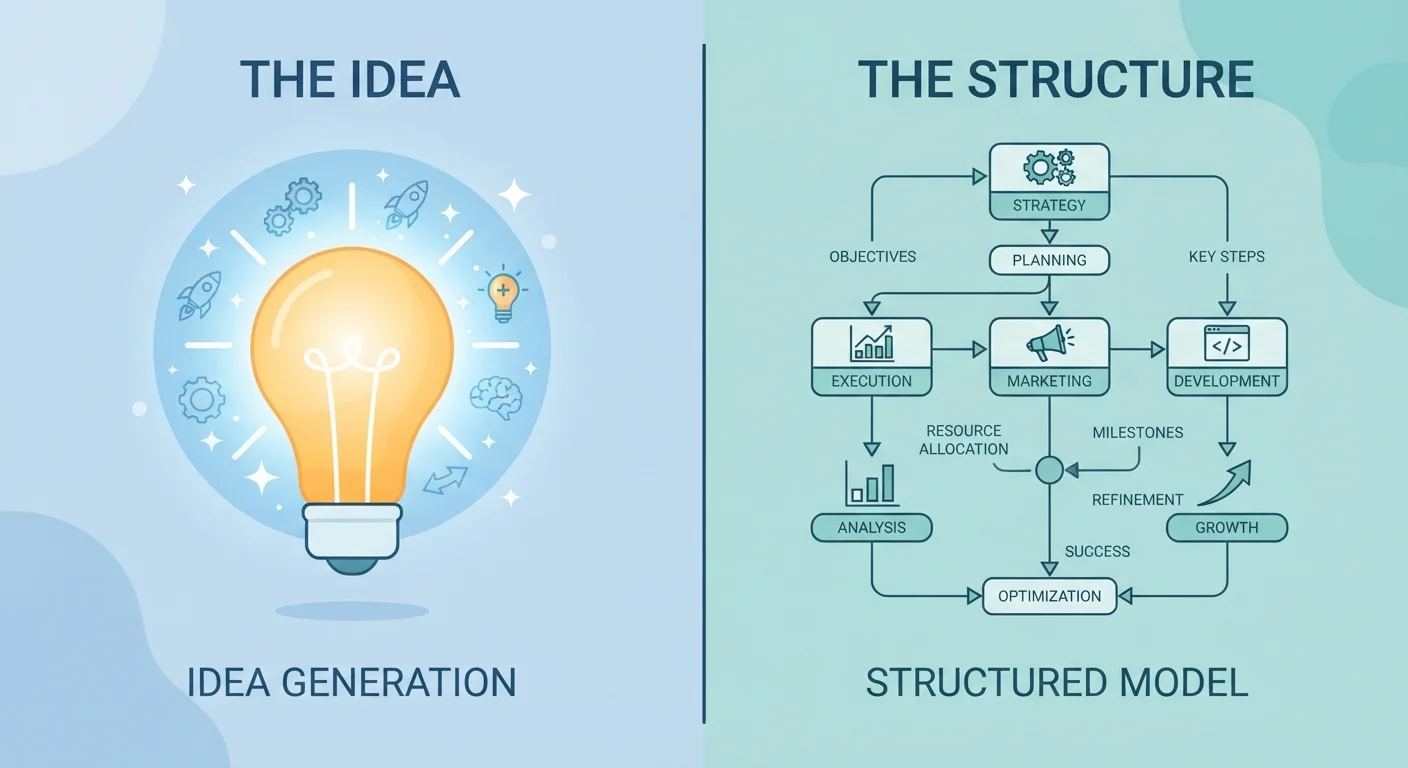
Having an idea is just the start. Learn what separates a compelling concept from a model that can actually generate revenue.
Key takeaways
- A business idea describes what you want to build; a business model explains how it generates revenue.
- Most failed startups had compelling ideas but untested or flawed business models.
- A single idea can support multiple business models — the right choice depends on your market and resources.
- Validating your business model early reduces costly pivots down the road.
- Revenue streams, cost structure, and customer acquisition are the three pillars every model must address.
Why the Distinction Matters
Aspiring founders spend enormous energy on the idea phase — refining the concept, imagining the product, picturing the customers. That energy is valuable, but it often masks a critical gap. An idea answers the question what could I build? A business model answers a much harder question: how will this actually work as a business?
The distinction matters because investors, partners, and the market itself don't fund ideas — they fund models. Research on startup failure consistently points to business model problems (inability to monetize, pricing mismatches, unsustainable unit economics) as leading causes of failure, often above product quality or market size. Understanding where your idea ends and your model begins is one of the most practical skills an early-stage founder can develop.
For a broader look at the full journey from concept to operation, see the Entrepreneurship End to End guide, which covers each stage in depth.
What a Business Idea Actually Is
A business idea is a observation paired with a proposed response. It typically follows a structure like: People struggle with X, so I'll offer Y. Ideas can be wildly creative or straightforwardly practical — what they share is that they haven't yet been tested against the mechanics of revenue generation.
Ideas exist at the level of the value proposition: the benefit you intend to deliver. They describe the what — what product, service, or experience you plan to create. This is genuinely important. Without a clear value proposition, nothing else holds together. But a value proposition alone doesn't tell you who specifically will pay, how much they'll pay, how you'll reach them, or whether your costs allow for profit.
~38%
Startups citing no market need as failure cause
CB Insights' analysis of startup post-mortems has repeatedly identified 'no market need' — a model-level failure — as among the most common reasons startups shut down.
1 idea → many models
Strategic model variations per core concept
Business model frameworks like the Business Model Canvas illustrate that any single value proposition can be structured into multiple distinct revenue configurations depending on customer segment and channel choices.
The idea phase is also where confirmation bias runs hottest. Most founders instinctively seek validation from people who will say encouraging things. The discipline is to move quickly from would you like this? to would you pay this specific amount for it, starting now? — which is where the business model conversation begins.
What a Business Model Actually Is
A business model is the operational logic that converts your value proposition into sustainable revenue. It answers at least three concrete questions:
- Who pays, and why? Identifying your customer segment and the specific reason they'll spend money on your offer.
- What do you charge, and how? Your revenue structure — one-time fees, subscriptions, usage-based pricing, advertising, licensing, or some combination.
- Can you make money at scale? Whether your cost structure allows for meaningful margin as volume grows.
A solid model also addresses customer acquisition: how you'll reach buyers efficiently enough that the cost of acquiring a customer doesn't consume the profit they generate. This ratio — often called the CAC to LTV relationship — is one of the most scrutinized metrics in early-stage businesses.
Founders who want to build without outside funding face these model questions especially early. The realities of bootstrapping make model clarity non-negotiable — there's no investor capital to absorb model-testing losses.
One Idea, Multiple Possible Models
One of the most clarifying exercises for early founders is to take a single idea and map it across several different business models. Consider a founder who wants to help small businesses with their bookkeeping:
- Service model: Charge a monthly retainer for ongoing bookkeeping work.
- Software model: Build a tool that automates the process and sell subscriptions.
- Course model: Teach business owners to do it themselves through paid online courses.
- Marketplace model: Connect small businesses with vetted freelance bookkeepers and take a platform fee.
The core idea — helping small businesses manage their books — is identical across all four. But the models imply radically different cost structures, margins, team requirements, and growth trajectories. Choosing a model isn't just a financial decision; it shapes what kind of company you're actually building.
This also intersects with the question of whether you're building a business or creating a job for yourself — a distinction explored in depth in Freelancing vs. Running a Business.
Testing Your Model Before You Commit
The goal at the model stage isn't perfection — it's informed hypothesis. Treat your initial business model as a set of assumptions that need to be tested, not conclusions to defend. The most important assumptions to validate early are:
- Willingness to pay: Not just interest, but actual payment at your target price point.
- Cost accuracy: Real costs, including time, often exceed early estimates significantly.
- Acquisition channels: Whether you can reach customers efficiently enough to sustain margin.
Small, low-cost experiments — a landing page, a pilot offer to ten customers, a manual version of an automated service — can surface model problems before they become expensive mistakes. For plain-language definitions of the financial terms you'll encounter during this process, the Key Terms Every New Business Owner Should Understand reference is a useful companion.
The transition from idea to model isn't a single moment — it's an iterative process. But entrepreneurs who treat it as a distinct and deliberate step consistently make better decisions about where to invest their time and money.
Frequently Asked Questions
All published content on this website is for informational and educational purposes only and should not be taken as professional advice. We recommend that readers seek expert opinion before making any decisions. The website is not responsible for any actions taken based on the information provided on this website. We are not liable for any inaccuracies, modifications, or omissions in information. Moreover, external links or third-party content are provided for convenience; we are not liable for their correctness. Users are advised to verify every piece of information before they use it for any purpose.